Discovery cuts cost of next generation optical fibers
January 17, 2008 Discovery cuts cost of next generation optical fibers

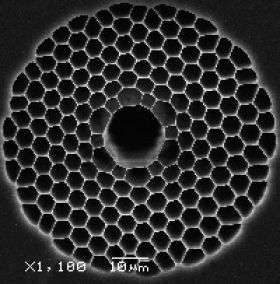
Electron microscope image of the hollow-core fiber. Credit: University of Bath

Scientists have discovered a way of speeding up the production of hollow-core optical fibres - a new generation of optical fibres that could lead to faster and more powerful computing and telecommunications technologies.

The procedure, described today in the journal Optics Express, cuts the production time of hollow-core optical fibres from around a week to a single day, reducing the overall cost of fabrication.

Initial tests show that the fibre is also superior in virtually every respect to previous versions of the technology, making it an important step in the development of new technologies that use light instead of electrical circuits to carry information.

These technologies include faster optical telecommunications, more powerful and accurate laser machining, and the cheaper generation of x-ray or ultra-violet light for use in biomedical and surgical optics.

“This is a major improvement in the development of hollow-core fibre technology,” said Professor Jonathan Knight from the Centre for Photonics & Photonic Materials in the Department of Physics at the University of Bath.

“In standard optical fibres, light travels in a small cylindrical core of glass running down the fibre length.

“The fact that light has to travel through glass limits them in many ways. For example, the glass can be damaged if there is too much light.

“Also, the glass causes short pulses of light to spread out in a blurring effect that makes them less well defined. This limits its usefulness in telecommunications and other applications.

“Hence, fibres in which light travels in air down a hollow core hold great promise for a next generation of optical fibres with performance enhanced in many ways.”

The problem in developing hollow-core fibres is that only a special sort of optical fibre can guide light down an air hole. They use a two-dimensional pattern of tiny holes in the glass around the core to trap the light within the core itself.

The highly detailed nature of these fibres means that they have been difficult to fabricate and they can only work for a limited range of wavelengths.

However, the new procedure developed by the Bath photonics group shows how a tiny change to these fibres – narrowing the wall of glass around the large central hole by just a hundred nanometres (a 10 millionth of a metre) – broadens the range of wavelengths which can be transmitted.

They achieved this by omitting some of the most difficult steps in the fabrication procedure, reducing the time required to make the fibres from around a week to a single day.

The improved fibre was developed as part of a European Commission-funded Framework 6 project ‘NextGenPCF’ for applications in gas sensing.

However, the superior performance of the fibre means that it could have a significant impact in a range of fields such as laser design and pulsed beam delivery, spectroscopy, biomedical and surgical optics, laser machining, the automotive industry and space science.

“The consequences of being able to use light rather than electrical circuits to carry information will be fundamental,” said Professor Knight.

“It will make optical fibres many times more powerful and brings the day when information technology will consist of optical devices rather than less efficient electronic circuits much closer. For biomedical research, we can use these fibres to deliver light for diagnosis or surgery anywhere – even deep inside the body. Almost any device where light is important or can be used, photonic crystal fibres can make more efficient, sensitive and powerful.”

Citation: ‘Control of surface modes in low loss hollow-core photonic bandgap fibers’, Optics Express, Vol. 16, Issue 2, pp. 1142-1149.

Source: University of Bath


print this article email this article download pdf blog this article bookmark this article     Stumble it Digg this share on Facebook retweet share on Reddit add to delicious
Rate this story - 4.7 /5 (46 votes)

Rank Filter

Move the slider to adjust rank threshold, so that you can hide some of the comments.


Display comments: newest first

  • nilbud - Jan 17, 2008
    • Rank: 1.5 / 5 (2)
    Homoeopathic fibre
  • KB6 - Jan 17, 2008
    • Rank: 5 / 5 (3)
    "They achieved this by omitting some of the most difficult steps in the fabrication procedure..."
    ---
    It's beautiful when omitting the most difficult steps results in a better product. :)
  • fsmith - Jan 17, 2008
    • Rank: not rated yet
    KB6-

    You beat me to it.
  • fsmith - Jan 17, 2008
    • Rank: 3.4 / 5 (5)
    "We were astonished to find that is in fact possible to strike the nail head directly with the hammer itself, rather than using the thumb of the supporting hand to transfer the blow. This discovery could potentially lead to faster, more efficient carpentry at far lower cost, as well as significantly reducing operator discomfort."
  • jburchel - Jan 17, 2008
    • Rank: 2 / 5 (1)
    What is homeopathic fibre? Does that comment mean this has already existed and is being rebranded for PR purposes, or what? So many "breakthroughs" are unfortunately re-reported many times... Anyway, sounds like this is cool, hopefully a good one.
  • nilbud - Jan 18, 2008
    • Rank: 1 / 5 (1)
    Homoeopathic fibre, because the less there is the more effective it becomes.

January 17, 2008 all stories

Comments: 6

4.7 /5 (46 votes)
  • Stumble this up

  • Digg this

  • share this

  • hide
  • Related Stories


  • hide
  • Relevant PhysicsForums posts

  • brewster's angle
    created 7 hours ago
  • ideal gas equation
    created 8 hours ago
  • electric charges experiment
    created 9 hours ago
  • What is wrong with this argument?
    created 12 hours ago
  • More from Physics Forums - General Physics

Other News

Spin polarization achieved in room temperature silicon

Physics / General Physics

created 58 minutes ago | popularity 4.5 / 5 (2) | comments 0

(PhysOrg.com) -- A group in The Netherlands has achieved a first: injection of spin-polarized electrons in silicon at room temperature. This has previously been observed only at extremely low temperatures, and the achievement ...


Superconductor magnet heat shield being developed

Superconductor magnet spacecraft heat shield being developed

Physics / General Physics

created 23 hours ago | popularity 4.9 / 5 (19) | comments 18

(PhysOrg.com) -- European space agencies and an aerospace giant are developing a new re-entry heat shield that will use superconductor magnets to generate a magnetic field strong enough to deflect the superhot ...


Restored machine to explore mysteries of Big Bang (AP)

Restored machine to explore mysteries of Big Bang

Physics / General Physics

created Nov 21, 2009 | popularity 4.6 / 5 (18) | comments 26

(AP) -- Scientists are preparing the world's largest atom smasher to explore the depths of matter after successfully restarting the $10 billion machine following more than a year of repairs.


Scientists react as they stand in front of a screen at CERN

First atoms reported smashed in Large Hadron Collider (Update)

Physics / General Physics

created Nov 23, 2009 | popularity 4.5 / 5 (31) | comments 22

Two circulating beams on Monday produced the first particle collisions in the world's biggest atom smasher, the Large Hadron Collider (LHC), three days after its restart, scientists announced.


Bacteria

Plasma produces KO cocktail for MRSA

Physics / General Physics

created Nov 26, 2009 | popularity 4.9 / 5 (12) | comments 2

MRSA (methicillin-resistant Staphylococcus Aureus) and other drug-resistant bacteria could face annihilation as low-temperature plasma prototype devices have been developed to offer safe, quick, easy and un ...