Contact lenses with circuits, lights a possible platform for superhuman vision
January 17, 2008
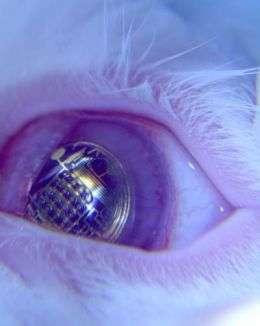
Contact lenses with metal connectors for electronic circuits were safely worn by rabbits in lab tests. Credit: University of Washington
Movie characters from the Terminator to the Bionic Woman use bionic eyes to zoom in on far-off scenes, have useful facts pop into their field of view, or create virtual crosshairs. Off the screen, virtual displays have been proposed for more practical purposes – visual aids to help vision-impaired people, holographic driving control panels and even as a way to surf the Web on the go.
The device to make this happen may be familiar. Engineers at the University of Washington have for the first time used manufacturing techniques at microscopic scales to combine a flexible, biologically safe contact lens with an imprinted electronic circuit and lights.
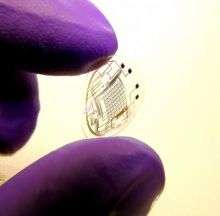
A researcher holds one of the completed lenses. Credit: University of Washington
"Looking through a completed lens, you would see what the display is generating superimposed on the world outside," said Babak Parviz, a UW assistant professor of electrical engineering. "This is a very small step toward that goal, but I think it's extremely promising." The results were presented today at the Institute of Electrical and Electronics Engineers' international conference on Micro Electro Mechanical Systems by Harvey Ho, a former graduate student of Parviz's now working at Sandia National Laboratories in Livermore, Calif. Other co-authors are Ehsan Saeedi and Samuel Kim in the UW's electrical engineering department and Tueng Shen in the UW Medical Center's ophthalmology department.There are many possible uses for virtual displays. Drivers or pilots could see a vehicle's speed projected onto the windshield. Video-game companies could use the contact lenses to completely immerse players in a virtual world without restricting their range of motion. And for communications, people on the go could surf the Internet on a midair virtual display screen that only they would be able to see.
"People may find all sorts of applications for it that we have not thought about. Our goal is to demonstrate the basic technology and make sure it works and that it's safe," said Parviz, who heads a multi-disciplinary UW group that is developing electronics for contact lenses.
The prototype device contains an electric circuit as well as red light-emitting diodes for a display, though it does not yet light up. The lenses were tested on rabbits for up to 20 minutes and the animals showed no adverse effects.
Ideally, installing or removing the bionic eye would be as easy as popping a contact lens in or out, and once installed the wearer would barely know the gadget was there, Parviz said.
Building the lenses was a challenge because materials that are safe for use in the body, such as the flexible organic materials used in contact lenses, are delicate. Manufacturing electrical circuits, however, involves inorganic materials, scorching temperatures and toxic chemicals. Researchers built the circuits from layers of metal only a few nanometers thick, about one thousandth the width of a human hair, and constructed light-emitting diodes one third of a millimeter across. They then sprinkled the grayish powder of electrical components onto a sheet of flexible plastic. The shape of each tiny component dictates which piece it can attach to, a microfabrication technique known as self-assembly. Capillary forces – the same type of forces that make water move up a plant's roots, and that cause the edge of a glass of water to curve upward – pull the pieces into position.
The prototype contact lens does not correct the wearer's vision, but the technique could be used on a corrective lens, Parviz said. And all the gadgetry won't obstruct a person's view.
"There is a large area outside of the transparent part of the eye that we can use for placing instrumentation," Parviz said. Future improvements will add wireless communication to and from the lens. The researchers hope to power the whole system using a combination of radio-frequency power and solar cells placed on the lens, Parviz said.
A full-fledged display won't be available for a while, but a version that has a basic display with just a few pixels could be operational "fairly quickly," according to Parviz.
Source: University of Washington


Still this technology will require tons of testing and a lot of improvements. Sounds pretty awesome though.
Whoa, amazing tech. The future is almost here! Sweet!! To bad I've never worn a contact lens and the idea of putting something on my eyes freaks me out. Although... I might be able to quickly overcome my aversion to it if they deliver.
"more practical purposes"
What the hell isn't practical about "bionic eyes to zoom in on far-off scenes, have useful facts pop into their field of view, or create virtual crosshairs"?!?!?! ;D
"lens does not correct the wearer's vision"
O.k. So what's the point?
For example I've designed a built a solar cell that is 99% efficient and costs 1 cent per square meter, but it doesn't produce electricity. Maybe I should issue a press release.
Is not the mashup of technology and the unique process of creating these lenses enough to be noted?! Not only that, they were DEMONSTRATED to not have any adverse effect (at least within 20 minutes) to the user's eye.
How is this information not valuable in the process of creating a fully functional device?! Apparently, because it didn't fall from the sky completely operational and flawless, it's pointless and vapid?!
How ignorant and "short sighted." Speaking of which, CreepyD, I don't think that's the point. I would imagine that yes, some applications such as immersive video games may lead to dangerous situations while attempting to do other things, but if that's the case, why would you be trying to do other things in the first place?! Also note that a potential use is to "help vision-impaired people." So instead of focusing on the negative aspects, what about the endless abilities and potential the devices hold?!
Sheesh.
---
The use of these while driving will require the development of robotically controlled vehicles. After that, these lenses will increasingly be used for things like immersion in virtual realities. Eventually, direct connection of the virtual world technologies to the brain will require the roboticization/automation of more areas of formerly human activity. This will ultimately progress to the point where humans exist entirely within a virtual world while machines take care of the "real world" and maintain the virtual world machinery for the humans.
This is the big secret of "The Matrix": It's not the fault of the machines that the humans deliberately built the matrix around themselves, relegating themselves to the status of eternally contented and well-entertained batteries. The humans went willingly.
That's at least one possible point.
The question is, given that the contact lenses will be feeding photons directly into the eye, can we program them so the photons have an apparent focus (from the eye muscle's point of view) in line with where the object is supposed to be in space. Seems to me that they'll have to be doing something like that if only because no eye muscle can focus our lenses on the surface of our own eyes! If so, then this will represent a major breakthrough in VR. Not before time.
In the end it's probably not worth solving since most people would probably get over the effect after regular use. Although, it may dull their sense of distance a bit.
The future will never get here, earls, because after all it is called the future, now the good thing about that is that there`s always something new to look forward to! :)
The "future" seems to be throttled back by the industry though, as an example, sony invested big $$ in LCD display tech, and wanna make sure they get their mony back, so if theres something new, and a lot better, and even cheaper you think they`d go for it and make in mainstream? I think not, and then holds back amazing potential.
Put 2 an 2 together an you`ll see than as amazing it is that we`ve come so far, still we could be a lot farther ahead then we actually are. ciao
Or how about hacked contact lenses that project a clear street that you are about to cross when there is a car is actually coming.
Yes, by controlling the phase of the emitted light. Ideally, you generate the same photons that would have passed through the lens if there was a real object present. Think of a hologram. This would be a hologram, but only visible from the narrow angle needed by the geometry.
The LEDs would not be like lightbulbs putting out light in all directions. Instead, they are thin beams that target specific pixels on the retina. The image is in the aiming, and does not have to be related to the physical location of the diodes. Think of a bank of theater spotlights above the stage, baffled to give a pencil-thin beam. You can spell out words on the floor by aiming the small spots.