Team finds an economical way to boost the vitamin A content of maize
January 17th, 2008 Team finds an economical way to boost the vitamin A content of maize

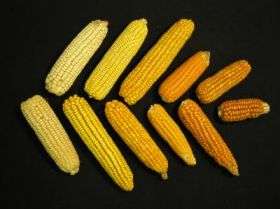
Maize has considerable natural variation in levels of provitamin A, the precursors that are converted to vitamin A upon consumption. These ears of maize are part of a collection of lines derived from an analysis that identifies different forms of a gene that influences concentrations of provitamin A. Credit: Photo by Catherine Bermudez Kandianis

A team of plant geneticists and crop scientists has pioneered an economical approach to the selective breeding of maize that can boost levels of provitamin A, the precursors that are converted to vitamin A upon consumption. This innovation could help to enhance the nutritional status of millions of people in the developing world.

The new method is described this week in the journal Science.

The team includes scientists from Cornell University, the University of Illinois, Boyce Thompson Institute, DuPont Crop Genetics Research, the University of North Carolina, the City University of New York, the International Maize and Wheat Improvement Center and the U.S. Department of Agriculture.

The innovation involves a new approach for selecting the parent stock for breeding maize, and significantly reduces the ambiguity and expense of finding varieties that yield the highest provitamin A content available. As part of this investigation, the researchers have identified a naturally mutated enzyme that enhances the provitamin A content of maize.

Vitamin A deficiency is a leading cause of eye disease and other health disorders in the developing world. Some 40 million children are afflicted with eye disease, and another 250 million suffer with health problems resulting from a lack of dietary vitamin A.

“Maize is the dominant subsistence crop in much of Sub-Saharan Africa and the Americas,” the researchers write, “where between 17 and 30 percent of children under the age of 5 are vitamin A deficient.”

Maize also is one of the most genetically diverse food crops on the planet, said Torbert Rocheford, a professor of plant genetics in the department of crop sciences at Illinois and a corresponding author on the paper.

This diversity is tantalizing to those hoping to make use of desirable traits, but it also provides a formidable challenge in trying to understand the genetic basis of those attributes.

One hurdle to increasing the provitamin A content of maize has been the expense of screening the parent stock and progeny of breeding experiments, Rocheford said.

A common technique, called high performance liquid chromatography (HPLC), can assess the provitamin A content of individual plant lines. But screening a single sample costs $50 to $75, he said.

“That’s really expensive, especially since plant breeders like to screen hundreds or more plants per cycle, twice a year,” he said. “The cost was just prohibitive.”

The new approach uses much more affordable methods and gives a more detailed picture of the genetic endowment of individual lines. One technique the researchers employed, called quantitative trait loci (QTL) mapping, allowed them to identify regions of the maize chromosomes that influence production of the precursors of vitamin A. They also used association mapping, which involves studying variation in selected genes and tracking inheritance patterns to see which form of a gene coincides with the highest provitamin A content. Polymerase chain reaction (PCR) allowed them to amplify and sequence the different versions (alleles) of the genes of interest, to find the alleles that boosted levels of vitamin A precursors in the plant.

This approach led to an important discovery. The team found a mutant form of an enzyme vital to the cascade of chemical reactions that produce the precursors of vitamin A in the plant. This mutant is transcribed in lower quantities than the normal allele and steers the biochemistry toward producing higher levels of vitamin A precursors.

The study analyzed 300 genetic lines selected to represent the global diversity of maize, and identified some varieties that came close to the target amount of 15 micrograms of beta-carotene (a form of provitamin A) per gram. Current maize varieties consumed in Africa can have provitamin A content as low as 0.1 micrograms per gram.

The researchers can now inexpensively screen different maize varieties for this allele and breed those that contain it to boost the nutritional quality of the maize, said Rocheford, who also is affiliated with the Institute for Genomic Biology.

Source: University of Illinois at Urbana-Champaign


print this article email this article download pdf blog this article bookmark this article     Digg this Stumble it share on Facebook share on Reddit add to delicious save to Yahoo! bookmarks
4.5/5 after 4 votes

Rank Filter

Move the slider to adjust rank threshold, so that you can hide some of the comments.


Display comments: newest first

  • Quantum_Conundrum - Jan 17, 2008
    • Rank: not rated yet
    That's nice. Studies recently published in a certain common magazine, Readers Digest, show that vitamin A and many other common vitamins are actually poisonous when taken in anything more than trace amounts.

    For example, anything above 50AU of vitamin A was found to accumulate and become toxic, and in one study with like 180,000 particicpants, the people taking multivitamins were 16% more likely to die than the participants taking no vitamins at all, and men in this study were as much as 33% more likely to develop prostate cancer.


    Sorry, but I don't want any of this super corn in the food chain.

January 17th, 2008 all stories
Biology /

Comments: 1
Rank: 4.5/5 after 4 votes

  • Stumble this up

  • Digg this

  • Share it:
  • share on Facebook
  • share on MySpace
  • share on Slashdot
  • rss-newsfeed
  • share on Google
  • share on Reddit
  • add to delicious
  • save to Yahoo! bookmarks
  • share on Windows Live
  • Add to Mixx!
Rating: 4.5/5 after 4 votes


Tags


  • Physicists Demonstrate Quantum Memory with Matter Qubits
    Physicists Demonstrate Quantum Memory with Matter Qubits
    Physics / General Physics
    created Jul 03, 2009 | popularity 4.4 / 5 (17) | comments 1
  • 'Holey' Nanosheets for Wastewater Dye Removal
    Nanotechnology / Nanomaterials
    created Jul 01, 2009 | popularity 5 / 5 (5) | comments 1
  • Jellyfish Robot Swims Like its Biological Counterpart
    Jellyfish Robot Swims Like its Biological Counterpart
    Electronics / Robotics
    created Jun 26, 2009 | popularity 4.4 / 5 (8) | comments 1
  • Could Maxwell's Demon Exist in Nanoscale Systems?
    Could Maxwell's Demon Exist in Nanoscale Systems?
    Physics / General Physics
    created Jun 24, 2009 | popularity 4.4 / 5 (18) | comments 29
  • Living Safely with Robots, Beyond Asimov's Laws
    Living Safely with Robots, Beyond Asimov's Laws
    Electronics / Robotics
    created Jun 22, 2009 | popularity 4.6 / 5 (52) | comments 40
  • Other News

    California water plan aims to save Puget Sound orcas

    Biology / Ecology

    created 10 hours ago | popularity not rated yet | comments 0

    A plan to restore salmon runs on California's Sacramento River also could help revive killer whale populations 700 miles to the north in Puget Sound, as federal scientists struggle to protect endangered species in a complex ...


    Scientists 'rebuild' giant moa using ancient DNA

    Biology / Plants & Animals

    created Jul 01, 2009 | popularity 5 / 5 (10) | comments 12

    (PhysOrg.com) -- Scientists have performed the first DNA-based reconstruction of the giant extinct moa bird, using prehistoric feathers recovered from caves and rock shelters in New Zealand.


    Pacific Giant Salamander (Dicamptodon tenebrosus)

    Salamanders, regenerative wonders, heal like mammals, people

    Biology / Microbiology

    created Jul 01, 2009 | popularity 5 / 5 (20) | comments 11

    The salamander is a superhero of regeneration, able to replace lost limbs, damaged lungs, sliced spinal cord -- even bits of lopped-off brain. But it turns out that remarkable ability isn't so mysterious after ...


    Genetically modified trees

    Anti-biotech groups obstruct forest biotechnology

    Biology / Biotechnology

    created Jun 30, 2009 | popularity 3.7 / 5 (7) | comments 5

    The potential of forest biotechnology to help address significant social and environmental issues is being "strangled at birth" by the rigid opposition of some groups and regulations that effectively preclude ...


    Super-sleepers could help super-sizers!

    Super-sleepers could help super-sizers!

    Biology / Plants & Animals

    created Jun 29, 2009 | popularity 5 / 5 (2) | comments 4

    Burrowing frogs can survive buried for several years without food or water. Scientists have discovered that the metabolism of their cells changes radically during the dormancy period allowing the frogs to ...