UltraBattery sets new standard for HEVs
January 17, 2008 UltraBattery sets new standard for HEVs

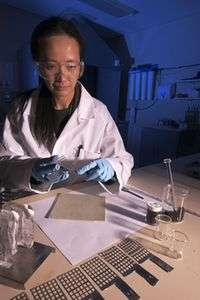
Researcher, Rosalie Louey, prepares components for the UltraBattery in CSIRO laboratories. Image credit – CSIRO

The odometer of a low emission hybrid electric test vehicle today reached 100,000 miles as the car circled a track in the UK using the power of an advanced CSIRO battery system.

The UltraBattery combines a supercapacitor and a lead acid battery in a single unit, creating a hybrid car battery that lasts longer, costs less and is more powerful than current technologies used in hybrid electric vehicles (HEVs).

“The UltraBattery is a leap forward for low emission transport and uptake of HEVs,” said David Lamb, who leads low emissions transport research with the Energy Transformed National Research Flagship.

“Previous tests show the UltraBattery has a life cycle that is at least four times longer and produces 50 per cent more power than conventional battery systems. It’s also about 70 per cent cheaper than the batteries currently used in HEVs,” he said.

By marrying a conventional fuel-powered engine with a battery to drive an electric motor, HEVs achieve the dual environmental benefit of reducing both greenhouse gas emissions and fossil fuel consumption.

The UltraBattery also has the ability to provide and absorb charge rapidly during vehicle acceleration and braking, making it particularly suitable for HEVs, which rely on the electric motor to meet peak power needs during acceleration and can recapture energy normally wasted through braking to recharge the battery.

Over the past 12 months, a team of drivers has put the UltraBattery to the test at the Millbrook Proving Ground in the United Kingdom, one of Europe’s leading locations for the development and demonstration of land vehicles.

“Passing the 100,000 miles mark is strong evidence of the UltraBattery's capabilities,” Mr Lamb said.
“CSIRO’s ongoing research will further improve the technology’s capabilities, making it lighter, more efficient and capable of setting new performance standards for HEVs.”

The UltraBattery test program for HEV applications is the result of an international collaboration. The battery system was developed by CSIRO in Australia, built by the Furukawa Battery Company of Japan and tested in the United Kingdom through the American-based Advanced Lead-Acid Battery Consortium.

UltraBattery technology also has applications for renewable energy storage from wind and solar. CSIRO is part of a technology start-up that will develop and commercialise battery-based storage solutions for these energy sources.

Source: CSIRO


Rate this story - 4.5 /5 (47 votes)


January 17, 2008 all stories

Comments: 0

4.5 /5 (47 votes)

  • hide
  • Related Stories

  • CSIRO's UltraBattery goes global in the auto sector
    created Oct 02, 2008 | popularity not rated yet | comments 0
  • Smarter energy storage for solar and wind power
    created Nov 26, 2007 | popularity not rated yet | comments 0
  • Plugging into an electric vehicle revolution
    created Oct 27, 2009 | popularity not rated yet | comments 0
  • Catalyst for water oxidation adopted from plants: a means for energy-efficient production of hydrogen?
    created Aug 25, 2008 | popularity not rated yet | comments 0
  • Imec achieves breakthrough in battery-less radios
    created 15 hours ago | popularity not rated yet | comments 0


  • hide
  • Relevant PhysicsForums posts

Other News

The power of 'random'

The power of 'random': 'Seemingly loopy' technique could dramatically improve communications networks

Technology / Computer Sciences

created 20 hours ago | popularity 4.8 / 5 (9) | comments 5 | with audio podcast

A radical new approach to the design of communications networks, called "network coding," promises to make Internet file sharing faster, streaming video more reliable, and cell-phone reception better -- among ...


'Revolutionary' water treatment units on their way to Afghanistan

Technology / Engineering

created 14 hours ago | popularity 4.4 / 5 (7) | comments 5 | with audio podcast

The United States Army has taken delivery of the first two units of a "revolutionary" waste-water treatment system that will clean putrid water within 24 hours and leave no toxic by-products, according to scientists at Sam ...


Android

Google developing a translator for smartphones

Technology / Software

created 21 hours ago | popularity 4.8 / 5 (9) | comments 3 | with audio podcast report

(PhysOrg.com) -- Google is developing a translator for its Android smartphones that aims to almost instantly translate from one spoken language to another during phone calls.


Imec and Holst Centre achieve breakthrough in battery-less radios

Imec achieves breakthrough in battery-less radios

Technology / Semiconductors

created 15 hours ago | popularity 4.9 / 5 (14) | comments 1 | with audio podcast

At today's International Solid State Circuit Conference, Imec and Holst Centre report a 2.4GHz/915MHz wake-up receiver which consumes only 51µW power. This record low power achievement opens the door to battery-less ...


In Utah, company aims to store energy in air

Technology / Energy

created 23 hours ago | popularity 3.4 / 5 (10) | comments 2

A Utah company plans to dig a series of underground caverns that it hopes to one day fill with compressed air, releasing it to generate electricity by turning a turbine and solving one of the most vexing problems facing the ...