Scientists may have identified new target for HIV vaccine
January 17, 2008
Image courtesy of Dana-Farber Cancer Institute
By coaxing the HIV-1 protein to reveal a hidden portion of its protein coat, scientists at Dana-Farber Cancer Institute and Harvard Medical School have provided a newly detailed picture of how protective, or so-called broadly neutralizing, antibodies block HIV-1 infection.
In a study in the January issue of Immunity, the investigators report that the discovery may help researchers overcome two of the main stumbling blocks that have arisen on the road to an HIV vaccine: the fact that the virus's envelope protein — the target for any antibody-based vaccine — varies greatly from one viral strain to the next and is strewn with sugar molecules, which make it difficult for the immune system to select the virus for destruction. The paper was posted on the journal's Web site on Jan. 10 in advance of the print publication.
"Not surprisingly, only a handful of broadly neutralizing antibodies (BNAbs) have been identified, and they are rarely elicited during natural human infection," says the study’s senior author, Ellis Reinherz, who is the faculty director of the Cancer Vaccine Center at Dana-Farber and a professor of medicine at Harvard Medical School.
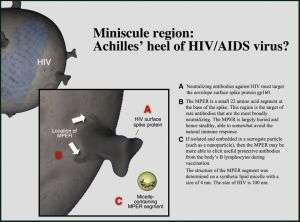
The study focuses on an HIV-1 surface protein called gp41 and, specifically, on a portion of it known as the membrane proximal ectodomain region (MPER). This region, which lies at the base of HIV's envelope protein, is consistent across different strains of the virus. In theory, that should make it an attractive target for immune system antibodies, but, in fact, the antibody response to it is rather meager.
To determine why this is so, the Dana-Farber team studied its structure using nuclear magnetic resonance (NMR), electron paramagnetic resonance (EPR), and surface plasmon resonance (SPR) imaging techniques. They discovered that MPER is not only immersed in the viral membrane, giving it refuge from immune system attack, but it also has a hinge in the middle, which provides flexibility and helps it attach to white blood cells known as T lymphocytes.
Despite this stealthiness, the researchers found that a BNAb called 4E10 homes in on the hinge area and, in so doing, pulls out key portions of MPER that had been buried inside the membrane. Then, like a rock climber who finds an additional handhold, 4E10 latches onto these newly exposed sections, forming a tighter bond with the virus and blunting its ability to fuse with the cell membrane, the first step in viral infection.
"The new features of MPER that we've discovered may be useful targets for antibody-based vaccines if they can be held in proper configuration," says study co-author Mikyung Kim, of Dana-Farber. "One way of doing this would be to place them in a synthetic lipid coat on nanoparticles. If the antibodies aren't 'confused' by other elements of the virus's protein envelope, this approach may elicit a strong immune response to viral presence.”
The study's lead authors, in addition to Kim, are Zhen-Yu Sun of Harvard Medical School, and Kyung Joon Oh of Dana-Farber and Harvard Medical School. The co-authors are Jessica Yu and Vladimir Brusic of Dana-Farber; Likai Song, Zhisong Qiao, and Jia-huai Wang, of Dana-Farber and Harvard Medical School; and Gerhard Wagner, of Harvard Medical School.
Source: Harvard Medical School
-
Fast photon control brings quantum photonic technologies closer
10 hours ago |
5 / 5 (4) |
0
-
Engineers build first sub-10-nm carbon nanotube transistor
Feb 01, 2012 |
4.9 / 5 (33) |
30
-
Something old, something new: Evolution and the structural divergence of duplicate genes
Jan 31, 2012 |
4.6 / 5 (7) |
1
-
The hidden nanoworld of ice crystals: Revealing the dynamic behavior of quasi-liquid layers
Jan 30, 2012 |
5 / 5 (5) |
1
-
Stock market network reveals investor clustering
Jan 27, 2012 |
3.9 / 5 (23) |
8
-
Classical and Quantum Mechanics via Lie algebras
Apr 15, 2011
- More from Physics Forums - Independent Research
More news stories
Discovery paves way for salmonella vaccine
(Medical Xpress) -- An international research team led by a University of California, Davis, immunologist has taken an important step toward an effective vaccine against salmonella, a group of increasingly antibiotic-resistant ...
42 minutes ago |
5 / 5 (2) |
0
|
First-of-its-kind stem cell study re-grows healthy heart muscle in heart attack patients
Results from a Cedars-Sinai Heart Institute clinical trial show that treating heart attack patients with an infusion of their own heart-derived cells helps damaged hearts re-grow healthy muscle.
Medicine & Health / Cardiology
48 minutes ago |
5 / 5 (1) |
2
|
Ovarian cancer arises in fallopian tube of knockout mice
(Medical Xpress) -- The most deadly form of "ovarian" cancer arises in the fallopian tubes not the ovaries of knockout mice that lack two genes associated with the disease, said researchers led by Baylor College ...
43 minutes ago |
not rated yet |
0
|
Smoking bans lead to less, not more, smoking at home: study
Smoking bans in public/workplaces don't drive smokers to light up more at home, suggests a study of four European countries with smoke free legislation, published online in Tobacco Control.
48 minutes ago |
not rated yet |
0
UK cases of progressive sight loss condition set to rise a third by 2020
New cases of the progressive sight loss condition, known as age-related macular degeneration, or AMD for short, are set to rise by a third in the UK over the next decade, reveals research published online in the British Jo ...
47 minutes ago |
not rated yet |
0
Time of year important in projections of climate change effects on ecosystems
(PhysOrg.com) -- Does it matter whether long periods of hot weather, such as last year's heat wave that gripped the U.S. Midwest, happen in June or July, August or September?
Medical school link to wide variations in pass rate for specialist exam
Wide variations in doctors' pass rates, for a professional exam that is essential for one type of specialty training, seem to be linked to the particular medical school where the student graduated, indicates research published ...
Scientists discover reason for Mt. Hood's non-explosive nature
(PhysOrg.com) -- For a half-million years, Mount Hood has towered over the landscape, but unlike some of its cousins in Oregons Cascade Mountains and many other volcanoes around the Pacific Rim ...
Missing dark matter located: Intergalactic space is filled with dark matter
Researchers at the University of Tokyos Institute for the Physics and Mathematics of the Universe (IPMU) and Nagoya University used large-scale computer simulations and recent observational data of gravitational ...
Plants use circadian rhythms to prepare for battle with insects
In a study of the molecular underpinnings of plants' pest resistance, Rice University biologists have shown that plants both anticipate daytime raids by hungry insects and make sophisticated preparations to ...
Sensing self and non-self: New research into immune tolerance
At the most basic level, the immune system must distinguish self from non-self, that is, it must discriminate between the molecular signatures of invading pathogens (non-self antigens) and cellular constituents that usually ...