Trees, Ants and Elephants: Balance Gone Bad
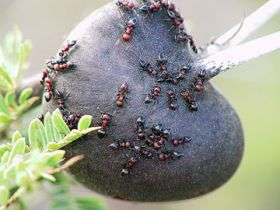
UC Davis researchers in Africa have a riveting tale of natural balance gone bad, with an unhappy moral for other ecosystems: This could happen to you.
The paper in the Jan. 11 issue of the journal Science is the latest to chronicle one of many patterns to emerge since 1995, when UC Davis ecologist Truman Young fenced elephants and other large herbivores out of 10-acre plots in the central Kenya savannah.
Because elephants eat acacia trees "like we eat cupcakes," as another researcher told National Public Radio, one might think that fencing them out would be good for the trees. Instead, excluding the elephants caused the collapse of a longstanding, mutually beneficial relationship between acacia trees and the ants that live in their branches.
For thousands of years, the ants had limited elephant grazing by swarming from the tree branches onto the animals' sensitive heads and trunks. In return, the trees kept their guardian ants happy by producing food and living quarters.
But when Young's fences took them off the elephants' menu, the acacia trees cut the ants' food and housing subsidies. The ants moved away; tree-eating bugs moved in. Eventually the trees inside the fences were smaller and sicker than those outside, even considering the effects of elephants grazing on the unfenced trees.
"Elephants today occupy only a fraction of their historical range in Africa, and this is one of the negative results of their loss," said Young, a professor in the Department of Plant Sciences and the Ecology Graduate Group. "That species as different as elephants, ants and trees are so intimately interconnected shows, once again, that when we mess with nature, we should expect dire consequences that we cannot anticipate."
Other authors on the new paper are Young's former graduate student Todd Palmer, now an assistant professor of zoology at the University of Florida; Maureen Stanton, a UC Davis professor of evolution and ecology; Richard Karban, a UC Davis professor of entomology; and researchers at University of British Columbia and Stanford University.
The paper, "Breakdown of an Ant-Plant Mutualism Follows the Loss of Large Herbivores from an African Savanna," is online at: www.sciencemag.org .
Source: UC Davis


