Researchers reveal HIV peptide's possible pathway into the cell
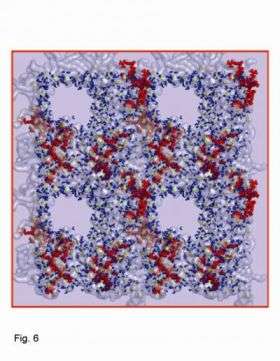
Two theoretical physicists at Rensselaer Polytechnic Institute have uncovered what they believe is the long-sought-after pathway that an HIV peptide takes to enter healthy cells. The theorists analyzed two years of biocomputation and simulation to uncover a surprisingly simple mechanism describing how this protein fragment penetrates the cell membrane. The discovery could help scientists treat other human illnesses by exploiting the same molecules that make HIV so deadly proficient.
The findings are detailed in the Dec. 26, 2007, issue of the Proceedings of the National Academy of Sciences.
For the last decade, scientists have known that a positively charged, 11-amino-acid chain of HIV (HIV-1 Tat protein) can do the nearly unthinkable ¡X cross through the cell membrane. Sometimes referred to as an "arrow protein," HIV-1 Tat pierces the cell membrane and carries a cargo though the cell membrane.
Its unique cell-puncturing ability has been the subject of hundreds of scientific articles investigating the type of materials that can piggyback on the peptide and also enter the cell. Researchers have proposed using the peptide to deliver genes for gene therapy and drugs that need to be delivered directly to a cell. But despite many potential medical applications, the actual mechanism that opens the holes in the cell remained undiscovered.
The Rensselaer researchers have discovered that the positively charged HIV peptide is drawn to negatively charged groups inside the cell membrane. When the HIV peptide cannot satisfy itself with the negative charges available on the cell membrane surface it is directly attached to, it reaches through the membrane to grab negatively charged groups in the molecules on the other side, opening a transient hole in the cell.
"What we saw in our computer calculations wasn't at all what we expected to see when we began," said co-lead author and Senior Constellation Professor of Biocomputation and Bioinformatics Angel Garcia. "The mechanism for entrance in the cell was clear in one simulation, but in some instances simulations show one result and you never see that result again. Then we started doing other simulations and it kept happening again and again."
Garcia and his collaborator, postdoctoral researcher Henry Herce, initially set out to uncover how the peptide interacts with a lipid bilayer that is used to model the cell membrane. A highly efficient biological system, the cell membrane is composed of a lipid bilayer (made up of two monolayers) designed to protect the cell by preventing the influx of material. Each lipid in the bilayer has a polar, or charged, end and a non-polar end. A monolayer of lipids faces the exterior of the cell, with the polar end facing the outside of the cell. Another monolayer is under the first layer, forming the bilayer. The polar end of the lower layer faces the interior of the cell, forming a middle section containing the uncharged halves of both monolayers.
Because charged particles seek each other in order to neutralize themselves and achieve a more stable state, the surface of the polar cell membrane and the positively charged HIV peptide are drawn to one another. But the interior of the bilayer is not charged and forms a strong barrier against the entrance of any charged material.
As was expected, in their simulations the researchers observed that the positive charges in the peptide quickly attached to the surface of the cell membrane and sought out and reacted with negatively charged phosphates from the charged portion of the lipid bilayer to satisfy their need for neutrality. "Then the peptide entered the forbidden territory of the cell," Garcia said. The positively charged peptide entered the membrane. "This is when this mechanism starts to challenge conventional wisdom," he said.
The researchers' model systems show the peptides grabbing for surrounding negative charges, but when no more of those charges are available due to their greedy peptide neighbors, some of the peptides reach into the cell membrane and grab negative charged phosphates from the other side. This opens a hole in the cell membrane and allows the flow of water and other material into the cell. Once all the peptides have been neutralized, the reaction stops and the hole closes, leaving behind a healthy, viable cell.
For the paper, the researchers reported a dozen different simulations run through a high-powered cluster of computers. Each simulation required a long process of testing and validating results. Garcia's computer cluster is now running simulations on the use of antimicrobial proteins which will open a pore in the cell and keep it open, killing the cell. Antimicrobial proteins have promising direct applications for killing harmful cells in the body.
Garcia hopes to harness the power of Rensselaer's newly opened Computational Center for Nanotechnology Innovations (CCNI), which houses the world's most powerful university-based supercomputing center. The CCNI will allow him to compile two years' worth of data on his normal cluster in just 10 to 20 days.
Source: Rensselaer Polytechnic Institute


