Europe's Mercury mission swings into action
January 18th, 2008 BepiColombo

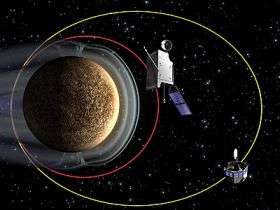
This artist’s impression provides a view of the two BepiColombo spacecraft, the Mercury Planetary Orbiter (MPO) and the Mercury Magnetospheric Orbiter (MMO), in their elliptical polar orbits around Mercury. The MPO will circle the planet along an orbit ranging between 400 and 1500 kilometres above the surface. The MMO orbit ranges between 400 and 12 000 kilometres above the surface. The inclination and the eccentricity of these orbits are optimised for the study of the planet and of its magnetosphere in the very high temperature environment around Mercury. The MPO will circle the planet along an orbit ranging between 400 and 1500 kilometres distance from the surface. The MMO orbit ranges between 400 and 12000 kilometres from the surface. The inclination and the eccentricity of these orbits are optimised for the study of the planet and of its magnetosphere in the very-high-temperature environment around Mercury. Credits: ESA - image by C.Carreau

The European Space Agency (ESA) signalled the start of a busy period for the planet Mercury, when it signed the contract for industrial development to start for the BepiColombo mission today (18th January 2008) at Astrium in Friedrichshafen, Germany. UK scientists and industry have key roles in BepiColombo, including construction of spacecraft subsystems and science instrument design.

BepiColombo, a mission to make the most comprehensive study of Mercury ever, is due for launch in August 2013. It is the first dual mission to Mercury, with one European spacecraft and one provided from Japan. The programme is carried out as a joint mission under ESA leadership with the Japanese Aerospace Exploration Agency (JAXA).

Professor Keith Mason, Chief Executive of the Science and Technology Facilities Council which funds UK space science said “BepiColombo will make the most detailed study of Mercury ever, revealing the secrets of the planet closest to the Sun – what it is formed of, how the Sun affects it and what we can learn about the other planets by comparison. It is technically challenging to send a probe to Mercury due to the extreme heat conditions, high levels of radiation and the strong gravitational pull of the Sun. A mission of this complexity reveals the ingenuity of our scientists and engineers.”

BepiColombo consists of two spacecraft. One spacecraft, ESA’s Mercury Planetary Orbiter (MPO), will carry 11 instruments to study the surface and internal composition of the planet with unprecedented accuracy, using different wavelengths and investigation techniques.

The second spacecraft, JAXA’s Mercury Magnetospheric Orbiter (MMO), will carry five instruments to study the planet’s magnetosphere, the region of space around the planet that is dominated by its magnetic field.

Professor George Fraser of the University of Leicester Space Research Centre is leading a research team from five countries to build the Mercury Imaging X-ray Spectrometer (MIXS) which will fly on the MPO craft. He said “MIXS will look at the x-rays coming from the planet Mercury to study the composition of the surface, helping us to test models of the planet’s formation. X-ray remote sensing has told us a great deal about the Moon and the asteroids, but MIXS will be the first true x-ray imaging telescope to be used in planetary science.”

Dr David Rothery of the Open University, who is the UK Lead Scientist for MIXS and Co-Chairman of ESA's Mercury Surface and Composition Working Group, said: “The preliminary close-up images from NASA's MESSENGER flyby of Mercury this week offer tantalising indications of a complex history of lava flows partly burying the planet's more ancient primitive crust. The high spatial resolution achievable by MIXS will be vital in order to distinguish the compositions of these two very different types of crust, which is essential if we are to unravel the mysteries of Mercury's origin and evolution.”

Magna Parva, a specialist firm from Loughborough are developing, the mechanical structure for the MIXS telescope with the University of Leicester Space Research Centre. The MIXS Optics structure is an extremely challenging mechanical engineering project that involves working alongside Prof. Fraser and his team to ensure that the science objectives of the MIXS instrument are met. The decision to involve a small, relatively unknown, flexible company in the MIXS project has brought an innovative approach to instrument design and may provide a model for UK space science projects in the future

A vital sister instrument to MIXS is the Solar Intensity X-ray Spectrometer (SIXS), led from Finland, which will measure the x-rays and particles from the Sun that trigger the fluorescence on Mercury’s surface.

Engineers at STFC’s Rutherford Appleton Laboratory are working on integrated circuits for reading out signals from the detectors of the SIXS instrument. These have been manufactured and testing will begin shortly.

On behalf of ESA, the prime contractor Astrium will lead a network of subcontractors to design and build ESA’s MPO spacecraft and the so-called Mercury Transfer Module - that is the module to carry the MPO-MMO composite spacecraft to its destination.

Astrium in the UK is responsible for the structure of the entire spacecraft including the launch vehicle adapter, the complex mission analysis that will require numerous swing-bys of the Earth, the moon, and Venus in its six year flight plan, and also the two chemical propulsion systems and the ion propulsion system.

Source: Science and Technology Facilities Council


print this article email this article download pdf blog this article bookmark this article     Digg this Stumble it share on Facebook share on Reddit add to delicious save to Yahoo! bookmarks
3.4/5 after 7 votes

Rank Filter

Move the slider to adjust rank threshold, so that you can hide some of the comments.


Display comments: newest first

  • Ashibayai - Jan 18, 2008
    • Rank: not rated yet
    Is it just me, or does the ESA seem to be targeting the same type of missions at the same places as NASA is, but just at later dates? I think it's great of course, because we'll have more data and different approaches to collecting it, but maybe we should be collaborating our efforts to minimize redundant discoveries in such an expensive industry.

January 18th, 2008 all stories
Space & Earth / Space Exploration

Comments: 1
Rank: 3.4/5 after 7 votes

  • Stumble this up

  • Digg this

  • Share it:
  • share on Facebook
  • share on MySpace
  • share on Slashdot
  • rss-newsfeed
  • share on Google
  • share on Reddit
  • add to delicious
  • save to Yahoo! bookmarks
  • share on Windows Live
  • Add to Mixx!
Rating: 3.4/5 after 7 votes

  • Related Stories

  • Magnetic Tornadoes Could Liberate Mercury's Tenuous Atmosphere
    created Jun 02, 2009 | popularity not rated yet | comments 0
  • NASA mission sends germs into space
    created May 05, 2009 | popularity not rated yet | comments 0
  • MESSENGER discovers an unusual impact basin on Mercury
    created Apr 30, 2009 | popularity not rated yet | comments 0
  • Magnesium detected in MESSENGER flyby of Mercury (w/Video)
    created Apr 30, 2009 | popularity not rated yet | comments 0
  • Researchers use multispectral images to reveal origin and evolution of Mercury
    created Apr 30, 2009 | popularity not rated yet | comments 0

Tags


  • Physicists Demonstrate Quantum Memory with Matter Qubits
    Physicists Demonstrate Quantum Memory with Matter Qubits
    Physics / General Physics
    created Jul 03, 2009 | popularity 4.4 / 5 (17) | comments 1
  • 'Holey' Nanosheets for Wastewater Dye Removal
    Nanotechnology / Nanomaterials
    created Jul 01, 2009 | popularity 5 / 5 (5) | comments 1
  • Jellyfish Robot Swims Like its Biological Counterpart
    Jellyfish Robot Swims Like its Biological Counterpart
    Electronics / Robotics
    created Jun 26, 2009 | popularity 4.4 / 5 (8) | comments 1
  • Could Maxwell's Demon Exist in Nanoscale Systems?
    Could Maxwell's Demon Exist in Nanoscale Systems?
    Physics / General Physics
    created Jun 24, 2009 | popularity 4.4 / 5 (18) | comments 29
  • Living Safely with Robots, Beyond Asimov's Laws
    Living Safely with Robots, Beyond Asimov's Laws
    Electronics / Robotics
    created Jun 22, 2009 | popularity 4.6 / 5 (52) | comments 40
  • Other News

    Forty years ago man first walked on the moon

    Space & Earth / Space Exploration

    created 7 hours ago | popularity 5 / 5 (2) | comments 0

    Forty years ago on July 20, 1969, American astronaut Neil Armstrong realized the oldest dream of human civilizations when he became the first man to walk on the moon.


    The least sea ice in 800 years

    The least sea ice in 800 years

    Space & Earth / Earth Sciences

    created Jul 01, 2009 | popularity 4.3 / 5 (59) | comments 52

    New research, which reconstructs the extent of ice in the sea between Greenland and Svalbard from the 13th century to the present indicates that there has never been so little sea ice as there is now. The ...


    Gas around young galaxy

    Intense heat killed the Universe's would-be galaxies, researchers say

    Space & Earth / Astronomy

    created Jul 01, 2009 | popularity 3.2 / 5 (19) | comments 25

    (PhysOrg.com) -- Our Milky Way galaxy only survived because it was already immersed in a large clump of dark matter which trapped gases inside it, scientists led by Durham University's Institute for Computational ...


    Scientists' Drill Hits Magma: Only Third Time on Record

    Scientists' Drill Hits Magma: Only Third Time on Record

    Space & Earth / Earth Sciences

    created Jun 29, 2009 | popularity 4.7 / 5 (20) | comments 19

    (PhysOrg.com) -- Scientists drilling a borehole deep into Iceland’s rocky crust to explore new methods of using geothermal energy hit a major roadblock on Thursday: Their drill ran into molten rock at a depth ...


    NASA manager pitches a cheaper return-to-moon plan

    Space & Earth / Space Exploration

    created Jun 30, 2009 | popularity 4 / 5 (7) | comments 18

    (AP) -- Like a car salesman pushing a luxury vehicle that the customer no longer can afford, NASA has pulled out of its back pocket a deal for a cheaper ride to the moon.