Copper's not coping: new chips call on light speed
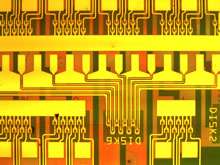
The tiny copper wires that connect different areas of an integrated circuit may soon limit microchip-processing speeds. So European researchers have developed technologies to produce and combine semiconductor microlasers with silicon wave guides for novel, power-efficient optical connections.
We have all experienced the effect of Moore's Law: almost from the second you unpack a newly purchased computer it is already outdated. The next model – with faster processing power and more advanced features – is already in the shop.
Gordon E. Moore, co-founder of Intel, described the phenomenon of microchip miniaturisation in 1965 when he observed that the number of transistors you can fit into an integrated circuit appeared to double about every two years.
The microelectronics industry still follows this “law”, but unless new fabrication or microprocessing technologies are quickly developed this relentless miniaturisation may peter out in less than a decade. Microchips based on silicon wafers are nearing their theoretical limits as physical properties of near nanoscale silicon integrated circuits begin to interfere with their performance.
The speed of data transfer within integrated circuits is one of the major bottlenecks. At present, to pass information from one part of a chip to another, the data packet is sent as electrons through copper wires, known as copper interconnects.
These wires may be just a few millimetres in length, but for the electrons it is like running between underground trains at rush hour. The electrons must all squeeze down narrow tunnels while a crowd backs up at the entrance.
Copper can’t cope
“Copper-wire interconnects place serious limitations on the performance of silicon integrated circuits,” says Dries Van Thourhout from Ghent University's Photonics Research Group and Belgium's micro- and nanoelectronics research centre IMEC. “It is hard to transmit data down these interconnects in a sufficiently fast, power-efficient way. It is a problem of bandwidth and copper will not be able to cope with the processing power of tomorrow's microchips.”
Optical interconnects use light instead of electrons to represent information; they are a highly appealing alternative to copper interconnects, with the potential to be far more efficient, transmitting more data but using the same or even less power.
Instead of travelling along copper wires, photons travel the distance between source and detector along wave guides, like miniature optical fibres. At this scale, however, the wave guides are made out of silicon rather than glass.
“Lots of research has shown that you can etch wave guides for photons into silicon,” says Van Thourhout. “This is great because you are using the same materials and fabrication technologies as you do to make integrated circuits. But there is one significant drawback: it is extremely hard to get light out of silicon.”
Despite extensive research to exploit many of silicon's peculiar properties, it is highly unlikely that purely silicon-based lasers will reach an efficiency comparable to that of their semiconductor-based cousins for the foreseeable future.
Van Thourhout has coordinated a European consortium that has successfully combined the best of both worlds: silicon wave guides and microscale lasers made from a semiconductor call indium-phosphate. The PICMOS project was a partnership between several European research institutions, universities and two French companies STMicroelectronics and TRACIT Technologies, now owned by Soitec.
Mini-laser system
Part of the research involved the fabrication of a miniaturised laser system small enough to generate light for each interconnect. The PICMOS partners developed a method to etch indium-phosphate lasers with a diameter of just 7μm, sufficiently small to integrate several thousand onto a 2cm x 2cm silicon chip. This is the first time that such compact lasers have been produced in a very practical, cost-efficient way.
The tiny lasers could also have applications in miniature optical sensors, such as strain detectors, or be used to build incredibly cheap, but very powerful optical biosensors. But the biggest breakthrough in the project was the development of a bonding technology that joins the silicon and iridium-phosphate materials together.
“The bonding process, now transferred to TRACIT, effectively 'glues' the silicon and semiconducting indium-phosphate in layers. It is possible to etch out the microlasers and the silicon wave guides and produce an optical interconnecting layer,” says Van Thourhout. “The bonding process and the refinement of the microlaser and the accompanying detectors have been major breakthroughs.”
The production cost of the prototype optical interconnect layer is still too high for mass production, although the results from the demonstrator 'chip' have been extremely encouraging. A follow-up project, WADIMOS, will continue to drive the PICMOS platform towards commercialisation. In particular it will develop a pilot line that integrates the fabrication of the optical interconnect layer into the regular integrated circuit manufacturing process.
“We envisage a layer on an integrated circuit that sits on top of the classical etched copper electrical interconnect layer,” says Van Thourhout. “This optical interconnect layer would be less sensitive to temperature, immune from electromagnetic noise, and have lower power consumption. Meanwhile, the bonding system could be adapted for many other electronics applications, for example to stack integrated circuits and in microfluidic technologies. The application of the PICMOS platform could be tremendous for tomorrow's chip technologies and wide-ranging in many other associated applications.”
Source: ICT Results


