Protein discovered that prevents HIV from spreading
January 18, 2008
Protein discovered that prevents HIV from spreading

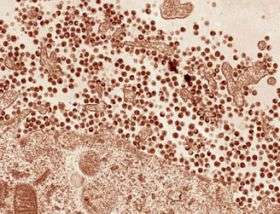
Sticky situation. HIV-1 particles (dark circles) lacking Vpu are unable to extricate themselves from the surface of their host cell. Instead, tetherin keeps them locked to the surface of the cell’s outer membrane, or causes them to be sucked back in and digested by the cell’s endosomes. Credit: Rockefeller University

In a study that could open up the field of virology to an entirely new suite of possibilities and that paves the way for future drug research, scientists at Rockefeller University and the Aaron Diamond AIDS Research Center have pinned down a molecule on the surface of human cells that helps keep particles of mutant strains of HIV from spreading.

Rather than floating off to infect more cells, the protein contains the virus particles by keeping them attached to the parent cell’s outer membrane, as if stuck there with glue.

Two years ago, Paul Bieniasz — head of the Laboratory of Retrovirology and ADARC scientist — discovered that normal HIV-1 particles are able to extricate themselves from the sticky membrane surface using a protein called Vpu. Bieniasz has been searching for the source of the glue itself ever since. Now, in an advanced online publication in Nature, he and his colleagues report that they found it: a protein they dubbed “tetherin” for its ability to keep viruses tied to a cell.

“All we knew when we started this two and a half years ago was that a virus lacking Vpu was released less efficiently from cells.” Bieniasz says. “And we had some electron micrographs that showed virus particles stuck there on the surface and clustered inside cells.” Once they started looking carefully at the reasons behind this, they found an antiviral mechanism keeping the HIV-1 mutant particles tethered to the cell. And it wasn’t just HIV — the glue appeared to interfere with the spread of other membrane-encapsulated (or “enveloped”) viruses, too.

To track down the cause of stickiness — and the likely reason HIV evolved Vpu — Bieniasz and his team looked at gene activity across all known human genes, making comparisons between cells that require Vpu for HIV-1 release and those that don’t. Ultimately, they narrowed it down to one very likely candidate. And the candidate, the tetherin protein, passed all the tests the researchers threw at it: When Vpu was not present but tetherin was, large numbers of virus particles piled up on the cell surface. When tetherin was missing, however, even the Vpu-deficient viruses were able to escape.

“We’ve discovered a new way that cells defend themselves against viruses,” Bieniasz says. “I think this will open up a new area of study in virology: how this protein antagonizes other viruses, and how viruses learn to get around it.” Going forward, his lab will focus on how broad tetherin’s antiviral activity is, and whether variations of it exist that might confer additional immunity or sensitivity to HIV and other viruses. And, he notes, if drug researchers are able to interfere with the interaction between tetherin and Vpu, their newly discovered protein might even provide a potential therapeutic target.

Source: Rockefeller University

4.8 /5 (38 votes)  

Filter


Move the slider to adjust rank threshold, so that you can hide some of the comments.


Display comments: newest first

barakn
Jan 18, 2008

Rank: 1 / 5 (1)
Ahem. Since the viruses were mutants lacking an important protein, tetherin does not prevent the type of HIV that people are infected with from spreading. Also this knowledge may aid therapy but its role on prevention is much less certain.
zbarlici
Jan 18, 2008

Rank: not rated yet
if you think the drug companies are working for a cure think again... only thing thats gonna get us anywhere are prizes offered for breakthroughs made by individuals, such prizes as the X prize.

It`ll be a freaking disgusting shame on the drug companies, if a small team of researchers find the cure within 5 years of so, meanwhile they been crackin at it for what seems like eternity, and then the drug companies should be held liable for all the AIDS-related deaths dating back 20 eyars of so, because of their unwillingness to actually work on a cure... always slow this, suppress that. give me a freaking cure already
enantiomer2000
Jan 18, 2008

Rank: not rated yet
@zbarlici,
even if the big pharmie corps are as you say, I don't believe that it is just prizes. University research also plays a huge factor as well.
Rank 4.8 /5 (38 votes)
Tags

Relevant PhysicsForums posts

More news stories

Seeing colors in music, tasting flavors in shapes may happen in life's early months

Famed violinist Itzhak Perlman sees a deep forest green whenever he plays a B-flat on his Stradivarius' G string. The A on the E string is red.

Medicine & Health / Psychology & Psychiatry

created 12 minutes ago | popularity 5 / 5 (1) | comments 0 | with audio podcast

Study suggests girls can 'rewire' brains to ward off depression

(Medical Xpress) -- What if you could teach your brain to respond differently to things that make you feel sad, down or stressed out? What if doing that helped ward off depression?

Medicine & Health / Psychology & Psychiatry

created 39 minutes ago | popularity not rated yet | comments 0

UNC investigator issues call to action for schizophrenia research

(Medical Xpress) -- Much of medical research is aimed at figuring out what role a single gene or molecule plays in the development of disease.

Medicine & Health / Psychology & Psychiatry

created 34 minutes ago | popularity 5 / 5 (1) | comments 0

What does love look like?

What does love look like? A dozen roses delivered on an ordinary weekday? Breakfast in bed? Or just a knowing glance between lovers?

Medicine & Health / Psychology & Psychiatry

created 33 minutes ago | popularity not rated yet | comments 0

Numeracy: The educational gift that keeps on giving?

(Medical Xpress) -- Cancer risks. Investment alternatives. Calories. Numbers are everywhere in daily life, and they figure into all sorts of decisions. A new article published in Current Directions in Psychological Science, a journal of the Association for Psychological Science, examin ...

Medicine & Health / Psychology & Psychiatry

created 26 minutes ago | popularity not rated yet | comments 0 | with audio podcast


New error-correcting codes guarantee the fastest possible rate of data transmission

Error-correcting codes are one of the triumphs of the digital age. They’re a way of encoding information so that it can be transmitted across a communication channel — such as an optical fiber o ...

A frank discussion of the power law and linking correlation to causation

(PhysOrg.com) -- Michael Stumpf a mathematics professor at Imperial College in London, and Mason Porter a lecturer at Oxford have teamed together to write and publish a perspective piece in Science regarding the in ...

Mars Science Laboratory computer issue resolved

(PhysOrg.com) -- Engineers have found the root cause of a computer reset that occurred two months ago on NASA's Mars Science Laboratory and have determined how to correct it.

Advanced power-grid model finds low-cost, low-carbon future in West

(PhysOrg.com) -- The least expensive way for the Western U.S. to reduce greenhouse gas emissions enough to help prevent the worst consequences of global warming is to replace coal with renewable and other ...

Small modular reactor design could be a 'SUPERSTAR'

(PhysOrg.com) -- Though most of today's nuclear reactors are cooled by water, we've long known that there are alternatives; in fact, the world's first nuclear-powered electricity in 1951 came from a reactor ...

Clam fields found at deep, low-temperature Mariana vents

(PhysOrg.com) -- Scientists have marveled at the unusual life forms thriving at high temperature hydrothermal vents of the deep ocean.