Organizing Gold Nanoparticles with DNA

March 22, 2006

Tiny billionth-of-a-meter sized clusters of gold atoms — gold “nanoparticles” — are being widely studied by scientists. They have many useful potential applications, from carriers for cancer-treatment drugs to digital data storage. But many of these applications, particularly those in electronics, require that the nanoparticles form ordered arrays that can be hard to achieve. At Arizona State University (ASU), researchers have discovered that grids made of DNA strands are excellent templates for neatly organizing gold nanoparticles.

“The collective properties of nanoparticles are heavily dependent on how the particles are grouped. Achieving an even spacing between the particles is particularly important, but can be difficult,” said the study’s lead scientist, ASU chemist Hao Yan. “However, when deposited onto a DNA grid the particles fall neatly into patterns with little effort on our part.”
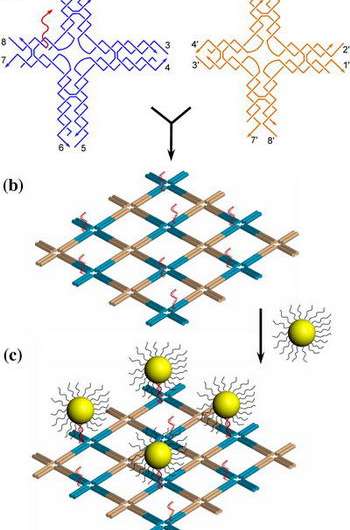
Organizing Gold Nanoparticles with DNA

(a) The two-tile system that forms the DNA nanogrids. Tile A is blue and tile B is orange. The numbers indicate the complementary “sticky” ends that allow the tiles to adhere together, with 1 pairing with 1´ and so on. The red strand on tile A is A15. (b) The DNA nanogrid, showing the A15 strand on each A tile. (c) Gold nanoparticles on the DNA grids. The zigzagged black lines surrounding the nanoparticles represent T15 strands. Credit: Hao Yan

Yan and his research group used gold nanoparticles that were five nanometers in diameter. Rather than being bare, the particles were coated with a layer of DNA “pieces,” called “T15 sequences,” which radiated from the particles’ surfaces like arms. The scientists then deposited the particles onto lattices formed by two types of cross-shaped DNA “tiles”, “A” tiles and “B” tiles, that bind together in an alternating fashion to form the DNA grid.

At regular intervals, each A tile contained a short single strand (called an “A15” strand) that protruded out of the tile surface. These strands served as tethering points for the T15-coated nanoparticles, allowing the particles to stick to the DNA surface, a bit like DNA-nanoparticle “Velcro.”

This configuration caused the nanoparticles to “self assemble” into a square pattern — each particle sitting on one A tile — with a nearly constant particle-particle distance of about 38 nanometers. The group confirmed this using an atomic force microscope, a very powerful imaging device.

However, this result, while welcomed by the scientists, wasn’t exactly what they expected.

“We were pleased that the gold nanoparticles formed a very regular square pattern, but it wasn’t quite the pattern we thought we’d see,” said Yan. “If you picture nine DNA tiles forming a square, we predicted that five particles would be organized on the square — one on each corner and one in the middle. But the pattern we observed lacked that middle particle.”

The scientists guess that this is due to the T15 sequence layer, which effectively increases the diameter of each nanoparticle and, moreover, makes each particle highly negatively charged. As a result, the nanoparticles repel each other if they are too close together, which limits the minimum particle-particle distance. Therefore, a particle located at the center of the square would violate this limit.

In future research, Yan and may try to use this organization method to form more complex nanoparticle arrays, such as denser patterns or patterns of different shapes, by altering the particles’ DNA coating.

Citation: “Periodic Square-Like Gold Nanoparticle Arrays Templated by Self-Assembled 2D DNA Nanogrids on a Surface,” Nano Lett., Vol. 6, No. 2, 248-251 (2006)

by Laura Mgrdichian, Copyright 2006 PhysOrg.com


Rate this story - 3.9 /5 (46 votes)


March 22, 2006 all stories

Comments: 0

3.9 /5 (46 votes)

  • hide
  • Related Stories

  • Nanoscience goes 'big': Discovery could lead to enhanced electronics
    created Jan 07, 2010 | popularity not rated yet | comments 0
  • Nanoparticles go platinum: NCEM instruments provide key images
    created Dec 21, 2009 | popularity not rated yet | comments 0
  • Gene Testing In the Doctors Office
    created Dec 02, 2009 | popularity not rated yet | comments 0
  • Metal sheets with DNA framework may enable nanocircuits
    created May 20, 2009 | popularity not rated yet | comments 0
  • Nanoneedle is small in size, but huge in applications
    created Apr 28, 2009 | popularity not rated yet | comments 0


Other News

Nanoscale Structures with Superior Mechanical Properties Developed

Nanoscale Structures with Superior Mechanical Properties Developed

Nanotechnology / Nanomaterials

created 7 hours ago | popularity 4.9 / 5 (7) | comments 1 | with audio podcast

(PhysOrg.com) -- Researchers at the California Institute of Technology have developed a way to make some notoriously brittle materials ductile -- yet stronger than ever -- simply by reducing their size.


Spray-on liquid glass

Spray-on liquid glass is about to revolutionize almost everything

Nanotechnology / Nanomaterials

created Feb 02, 2010 | popularity 4.7 / 5 (240) | comments 93 | with audio podcast report

(PhysOrg.com) -- Spray-on liquid glass is transparent, non-toxic, and can protect virtually any surface against almost any damage from hazards such as water, UV radiation, dirt, heat, and bacterial infections. ...


IBM Scientists Demonstrate World's Fastest Graphene Transistor

IBM Scientists Demonstrate World's Fastest Graphene Transistor

Nanotechnology / Nanophysics

created Feb 05, 2010 | popularity 4.9 / 5 (38) | comments 25 | with audio podcast

(PhysOrg.com) -- In a just-published paper in the magazine Science, IBM researchers demonstrated a radio-frequency graphene transistor with the highest cut-off frequency achieved so far for any graphene device ...


Conductive eTextiles: Stanford finds a new use for cloth

Conductive eTextiles: Researchers move from making batteries from paper to making batteries from cloth

Nanotechnology / Nanomaterials

created Feb 05, 2010 | popularity 4.3 / 5 (7) | comments 4 | with audio podcast

(PhysOrg.com) -- Stanford researchers have moved from making batteries from paper to making batteries from cloth. Your-T-shirt could become a lighted, moving display.


Carbon Based Chips May One Day Replace Silicon Transistors

Carbon Based Chips May One Day Replace Silicon Transistors

Nanotechnology / Nanomaterials

created Feb 03, 2010 | popularity 4.7 / 5 (18) | comments 3 | with audio podcast weblog

(PhysOrg.com) -- IBM researchers are hopeful that, over the next decade, silicon-based transistors will be replaced by carbon-based transistors. IBM has already laid out the ground work for carbon-based transistors.