Skin care: new research into scar-free healing
January 21, 2008 Skin care: new research into scar-free healing

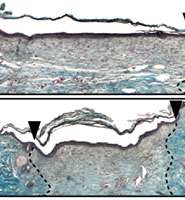
Treating skin wounds (blue) with osteopontin antisense DNA (top) reduces the size of scars (area between arrows)

New research from the University of Bristol shows that by suppressing one of the genes that normally switches on in wound cells, wounds can heal faster and reduce scarring. This has major implications not just for wound victims but also for people who suffer organ tissue damage through illness or abdominal surgery.

When skin is damaged a blood clot forms and cells underneath the wound start to repair the damage, leading to scarring. Scarring is a natural part of tissue repair and is most obvious where skin has healed after a cut or burn. It ranges from trivial (a grazed knee) to chronic (diabetic leg ulcers) and is not limited to the skin. All tissues scar as they repair; for example, alcohol-induced liver damage leads to fibrosis and liver failure, and after most abdominal surgeries scars can often lead to major complications.

Tissue damage triggers an inflammatory response by white cells to protect skin from infection by killing microbes. The same white cells guide the production of layers of collagen. These layers of collagen help the wound heal but they stand out from the surrounding skin and result in scarring. Research by Professor Paul Martin and colleagues at the University of Bristol shows that osteopontin (OPN) is one of the genes that triggers scarring and that applying a gel, which suppresses OPN to the wound, can accelerate healing and reduces scarring. It does this in part by increasing the regeneration of blood vessels around the wound and speeding up tissue reconstruction.

The findings will be published by the Journal of Experimental Medicine on 26 January in a paper entitled ‘Molecular mechanisms linking wound inflammation and fibrosis: knockdown of osteopontin leads to rapid repair and reduced scarring’. The paper is available online now.

Speaking of the discovery, Professor Martin said: ‘White blood cells (macrophages), and the chemical signals (PDGF) delivered to the wound cells, and osteopontin itself are now all clear targets for developing medicines to improve healing of skin wounds and other organs where fibrotic tissue repair can be debilitating. We hope that it won’t be too long before such therapies are available in the clinic. Indeed, the technique for suppressing OPN to reduce scarring is currently being licensed and patented by a Biotech company specializing in wound-healing therapies.’

Earlier research by Professor Martin’s lab and others has shown that embryos of many species, including humans, heal wounds without leaving a scar. Now it looks like the same may be true for adults.

Source: University of Bristol


print this article email this article download pdf blog this article bookmark this article     Stumble it Digg this share on Facebook retweet share on Reddit add to delicious
Rate this story - 5 /5 (3 votes)


January 21, 2008 all stories

Comments: 0

5 /5 (3 votes)
  • Stumble this up

  • Digg this

  • share this

  • hide
  • Related Stories

  • Clinical trials of spray-on skin to start in US
    created Nov 24, 2009 | popularity not rated yet | comments 0
  • Study finds way to protect healthy cells from radiation damage
    created Oct 21, 2009 | popularity not rated yet | comments 0
  • Time (and PPAR-beta/delta) heals all wounds
    created Mar 23, 2009 | popularity not rated yet | comments 0
  • A perfect bond
    created Nov 10, 2008 | popularity not rated yet | comments 0
  • First demonstration of new hair follicle generation in an animal model
    created May 16, 2007 | popularity not rated yet | comments 0


  • hide
  • Relevant PhysicsForums posts

Other News

Implant-based cancer vaccine is first to eliminate tumors in mice

Medicine & Health / Cancer

created 21 minutes ago | popularity not rated yet | comments 0

A cancer vaccine carried into the body on a carefully engineered, fingernail-sized implant is the first to successfully eliminate tumors in mammals, scientists report this week in the journal Science Translational Medicine.


CDC: Swine flu vaccine safe; no big problems seen

Medicine & Health / Medications

created 5 minutes ago | popularity not rated yet | comments 0

(AP) -- U.S. health officials say there's no evidence that the swine flu vaccine is causing any serious side effects.


First 'genetic map' of Han Chinese may aid search for disease susceptibility genes

Medicine & Health / Genetics

created 23 minutes ago | popularity not rated yet | comments 0

The first genetic historical map of the Han Chinese, the largest ethnic population in the world, as they migrated from south to north over evolutionary time. was published online today by the American Journal of Human Ge ...


Medical students regularly stuck by needles, often fail to report injuries

Medicine & Health / Other

created 29 minutes ago | popularity not rated yet | comments 0

Medical students are commonly stuck by needles -- putting them at risk of contracting potentially dangerous blood-borne diseases -- and many of them fail to report the injuries to hospital authorities, according to a Johns ...


Feeding the clock

Feeding the clock: Cycles of feeding and fasting drive circadian gene expression in the liver

Medicine & Health / Research

created 3 hours ago | popularity 4 / 5 (1) | comments 0

When you eat may be just as vital to your health as what you eat, found researchers at the Salk Institute for Biological Studies. Their experiments in mice revealed that the daily waxing and waning of thousands ...