Rich nations' environmental footprints tread heavily on poor countries
January 21st, 2008 The Ecological Footprints of Nations

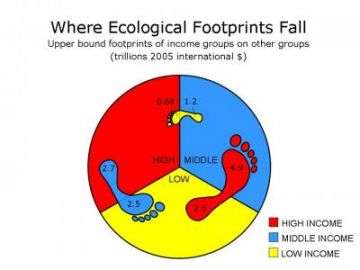
The environmental impacts of high-, middle- and low-income nations fall on other income tiers, as indicated by the footprints. The numbers are in trillions of 2005 international dollars. Credit: Thara Srinivasan/UC Berkeley

The environmental damage caused by rich nations disproportionately impacts poor nations and costs them more than their combined foreign debt, according to a first-ever global accounting of the dollar costs of countries' ecological footprints.

The study, led by former University of California, Berkeley, research fellow Thara Srinivasan, assessed the impacts of agricultural intensification and expansion, deforestation, overfishing, loss of mangrove swamps and forests, ozone depletion and climate change during a 40-year period, from 1961 to 2000. In the case of climate change and ozone depletion, the researchers also estimated the impacts that may be felt through the end of this century.

"At least to some extent, the rich nations have developed at the expense of the poor and, in effect, there is a debt to the poor," said coauthor Richard B. Norgaard, an ecological economist and UC Berkeley professor of energy and resources. "That, perhaps, is one reason that they are poor. You don't see it until you do the kind of accounting that we do here."

The calculation of the ecological footprints of the world's low-, middle- and high-income nations drew upon more than a decade of assessments by environmental economists who have tried to attach monetary figures to environmental damage, plus data from the recent United Nations Millennium Ecosystem Assessment and World Bank reports.

Because of the monumental nature of such an accounting, the UC Berkeley researchers limited their study to six areas of human activity. Impacts of activities that are difficult to assess, such as loss of habitat and biodiversity and the effects of industrial pollution, were ignored. Because of this, the researchers said that the estimated financial costs in the report are a minimum.

"We think the measured impact is conservative. And given that it's conservative, the numbers are very striking," said Srinivasan, who is now at the Pacific Ecoinformatics and Computational Ecology (PEaCE) Lab in Berkeley. "To our knowledge, our study is the first to really examine where nations' ecological footprints are falling, and it is an interesting contrast to the wealth of nations."

Srinivasan, Norgaard and their colleagues reported their results this week in the early online edition of the journal Proceedings of the National Academy of Sciences.

"In the past half century, humanity has transformed our natural environment at an unprecedented speed and scale," Srinivasan said, noting that the Earth's population doubled in the past 50 years to 6.5 billion as the average per-capita gross world product also doubled. "What we don’t know is which nations around the world are really driving the ecological damages and which are paying the price."

Norgaard said that the largest environmental impact by far is from climate change, which has been assessed in previous studies. The current study broadens the assessment to include other significant human activities with environmental costs and thus provides a context for the earlier studies.

The study makes clear, for example, that while deforestation and agricultural intensification primarily impact the host country, the impacts from climate change and ozone depletion are spread widely over all nations.

"Low-income countries will bear significant burdens from climate change and ozone depletion. But these environmental problems have been overwhelmingly driven by emission of greenhouse gases and ozone-depleting chemicals by the rest of the world," Srinivasan said.

Climate change is expected to increase the severity of storms and extreme weather, including prolonged droughts and flooding, with an increase in infectious diseases. Ozone depletion mostly impacts health, with increases expected in cancer rates, cataracts and blindness All of these will affect vulnerable low-income countries disproportionately.

In addition to climate change and ozone depletion, overfishing and conversion of mangrove swamps to shrimp farming are areas in which rich nations burden poor countries.

"Seafood derived from depleted fish stocks in low-income country waters ultimately ends up on the plates of consumers in middle-income and rich countries," Srinivasan said. "The situation is similar for farmed shrimp. For such a small, rare habitat, mangroves, when cut down, exact a surprisingly large cost borne primarily by the poor- and middle-income countries."

The primary cost is loss of storm protection, which some say was a major factor in the huge loss of life from 2005's tsunami in Southeast Asia.

Deforestation, on the other hand, can exacerbate flooding and soil erosion, affect the water cycle and offshore fisheries and lead to the loss of recreation and of non-timber products such as latex and food sources. Agricultural intensification can lead to drinking water contamination by pesticides and fertilizers, pollution of streams, salinization of croplands and biodiversity loss, among other impacts.

When all these impacts are added up, the portion of the footprint of high-income nations that is falling on the low-income countries is greater than the financial debt recognized for low income countries, which has a net present value of 1.8 trillion in 2005 international dollars, Srinivasan said. (International dollars are U.S. dollars adjusted to account for the different purchasing power of different currencies.) "The ecological debt could more than offset the financial debt of low-income nations," she said.

Interestingly, middle-income nations may have an impact on poor nations that is equivalent to the impact of rich nations, the study shows. While poor nations impact other income tiers also, their effect on rich nations is less than a third of the impact that the rich have on the poor.

Norgaard admits that "there will be a lot of controversy about whether you can even do this kind of study and whether we did it right. A lot of that will just be trying to blindside the study, to not think about it. What we really want to do is challenge people to think about it. And if anything, if you don't believe it, do it yourself and do it better."

Source: University of California - Berkeley


print this article email this article download pdf blog this article bookmark this article     Digg this Stumble it share on Facebook share on Reddit add to delicious save to Yahoo! bookmarks
4/5 after 24 votes

Rank Filter

Move the slider to adjust rank threshold, so that you can hide some of the comments.


Display comments: newest first

  • RAL - Jan 21, 2008
    • Rank: not rated yet
    What a complete and total crock. It starts with the assumption that we are to blame for all the worlds problems, then quantifies it in six dimensions. Our tax dollars at work at today's modern university.

    "To some extent the rich nations have developed at the expense of the poor". Sounds like warmed over Marxism applied to nations now instead of classes. Where would America be if we hadn't exploited Namibia?
  • rubberman - Jan 22, 2008
    • Rank: not rated yet
    Instantly on the defensive and worried about allocation of tax dollars....easy there tiger. The artical does mispeak as far as rich nations developing at the expense of the poor. The human footprint on the environment has been made as a race, rich nations may have stomped a little harder than say Namibia, but in one way or another every human being creates a footprint. The point they are trying to make above that you clearly have missed is that in order to combat any negative environmental issues that are anthroprogenic in origin, we have the luxury of allocating your tax dollars towards combating those issues. Namibia does not. Also the average Namibian does not produce the same amount of waste or pollution that the average citizen of a rich or middle-class nation does. Therefore, you contribute more than someone from a poor country does to a global problem, but have more ways of dealing with those problems so they effect you less. Hence the portion of the statement "at the expense of the poor". What we do effects others more than it does us because of our lifestyle and the infrastructure we have to filter our crap away from us.
  • RAL - Jan 23, 2008
    • Rank: not rated yet
    Obviously laying the groundwork for an attempt to penalize the most productive societies on the planet, this is warmed over nonsense. In fact those less developed societies have benefited immensely from technologies shared by the advanced ones. Their quality of life has been raised by knowledge about the universe around them, their agriculture made more productive by genetic developments, their entire economies brought into being by resource identification and extraction. And the next step is what? Reparations by the wealthier and more advanced nations towards those mired in Marxist dictatorships and thuggery. No thanks.
    There are reasons why advanced nations are advanced, and they owe not a nickel to those who are not, beyond what they choose to share out of their own goodness and humanity. Take this nonsense and shove it, it is not science, it is not economics, it is a political smokescreen to penalize the most productive societies by developing a false construct to put them in debt of the least. Preposterous.

January 21st, 2008 all stories
Space & Earth / Environment

Comments: 3
Rank: 4/5 after 24 votes

  • Stumble this up

  • Digg this

  • Share it:
  • share on Facebook
  • share on MySpace
  • share on Slashdot
  • rss-newsfeed
  • share on Google
  • share on Reddit
  • add to delicious
  • save to Yahoo! bookmarks
  • share on Windows Live
  • Add to Mixx!
Rating: 4/5 after 24 votes

  • Related Stories

  • WHO: No swine flu vaccine available for months (Update)
    created May 19, 2009 | popularity not rated yet | comments 0
  • Scientists urge world leaders to respond cooperatively to Pacific Ocean threats
    created May 12, 2009 | popularity not rated yet | comments 0
  • Critics: WHO slow on generics for swine flu
    created May 11, 2009 | popularity not rated yet | comments 0
  • US more optimistic about climate deal after talks
    created Apr 28, 2009 | popularity not rated yet | comments 0
  • Kyoto treaty is ‘failing the world’s poor’, say scientists
    created Apr 16, 2009 | popularity not rated yet | comments 0

Tags


  • Physicists Demonstrate Quantum Memory with Matter Qubits
    Physicists Demonstrate Quantum Memory with Matter Qubits
    Physics / General Physics
    created Jul 03, 2009 | popularity 4.4 / 5 (17) | comments 1
  • 'Holey' Nanosheets for Wastewater Dye Removal
    Nanotechnology / Nanomaterials
    created Jul 01, 2009 | popularity 5 / 5 (5) | comments 1
  • Jellyfish Robot Swims Like its Biological Counterpart
    Jellyfish Robot Swims Like its Biological Counterpart
    Electronics / Robotics
    created Jun 26, 2009 | popularity 4.4 / 5 (8) | comments 1
  • Could Maxwell's Demon Exist in Nanoscale Systems?
    Could Maxwell's Demon Exist in Nanoscale Systems?
    Physics / General Physics
    created Jun 24, 2009 | popularity 4.4 / 5 (18) | comments 29
  • Living Safely with Robots, Beyond Asimov's Laws
    Living Safely with Robots, Beyond Asimov's Laws
    Electronics / Robotics
    created Jun 22, 2009 | popularity 4.6 / 5 (52) | comments 40
  • Other News

    Forty years ago man first walked on the moon

    Space & Earth / Space Exploration

    created 19 hours ago | popularity 4.3 / 5 (4) | comments 2

    Forty years ago on July 20, 1969, American astronaut Neil Armstrong realized the oldest dream of human civilizations when he became the first man to walk on the moon.


    The least sea ice in 800 years

    The least sea ice in 800 years

    Space & Earth / Earth Sciences

    created Jul 01, 2009 | popularity 4.1 / 5 (63) | comments 59

    New research, which reconstructs the extent of ice in the sea between Greenland and Svalbard from the 13th century to the present indicates that there has never been so little sea ice as there is now. The ...


    Gas around young galaxy

    Intense heat killed the Universe's would-be galaxies, researchers say

    Space & Earth / Astronomy

    created Jul 01, 2009 | popularity 3.4 / 5 (21) | comments 27

    (PhysOrg.com) -- Our Milky Way galaxy only survived because it was already immersed in a large clump of dark matter which trapped gases inside it, scientists led by Durham University's Institute for Computational ...


    Scientists' Drill Hits Magma: Only Third Time on Record

    Scientists' Drill Hits Magma: Only Third Time on Record

    Space & Earth / Earth Sciences

    created Jun 29, 2009 | popularity 4.7 / 5 (22) | comments 19

    (PhysOrg.com) -- Scientists drilling a borehole deep into Iceland’s rocky crust to explore new methods of using geothermal energy hit a major roadblock on Thursday: Their drill ran into molten rock at a depth ...


    NASA manager pitches a cheaper return-to-moon plan

    Space & Earth / Space Exploration

    created Jun 30, 2009 | popularity 4.1 / 5 (8) | comments 18

    (AP) -- Like a car salesman pushing a luxury vehicle that the customer no longer can afford, NASA has pulled out of its back pocket a deal for a cheaper ride to the moon.