Researchers develop darkest manmade material
January 22, 2008
Researchers develop darkest manmade material

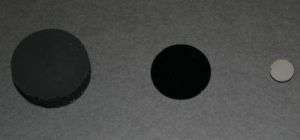
The new darkest manmade material, with its 0.045 percent reflectance (center), is noticeably darker than the 1.4 percent NIST reflectance standard (left) and a piece of glassy carbon (right). Credit: Rensselaer

Researchers at Rensselaer Polytechnic Institute and Rice University have created the darkest material ever made by man.

The material, a thin coating comprised of low-density arrays of loosely vertically-aligned carbon nanotubes, absorbs more than 99.9 percent of light and one day could be used to boost the effectiveness and efficiency of solar energy conversion, infrared sensors, and other devices. The researchers who developed the material have applied for a Guinness World Record for their efforts.
Researchers develop darkest manmade material

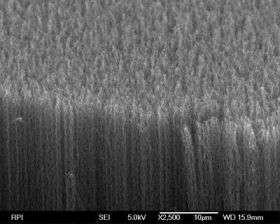
A side-view scanning electron micrograph of the darkest material at a high magnification. The nanotubes are vertically aligned, forming a highly porous nanostructure. Credit: Rensselaer

“It is a fascinating technology, and this discovery will allow us to increase the absorption efficiency of light as well as the overall radiation-to-electricity efficiency of solar energy conservation,” said Shawn-Yu Lin, professor of physics at Rensselaer and a member of the university’s Future Chips Constellation, who led the research project. “The key to this discovery was finding how to create a long, extremely porous vertically-aligned carbon nanotube array with certain surface randomness, therefore minimizing reflection and maximizing absorption simultaneously.”

The research results were published in the journal Nano Letters.

All materials, from paper to water, air, or plastic, reflect some amount of light. Scientists have long envisioned an ideal black material that absorbs all the colors of light while reflecting no light. So far they have been unsuccessful in engineering a material with a total reflectance of zero.

The total reflectance of conventional black paint, for example, is between 5 and 10 percent. The darkest manmade material, prior to the discovery by Lin’s group, boasted a total reflectance of 0.16 percent to 0.18 percent.

Lin’s team created a coating of low-density, vertically aligned carbon nanotube arrays that are engineered to have an extremely low index of refraction and the appropriate surface randomness, further reducing its reflectivity. The end result was a material with a total reflective index of 0.045 percent – more than three times darker than the previous record, which used a film deposition of nickel-phosphorous alloy.

“The loosely-packed forest of carbon nanotubes, which is full of nanoscale gaps and holes to collect and trap light, is what gives this material its unique properties,” Lin said. “Such a nanotube array not only reflects light weakly, but also absorbs light strongly. These combined features make it an ideal candidate for one day realizing a super black object.”

“The low-density aligned nanotube sample makes an ideal candidate for creating such a super dark material because it allows one to engineer the optical properties by controlling the dimensions and periodicities of the nanotubes,” said Pulickel Ajayan, the Anderson Professor of Engineering at Rice University in Houston, who worked on the project when he was a member of the Rensselaer faculty.

The research team tested the array over a broad range of visible wavelengths of light, and showed that the nanotube array’s total reflectance remains constant.

“It’s also interesting to note that the reflectance of our nanotube array is two orders of magnitude lower than that of the glassy carbon, which is remarkable because both samples are made up of the same element – carbon,” said Lin.

This discovery could lead to applications in areas such as solar energy conversion, thermalphotovoltaic electricity generation, infrared detection, and astronomical observation.

Other researchers contributing to this project and listed authors of the paper include Rensselaer physics graduate student Zu-Po Yang; Rice postdoctoral research associate Lijie Ci; and Rensselaer senior research scientist James Bur.

The project was funded by the U.S. Department of Energy’s Office of Basic Energy Sciences and the Focus Center New York for Interconnects.

Lin’s research was conducted as part of the Future Chips Constellation at Rensselaer, which focuses on innovations in materials and devices, in solid state and smart lighting, and applications such as sensing, communications, and biotechnology. A new concept in academia, Rensselaer constellations are led by outstanding faculty in fields of strategic importance. Each constellation is focused on a specific research area and comprises a multidisciplinary mix of senior and junior faculty, as well as postdoctoral researchers and graduate students.

Source: Rensselaer Polytechnic Institute

4.4 /5 (39 votes)  

Filter


Move the slider to adjust rank threshold, so that you can hide some of the comments.


Display comments: newest first

CTYankee
Jan 22, 2008

Rank: not rated yet
looks like cavity radiation ;-)
Ashibayai
Jan 22, 2008

Rank: not rated yet
So...this thing would heat up really fast in light right?
ShadowRam
Jan 23, 2008

Rank: not rated yet
You'd think it would heat up, but I'm willing to bet although it absorbs 'visible' light, it probably has a very high radiation emission. After-all it does have a huge surface area
Embi
Jan 23, 2008

Rank: not rated yet
Query for any physicists out there who understand this from a science perspective - What happens to all the light it absorbs? Would it theoretically turn into a black hole if it absorbed enough light for a long enough time?
seanpu
Jan 24, 2008

Rank: not rated yet
bet its a bitch to clean
Ashibayai
Jan 24, 2008

Rank: not rated yet
Query for any physicists out there who understand this from a science perspective - What happens to all the light it absorbs? Would it theoretically turn into a black hole if it absorbed enough light for a long enough time?


I think the rate it radiates energy would balance out before it could absorb that much energy. I mean, that's energy in terms of mass, which is just crazy. In fact, I think it would radiate away it's light energy as thermal energy before it could even get close to melting point...
dulmesn
Apr 16, 2008

Rank: not rated yet
First off it would not heat up really fast. Because it is made of billions of very small tubes it's surface area would be near infinite compared to it's volume. Which would mean it stay cool. And as for a black hole, they have nothing to do with light. A black hole forms when the gravity forces in a star over come the explosive forces of fusion. Depending on the size of the star it could collapse enough to become a black hole with the gravity of the star that it was before. Then it'll begin to pull and move toward objects. Light in its photon form has technically no mass because of it's speed but needs mass to be attracted into the black hole. And yes that seems messed up but that's about how it works.
Rank 4.4 /5 (39 votes)
Tags

Relevant PhysicsForums posts
  • polymer nanocomposites
    created15 hours ago
  • Corrosion Tests on Magnesium
    createdFeb 09, 2012
  • polyethylene copper nanocomposite
    createdFeb 09, 2012
  • Output of xrd analysis
    createdFeb 08, 2012
  • Transport phenomena problem based on problems 18.B11 and 19B.6 from Bird, stewart, lw
    createdFeb 06, 2012
  • Help with material selection - Car Piston
    createdFeb 05, 2012
  • More from Physics Forums - Materials & Chemical Engineering

More news stories

'Dark plasmons' transmit energy

Microscopic channels of gold nanoparticles have the ability to transmit electromagnetic energy that starts as light and propagates via "dark plasmons," according to researchers at Rice University.

Nanotechnology / Nanophysics

created 23 hours ago | popularity 5 / 5 (6) | comments 1 | with audio podcast

What lies beneath: Mapping hidden nanostructures

The ability to diagnose and predict the properties of materials is vital, particularly in the expanding field of nanotechnology. Electron and atom-probe microscopy can categorize atoms in thin sheets of material, ...

Nanotechnology / Nanophysics

created 7 hours ago | popularity 5 / 5 (1) | comments 1

New kind of solar cell could capture significantly more energy than current cells

New solar cells could increase the maximum efficiency of solar panels by over 25%, according to scientists from the University of Cambridge.

Nanotechnology / Nanophysics

created Feb 08, 2012 | popularity 4.5 / 5 (12) | comments 14 | with audio podcast

Nanoshell whispering galleries improve thin solar panels

Visitors to Statuary Hall in the U.S. Capitol Building may have experienced a curious acoustic feature that allows a person to whisper softly at one side of the cavernous, half-domed room and for another on ...

Nanotechnology / Nanomaterials

created Feb 07, 2012 | popularity 4.3 / 5 (6) | comments 6 | with audio podcast

Nanotube therapy takes aim at breast cancer stem cells

Wake Forest Baptist Medical Center researchers have again proven that injecting multiwalled carbon nanotubes (MWCNTs) into tumors and heating them with a quick, 30-second laser treatment can kill them.

Nanotechnology / Bio & Medicine

created Feb 09, 2012 | popularity 5 / 5 (1) | comments 0 | with audio podcast


CIA website offline, Anonymous takes credit

The website of the Central Intelligence Agency was unresponsive on Friday after the hacker group Anonymous claimed to have knocked it offline.

Q&A: Obama and the birth control controversy

(AP) -- What birth control debate? A half-century after the introduction of the pill, acceptance of birth control by American women is virtually universal.

Complex wiring of the nervous system may rely on a just a handful of genes and proteins

Researchers at the Salk Institute have discovered a startling feature of early brain development that helps to explain how complex neuron wiring patterns are programmed using just a handful of critical genes. ...

The power of estrogen -- male snakes attract other males

A new study has shown that boosting the estrogen levels of male garter snakes causes them to secrete the same pheromones that females use to attract suitors, and turned the males into just about the sexiest ...

New error-correcting codes guarantee the fastest possible rate of data transmission

Error-correcting codes are one of the triumphs of the digital age. They’re a way of encoding information so that it can be transmitted across a communication channel — such as an optical fiber o ...

Humans may have helped the decline of African rainforests 3000 years ago

(PhysOrg.com) -- Large areas of rainforests in Central Africa mysteriously disappeared over three thousand years ago, to be replaced by savannas. The prevailing theory has been that the cause was a change ...