Cell division studies hint at future cancer therapy
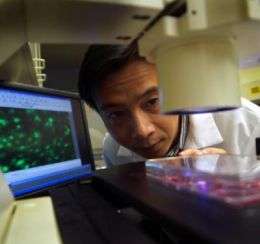
When a cell’s assets get divided between daughter cells, Dr. Quansheng Du wants to make sure both offspring do well.
He’s dissecting the complex, continuous and amazing process that enables one cell to become two.
When all goes well, cell division, or mitosis, helps repopulate a damaged organ or replenish endogenous stem cells.
When it goes badly, it can result in cancer or developmental defects.
“What we are trying to understand is how cells divide,” says Dr. Du, cell biologist at the Medical College of Georgia, who recently received $2 million in grants from the National Institutes of Health and the American Cancer Society to pursue his studies.
He focuses on the mitotic spindle, a sort of demarcation line that helps a dividing cell divvy up its genetic information. Once a cell decides to divide, it duplicates its genetic material and the nuclear envelope containing the material dissolves. Microtubules, stick-like projections that look like spokes on a wheel, start moving, reorganizing into a spindle-shaped structure that attaches and aligns the genetic material at the center of the spindle. The cell, sensing the microtubule attachment, initiates a process that pulls the duplicated genetic material apart.
The outcome of normal cell division is typically two cells that look just like the original. In a culture dish and in humans, the process takes about an hour.
Not every cell can divide. Terminally differentiated cells, such as neurons and muscle cells, can’t.
However, stem cells, known for their flexibility, divide well and at least three ways. They can divide genetic material evenly, forming two identical stem cells. They can undergo asymmetric cell division, birthing one identical stem cell as well as a new daughter cell that differentiates into another cell type, such as a skin cell or neuron. They can even make two uniquely differentiated cells, thus depleting the stem cell.
During mammalian development and tissue maintenance, stem cells are constantly balancing between self-renewal and differentiation by adapting different types of cell division.
While a postdoctoral fellow at the University of Virginia, Dr. Du was studying cell polarity, essential to asymmetric cell division because it attracts so-called cell fate determinants to one side of the mother cell and directs spindle orientation.
In work published in Nature Cell Biology, Current Biology and Cell, he detailed a group of proteins critical for spindle organization and positioning in mammalian cells.
These proteins may help determine cell fate after asymmetric cell division as well, he says: for example, determining whether the daughter cells keep being stem cells or differentiate into another cell type.
Now, he wants to know how these proteins get where they need to be and how they cooperate with other proteins to organize the spindle and direct its orientation.
These details may eventually lead to better cancer treatment, such as disrupting mitotic spindle organization so cancer cells cannot divide, Dr. Du says.
The relatively recent discoveries of cancer stem cells make the possibilities even more intriguing.
“The current cancer stem cell theory is that it’s actually just a small population of cells within the tumor that are the original cancer-initiating cells,” says Dr. Du. Still if each cancer stem cell in that small population divides, the numbers add up quickly.
“How normal stem cells become cancer stem cells is not clear,” he says. “Abnormal asymmetric stem cell division, which will break the balance between stem cell self-renewal and differentiation, may be an early event that drives the development of cancer stem cells.”
Understanding the mechanisms of stem cell division will provide clues for targeted cancer therapy against these cancer stem cells. Manipulating the balance toward differentiation, for example, would probably lead to the depletion of cancer stem cells, Dr. Du says.
Source: Medical College of Georgia


