Foreseeing the Sun’s fate: Astronomical interferometry reveals the close environment of Mira stars
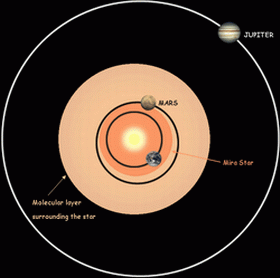
For the first time, an international team of astronomers led by Guy Perrin from the Paris Observatory/LESIA, (Meudon, France) and Stephen Ridgway from the National Optical Astronomy Observatory (Tucson, Arizona, USA) has observed the close environment of five so-called red giant Mira stars, using astronomical interferometric techniques. They found that the observed Mira stars are embedded in a shell of water vapor and possibly of carbon monoxide that extends to twice the stellar radius. Studying these Mira stars is of particular interest since they are now undergoing a late stage of the evolution that one-solar mass stars, including our Sun, experience. Therefore, these stars illustrate the fate of our Sun five billion years from now. Would such a star, including its surrounding shell, be located at the Sun’s position in our solar system, it would extend far beyond Mars.
Although they are really very large (up to a few hundred solar radii), red giant stars are point-like to the unaided human eye on Earth, and even the largest telescopes fail to distinguish their surfaces. This challenge can be overcome by combining signals from separate telescopes using a technique called “astronomical interferometry” that makes it possible to study very small details in the close surroundings of Mira stars. Ultimately, images of the observed stars can be reconstructed.
Mira stars, named after the first such known object, Mira (omicron Ceti), have been observed for more than 400 years by astronomers both professional and amateur. This class of variable red giants is famous for their pulsations that last for 80-1000 days and that cause their apparent brightness to vary by ten or more during a cycle at visible wavelengths. A possible explanation of their significant variability is that large amounts of material, including dust and molecules, are produced during each cycle. This material blocks the stellar radiation until the material becomes diluted by expansion. The close environment of Mira stars is therefore complex, and the characteristics of the central object are difficult to observe.
To study the close environment of these stars, the team led by Guy Perrin and Stephen Ridgway carried out interferometric observations at the Infrared-Optical Telescope Array (IOTA) of the Smithsonian Astrophysical Observatory in Arizona. IOTA is a Michelson stellar interferometer [2], with two arms forming an L-shaped array. It operates with three collectors that can be located at different stations on each arm. In the framework of the present study, observations were made at several wavelengths using different telescope spacings ranging from 10 to 38 meters.
From these observations, the team was able to reconstruct the variation of the stellar brightness with the distance from the star’s center for each star. Details down to about 10 milli-arcseconds can be detected. At Mira’s distance from the Earth, that corresponds to details of about 200 million kilometers. In comparison, at the Moon’s distance, that would correspond to details of only 20 meters.
The observations were made at near-infrared wavelengths that are of particular interest for the study of water vapor (H2O) and carbon monoxide (CO). The role played by these molecules was suspected some years ago by the team and independently confirmed by observations with the Infrared Space Observatory. It is now clearly demonstrated: the five observed Mira stars are surrounded by a molecular layer made of water vapor and, at least in some cases, of carbon monoxide. This layer has a temperature of about 2000 K and extends to about one stellar radius above the stellar photosphere.
For the first time, an in-depth description of the close environment of a Mira star has been achieved. Previous interferometric studies of Mira stars led to estimates of star diameters that were biased by the presence of the molecular layer and were thus much overestimated. This new result shows that the Mira stars are about 30% smaller as previously believed. The space between the star's surface and the molecular layer very likely contains gas, like an atmosphere, but it is relatively transparent at the observed wavelengths. In visible light, the molecular layer is rather opaque, giving the impression that it is a surface, but in the infrared, it is thin and the star can be seen through it.
The observations presented by the team are interpreted in the framework of a model that bridges the gap between observations and theory. This model is the first ever to explain the structure of Mira stars over a wide range of spectral wavelengths from the visible to the mid-infrared and to be consistent with the theoretical properties of their pulsation. Indeed, for the first time, the size measurements of Mira stars are in agreement with the models that describe their pulsating behaviour. However, the presence of the layer of molecules far above the stellar surface is still somewhat mysterious. The layer is too high and dense to be supported purely by atmospheric pressure. The pulsations of the star probably play a role in producing the molecular layer, but the mechanism is not yet understood.
Mira stars eject large amounts of gas and dust into space, typically about 1/3 of the Earth’s mass per year, thus providing more than 75% of the molecules in the Galaxy, including most of those we are made. Better knowledge of the atmospheres of Mira stars is a clue to understanding this mechanism that still remains a speculation. Additionally, as Mira stars occupy a late evolutionary stage of Sun-like stars, it is crucial to better describe the processes that occur in and around these stars. If a Mira star and its 2000 K surrounding layer were located at the Sun’s position in the Solar System (see Figure 1), the molecular layer of such a star would extend to the asteroid belt between the orbits of Mars and Jupiter, far beyond the Earth’s orbit. One can thus foresee the eventual envelopment of the Earth by the expanding Sun, after it evolves as a Mira star, 5 billion years from now.
Source: Journal Astronomy and Astrophysics


