New Antarctic ice core to provide clearest climate record yet
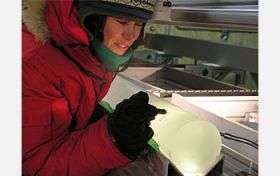
After enduring months on the coldest, driest, and windiest continent on Earth, researchers today closed out the inaugural season on an unprecedented, multi-year effort to retrieve the most detailed record of greenhouse gases in Earth’s atmosphere over the last 100,000 years.
Working as part of the National Science Foundation’s West Antarctic Ice Sheet Divide (WAIS Divide) Ice Core Project, a team of scientists, engineers, technicians, and students from multiple U.S. institutions have recovered a 580-meter (1,900-foot) ice core – the first section of what is hoped to be a 3,465-meter (11,360-foot) column of ice detailing 100,000 years of Earth’s climate history, including a precise year-by-year record of the last 40,000 years.
The dust, chemicals, and air trapped in the two-mile-long ice core will provide critical information for scientists working to predict the extent to which human activity will alter Earth’s climate, according to the chief scientist for the project, Kendrick Taylor of the Desert Research Institute of the Nevada System of Higher Education. DRI, along with the University of New Hampshire, operates the Science Coordination Office for the WAIS Divide Project.
WAIS Divide, named for the high-elevation region that is the boundary separating opposing flow directions on the ice sheet, is the best spot on the planet to recover ancient ice containing trapped air bubbles – samples of the Earth’s atmosphere from the present to as far back as 100,000 years ago.
While other ice cores have been used to develop longer records of Earth’s atmosphere, the record from WAIS Divide will allow a more detailed study of the interaction of previous increases in greenhouse gases and climate change. This information will improve computer models that are used to predict how the current unprecedented high levels of greenhouse gases in the atmosphere caused by human activity will influence future climate.
The WAIS Divide core is also the Southern Hemisphere equivalent of a series of ice cores drilled in Greenland beginning in 1989, and it will provide the best opportunity for scientists to determine if global-scale climate changes that occurred before human activity started to influence climate were initiated in the Arctic, the tropics, or Antarctica.
The new core will also allow investigations of biological material in deep ice, which will yield information about biogeochemical processes that control and are controlled by climate, as well as lead to fundamental insights about life on Earth.
Says Taylor, “We are very excited to work with ancient ice that fell as snow as long as 100,000 years ago. We read the ice like other people might read a stack of old weather reports.”
The WAIS project took more than 15 years of planning and preparation, including extensive airborne reconnaissance and ground-based geophysical research, to pinpoint the one-square-kilometer (less than a square mile) space on the 932,000-square-kilometer (360,000-square-mile) ice sheet that scientists believe will provide the clearest climate record for the last 100,000 years.
With only some 40 days a year when the weather is warm enough for drilling – yesterday’s temperature was a balmy -15 degrees Celsius (5 degrees Fahrenheit) – it is expected to take until January 2010 to complete the fieldwork.
For the project, Ice Coring and Drilling Services of the University of Wisconsin-Madison built and is operating a state-of-the-art, deep ice-coring drill, which is more like a piece of scientific equipment than a conventional rock drill used in petroleum exploration. The U.S. Geological Survey National Ice Core Laboratory in Denver designed the core handling system. Raytheon Polar Services Corporation provides the logistical support. The NSF Office of Polar Programs-U.S. Antarctic Program funds the project. The core will be archived at the National Ice Core Laboratory, which is run by the USGS with funding from NSF.
Source: University of New Hampshire


