Researchers study agricultural impact on Mississippi River
January 23, 2008 Researchers study agricultural impact on Mississippi River

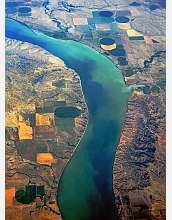
Farming practices have changed the chemistry of the Mississippi River and the Gulf of Mexico. Credit: Jerry Ting

According to a study published in Nature by researchers at LSU and Yale University, farming has significantly changed the hydrology and chemistry of the Mississippi River, injecting more carbon dioxide into the river and raising river discharge during the past 50 years.

LSU Professor R. Eugene Turner and graduate student Whitney Broussard, along with their colleagues at Yale, tracked changes in the discharge of water and the concentration of bicarbonate, which forms when carbon dioxide in soil water dissolves rock minerals. Bicarbonate in rivers plays an important, long-term role in absorbing atmospheric carbon dioxide, a greenhouse gas. Oceans then absorb this carbon dioxide, but become more acidic in the process, making it more difficult for organisms to form hard shells – a necessary function in coral reefs, for example.

Researchers concluded that liming and farming practices, such as changes in tile drainage, tillage practices and crop type, are most likely responsible for the majority of the increase in water and carbon in the Mississippi River, North America’s largest river.

“It’s like the discovery of a new large river being piped out of the corn belt,” said Pete Raymond, lead author of the study and associate professor of ecosystem ecology at the Yale School of Forestry & Environmental Studies.

The research team analyzed 100-year-old data on the Mississippi River warehoused at two New Orleans water treatment plants, and combined it with data on precipitation and water export.

“The water quality information we used has been sitting idle for over 50 years in an attic in New Orleans, waiting to be discovered,” said Broussard, who is pursuing a doctoral degree in coastal ecology at LSU. “I felt like a treasure-hunter when we opened those boxes in that 100-plus degree attic to find those data logs. You never know where your research will take you if you’re open to suggestion and serendipity.” Turner, distinguished professor of coastal ecology, added, “and [where it will take you] if you have the benefits of long-term collaborations of trusting and high-quality academic research groups.”

The research team used the data to demonstrate the effects of this excess water on the carbon content of the river, and argue that the additional water in the river is altering the chemistry of the Gulf of Mexico as by increasing the amount of nutrients and pollution the river transports to the Gulf.

“We’re learning more and more about the far-reaching effects of American agriculture on rivers and lakes. This also means that the agricultural community has an incredible opportunity to influence the natural environment in a positive way, more than any other contemporary enterprise,” said Broussard. “If we want to clean the water, we have to steward the land with right agriculture.”

Source: Louisiana State University


print this article email this article download pdf blog this article bookmark this article     Stumble it Digg this share on Facebook retweet share on Reddit add to delicious
Rate this story - 3.5 /5 (4 votes)


January 23, 2008 all stories

Comments: 0

3.5 /5 (4 votes)
  • Stumble this up

  • Digg this

  • share this

  • hide
  • Related Stories

  • Fighting climate change by turning CO2 to stone
    created Nov 17, 2009 | popularity not rated yet | comments 0
  • New research provides insights into potential ecological costs and cobenefits of REDD
    created Nov 16, 2009 | popularity not rated yet | comments 0
  • Scientists pinpoint origin of dissolved arsenic in Bangladesh drinking water
    created Nov 15, 2009 | popularity not rated yet | comments 0
  • Where Did the Uranium Go?
    created Oct 26, 2009 | popularity not rated yet | comments 0
  • Designer molecule detects tiny amounts of cyanide, then glows
    created Oct 21, 2009 | popularity not rated yet | comments 0


  • hide
  • Relevant PhysicsForums posts

  • Ocean colonization
    created 7 hours ago
  • Will the Earth really flood when global warming happens?
    created Dec 03, 2009
  • A question about trends and noisy data
    created Dec 01, 2009
  • Satellite temp data
    created Dec 01, 2009
  • More from Physics Forums - Earth

Other News

Sandtrapped Rover Makes a Big Discovery

Sandtrapped Rover Makes a Big Discovery

Space & Earth / Space Exploration

created Dec 03, 2009 | popularity 4.8 / 5 (41) | comments 12

Homer's Iliad tells the story of Troy, a city besieged by the Greeks in the Trojan War. Today, a lone robot sits besieged in the sands of Troy while engineers and scientists plot its escape.


UK climate scientist to temporarily step down (AP)

UK climate scientist to temporarily step down

Space & Earth / Environment

created Dec 01, 2009 | popularity 3.3 / 5 (8) | comments 22

(AP) -- The chief of a prestigious British research center caught in a storm of controversy over claims that he and others suppressed data about climate change has stepped down pending an investigation, the ...


Study: Slowdown in warming last year not permanent

Space & Earth / Earth Sciences

created Dec 04, 2009 | popularity 3.3 / 5 (10) | comments 16

(AP) -- Cooler temperatures in North America last year do not mean global warming is easing, government and academic scientists said Friday.


United Nations to probe climate e-mail leak (AP)

United Nations to probe climate e-mail leak

Space & Earth / Environment

created Dec 04, 2009 | popularity 3.7 / 5 (6) | comments 16

(AP) -- The United Nations will conduct its own investigation into e-mails leaked from a leading British climate science center in addition to the probe by the University of East Anglia, a senior U.N. climate ...


Superior Super Earths

Superior Super Earths

Space & Earth / Space Exploration

created Nov 30, 2009 | popularity 4.8 / 5 (49) | comments 14

Super Earths are named for their size, but these planets - which range from about 2 to 10 Earth masses - could be superior to the Earth when it comes to sustaining life. They could also provide an answer to ...