Team IDs weakness in anthrax bacteria
January 23, 2008 Team IDs weakness in anthrax bacteria

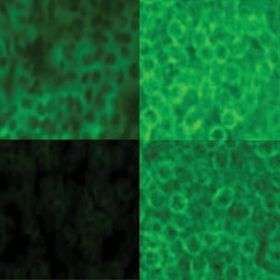
These images show macrophages infected with anthrax. The fluorescent green areas indicate the presence of nitric oxide (NO). In the top two panels, the anthrax can produce NO. At top left, an image taken two hours after infection shows that NO is present. At 18 hours, top right, more NO is present, produced by the macrophages. In the bottom two panels, the anthrax infecting the macrophages is unable to produce NO. At bottom left, after two hours, almost no NO is present, but it is present (produced by the macrophages) at 18 hours, bottom right. Image / Stephen Lippard

MIT and New York University researchers have identified a weakness in the defenses of the anthrax bacterium that could be exploited to produce new antibiotics.

The researchers found that nitric oxide (NO) is a critical part of Bacillus anthracis's defense against the immune response launched by cells infected with the bacterium. Anthrax bacteria that cannot produce NO succumb to the immune system's attack.

Stephen Lippard, the Arthur Amos Noyes Professor of Chemistry at MIT and an author of a paper on the work, said antibiotics developed to capitalize on this vulnerability could be effective against other bacteria that employ the same defense system. Those bacteria include Staphylococcus aureus, which commonly causes infections in hospitals and can be extremely drug-resistant.

The paper appeared in the Jan. 21 online edition of the Proceedings of the National Academy of Sciences.

Anthrax occurs naturally around the world and can infect all warm-blooded animals including humans. Treatment usually includes large doses of intravenous and oral antibiotics, but the disease can often be fatal--especially if treatment is not started right away.

In the human immune system, specialized cells called macrophages are the first line of defense against anthrax infection. Macrophages engulf the bacteria and bombard them with reactive oxygen and nitrogen species, which create chemical reactions toxic to the bacteria.

The research team found that NO produced by the bacteria pre-emptively defends against attack by reactive oxygen species produced by the macrophages soon after infection. Twelve hours later, when the macrophages release NO to join in the attack, it is too late--by then the bacteria have taken over and eventually destroy the macrophages.

When the gene for the enzyme that synthesizes NO is knocked out in the bacteria, they cannot defend against early attack by the macrophages, which can then survive the infection.

"With the aid of an intracellular probe developed in our laboratory, which fluoresces in the presence of NO, our collaborators Evgeny Nudler and his group discovered a completely new target for the next generation of antibiotics," said Lippard.

With this knowledge in hand, the researchers are now using the fluorescent probe to screen libraries of chemicals for compounds that could potentially interfere with the bacterium's ability to synthesize NO, said Lippard. Such compounds could eventually be developed into new antibiotics.

Source: MIT


print this article email this article download pdf blog this article bookmark this article     Stumble it Digg this share on Facebook retweet share on Reddit add to delicious
Rate this story - 5 /5 (2 votes)


January 23, 2008 all stories

Comments: 0

5 /5 (2 votes)
  • Stumble this up

  • Digg this

  • share this

  • hide
  • Related Stories

  • Scientists move closer to a safer anthrax vaccine
    created Sep 04, 2009 | popularity not rated yet | comments 0
  • Researchers image crucial anthrax protein
    created Jul 14, 2009 | popularity not rated yet | comments 0
  • Cigarettes harbor many pathogenic bacteria: Study
    created Nov 19, 2009 | popularity not rated yet | comments 0
  • The indefinite self-renewal of specialized cells without the need for stem cell intermediates
    created Nov 16, 2009 | popularity not rated yet | comments 0
  • New explanation for nature's hardiest life form
    created Nov 12, 2009 | popularity not rated yet | comments 0


Other News

First-ever blueprint of a minimal cell is more complex than expected

First-ever blueprint of a minimal cell is more complex than expected

Biology / Cell & Microbiology

created 8 hours ago | popularity 5 / 5 (10) | comments 0

What are the bare essentials of life, the indispensable ingredients required to produce a cell that can survive on its own? Can we describe the molecular anatomy of a cell, and understand how an entire organism ...


The six elephants in Sierra Leone were shot and "crudely butchered"

S.Leone elephants 'wiped out' by poachers: official

Biology / Ecology

created 10 hours ago | popularity 5 / 5 (4) | comments 5

Poachers "wiped out" the entire elephant herd in Sierra Leone's only wildlife park, wildlife managers said Thursday after police said they had arrested a gang of 10 poachers.


Ecological speciation by sexual selection on good genes: Is speciation adaptive?

Biology / Ecology

created 8 hours ago | popularity 5 / 5 (1) | comments 0

Darwin suggested that the action of natural selection can produce new species, but 150 years after the publication of his famous book, 'On the Origin of Species', debate still continues on the mechanisms of speciation. New ...


Knockouts in human cells point to pathogenic targets

Knockouts in human cells point to pathogenic targets

Biology / Cell & Microbiology

created 12 hours ago | popularity not rated yet | comments 0

(PhysOrg.com) -- Whitehead researchers have developed a new approach for genetics in human cells and used this technique to identify specific genes and proteins required for pathogens.


Whiteflies sabotage alarm system of plant in distress

Whiteflies sabotage alarm system of plant in distress

Biology / Plants & Animals

created 13 hours ago | popularity 5 / 5 (1) | comments 0

(PhysOrg.com) -- When spider mites attack a bean plant, the plant responds by producing odours which attract predatory mites. These predatory mites then exterminate the spider mite population, thus acting ...