New discovery on magnetic reconnection to impact future space missions
January 23, 2008
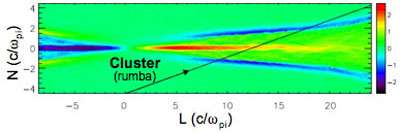
This figure shows the trajectory of a Cluster satellite (Rumba) overlaid on a numerical simulation of an electron diffusion region in the magnetosheath. The axes represent the distance from the core of the magnetic reconnection process, where the kink occurs, in between the thin blue jet and the red jet. Credits: University of Delaware (M. Shay)
ESA’s Cluster mission has, for the first time, observed the extent of the region that triggers magnetic reconnection, and it is much larger than previously thought. This gives future space missions a much better chance of studying it.
Space is filled with plasma (a gas composed of ions and electrons, globally neutral) and is threaded by magnetic fields. These magnetic fields store energy which can be released explosively, in a process called magnetic reconnection.
This process plays a key role in numerous astrophysical phenomena: star formation, solar flares and intense aurorae, to name a few. On Earth, magnetic reconnection prevents the efficient production of electricity in controlled fusion reactors, potential sources of electricity for the future.
At the heart of magnetic reconnection is the ‘electron diffusion region’, where reconnection is thought to be triggered. Here, a kink in newly-reconnected magnetic field lines produces large-scale high-velocity jets of plasma.
“Understanding the structure of the diffusion region and its role in controlling the rate at which magnetic energy is converted into particle energy remains a key scientific challenge,” says Dr Michael Shay, University of Delaware, USA.
Until recently, theoretical scientists believed that the electron diffusion region was relatively tiny (width about 2 km, length about 10 km). In the vastness of space, the chance of a spacecraft encountering this region would therefore be exceedingly small.
With increased computational power, simulations showed electron diffusion regions that were a lot more elongated than those seen earlier. It was not possible to judge whether the new finding was real because the length of the region increased with more powerful simulations. Nor it was known whether such a layer would be stable in the real, 3D world.
On 14 January 2003, the four Cluster satellites were crossing the magnetosheath, a turbulent plasma region located just outside Earth’s magnetosphere, when they encountered an electron diffusion region. The length of the observed region measured 3000 km, 300 times longer than the earlier theoretical expectations and four times longer than seen in recent simulations. Nevertheless, the observations strongly support new simulations.
“These Cluster observations are very significant since they are the first measurements of the length of the electron diffusion region in the space environment. The finding drastically changes the way we understand the physics of reconnection,” noted Dr James Drake, University of Maryland, USA.
“This discovery of a large electron diffusion region gives future ESA and NASA missions a much better chance to study it,” said Tai Phan at the University of California at Berkeley, USA, lead author of the paper on the findings.
Cluster was able to detect the region based on its high-resolution magnetic field, electric field and ion measurements. But to understand the fundamental physics of the electron diffusion region responsible for reconnection, higher time resolution measurements are needed to resolve the layer.
The four spacecraft of NASA’s Magnetospheric Multi-Scale mission, planned for launch in 2014, are being designed for such measurements. Cross-scale, a mission under study at ESA in collaboration with other space agencies, would use 12 spacecraft to probe the diffusion region, whilst simultaneously measuring the consequences of energy released by reconnection in the surrounding environment.
“With the higher probability of encountering the electron diffusion region, we can be confident that future missions will be able to fully understand magnetic reconnection,” said Dr Philippe Escoubet, ESA’s Cluster and Double Star Project Scientist and Cross-scale Study Scientist.
The findings appear in, ‘Evidence for an elongated (> 60 ion skin depths) electron diffusion region during fast magnetic reconnection,’ by T. Phan, J. Drake, M. Shay, F. Mozer and J. Eastwood, published in the Physical Review Letters, on 21 December 2007.
Source: ESA
-
Patterns of connections reveal brain functions
Jan 03, 2012 |
4.9 / 5 (7) |
2
-
Stroke: Restructuring the brain
Dec 06, 2011 |
not rated yet |
0
-
'Heading' a soccer ball could lead to brain injury
Nov 29, 2011 |
1 / 5 (1) |
0
-
Regeneration after a stroke requires intact communication channels between the two halves of the brain
Nov 21, 2011 |
not rated yet |
0
-
Scientists identify abnormal disease pathway in dystonia
Apr 12, 2011 |
not rated yet |
0
-
Engineers build first sub-10-nm carbon nanotube transistor
Feb 01, 2012 |
4.9 / 5 (33) |
30
-
Something old, something new: Evolution and the structural divergence of duplicate genes
Jan 31, 2012 |
4.6 / 5 (7) |
1
-
The hidden nanoworld of ice crystals: Revealing the dynamic behavior of quasi-liquid layers
Jan 30, 2012 |
5 / 5 (4) |
1
-
Stock market network reveals investor clustering
Jan 27, 2012 |
3.9 / 5 (23) |
8
-
Of microchemistry and molecules: Electronic microfluidic device synthesizes biocompatible probes
Jan 26, 2012 |
5 / 5 (2) |
0
-
Thermodynamics q
4 hours ago
-
what is electricity???
7 hours ago
-
Can Plasma Be Solid
8 hours ago
-
What is delta Δ ?
9 hours ago
-
Need some help understanding Hertz–Knudsen formula
9 hours ago
-
Anatomy of Fat man: implosion-critical bomb
11 hours ago
- More from Physics Forums - General Physics
More news stories
Explained: Sigma
It's a question that arises with virtually every major new finding in science or medicine: What makes a result reliable enough to be taken seriously? The answer has to do with statistical significance -- but ...
Feb 09, 2012 |
5 / 5 (20) |
78
Quantum physicist explains $100K offer for proof scaled-up quantum computing is impossible
(PhysOrg.com) -- MIT researcher Scott Aaronson has certainly riled the physics community with his offer this past Friday, of $100,000 to anyone who can prove that scaled-up quantum computing is impossible. ...
Diamond light, brighter than the sun
Its the size of five football pitches and generates light 10 billion times brighter than the sun. As the Diamond Light Source celebrates its tenth anniversary this year, Penny Bailey visits one of the ...
Feb 07, 2012 |
4.1 / 5 (11) |
18
|
Physicists 'record' magnetic breakthrough
An international team of scientists has demonstrated a revolutionary new way of magnetic recording which will allow information to be processed hundreds of times faster than by current hard drive technology.
Feb 07, 2012 |
4.6 / 5 (43) |
15
|
Hints of the Higgs - papers are submitted
Back in December 2011, the ATLAS and CMS experiments at CERN presented some exciting results that provided tantalising hints of the Higgs boson.
Feb 08, 2012 |
4.3 / 5 (8) |
10
Japan's Fukushima reactor may be reheating: operator
Temperature readings at one of the crippled Fukushima nuclear reactors have risen above Japan's stringent new safety standard but there was no immediate danger, its operator said Sunday.
Scientists discover molecular secrets of 2,000-year-old Chinese herbal remedy
For roughly two thousand years, Chinese herbalists have treated Malaria using a root extract, commonly known as Chang Shan, from a type of hydrangea that grows in Tibet and Nepal. More recent studies suggest that halofuginone, ...
New method to examine batteries -- MRI from the inside
There is an ever-increasing need for advanced batteries for portable electronics, such as phones, cameras, and music players, but also to power electric vehicles and to facilitate the distribution and storage of energy derived ...
Google might launch Drive for cloud storage soon
(PhysOrg.com) -- Google's next big move, according to the Wall Street Journal, is a cloud storage service called Drive. Hardly first to the plate, Google is simply catching up to introducing its cloud reposi ...
A mitosis mystery solved: How chromosomes align perfectly in a dividing cell
Although the process of mitotic cell division has been studied intensely for more than 50 years, Whitehead Institute researchers have only now solved the mystery of how cells correctly align their chromosomes during symmetric ...
Lab study raises questions over nano-particle impact
Tests involving chickens have raised questions about the impact on health from engineered nano-particles, the ultra-fine grains commonly used in drugs and processed foods, scientists said on Sunday.
Jan 23, 2008
Rank: 2 / 5 (9)
Electric reconnection, yes.
The electric current flow creates the magnetic field. So if the current changes, the magnetic field changes.
Jan 24, 2008
Rank: 2.2 / 5 (6)
Jan 24, 2008
Rank: 1 / 5 (1)
http://en.wikiped..._Maxwell
http://en.wikiped...ic_field
>>>>The electromagnetic field can be viewed as the combination of an electric field and a magnetic field. The electric field is produced by stationary charges, and the magnetic field by moving charges (currents); these two are often described as the sources of the field. The way in which charges and currents interact with the electromagnetic field is described by Maxwell's equations and the Lorentz Force Law.
Jan 24, 2008
Rank: 2 / 5 (1)
Want an answer to mysterious magnetic anomalies, look to the powering electric currents. Electric charge is to the electric field as electric current is to the magnetic field!
Jan 31, 2008
Rank: 5 / 5 (2)
Just because you don't know physics and don't immediately grasp something with your intuition does not mean it is all wrong! Maxwell's equations show that electric and magnetic fields DO exist on their own, and can be self-sustaining and propagating. That gives the electromagnetic radiation model of light! What do you think the cluster crafts have been studying all this time? Science works. Science lets engineers build things that work.