Scientists Solve Problem of Quantum Dot 'Blinking'
January 23rd, 2008 JILA Solves Problem of Quantum Dot 'Blinking'

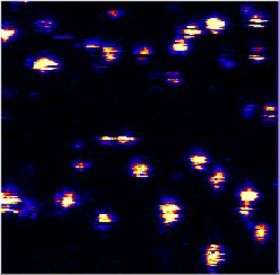
JILA scientists have found a way to suppress the blinking problem in quantum dots by bathing them in a chemical solution. This animated image, which demonstrates the basic blinking phenomenon, is made from a series of 40 images taken about one minute apart. Quantum dots actually blink on time scales ranging from millionths of a second to tens of seconds or longer. Credit: K Kuno/JILA

Quantum dots—tiny, intense, tunable sources of colorful light—are illuminating new opportunities in biomedical research, cryptography and other fields. But these semiconductor nanocrystals also have a secret problem, a kind of nervous tic. They mysteriously tend to “blink” on and off like Christmas tree lights, which can reduce their usefulness.

Scientists at JILA have found one possible way to solve the blinking problem and have induced quantum dots to emit photons (the smallest particles of light) faster and more consistently. The advance could make quantum dots more sensitive as fluorescent tags in biomedical tests and single-molecule studies and steadier sources of single photons for “unbreakable” quantum encryption. JILA is a joint venture of the National Institute of Standards and Technology and the University of Colorado at Boulder.

By bathing the dots in a watery solution of an antioxidant chemical used as a food additive, the JILA team increased photon emission rate four- to fivefold, a “shocking” result because the rate at which light radiates is generally considered an immutable property of the dot, JILA/NIST Fellow David Nesbitt says.

The JILA scientists dramatically reduced the average time delay between excitation of a quantum dot and resulting photon emission from 21 nanoseconds to 4 nanoseconds while reducing the probability of blinking up to 100 fold. Nesbitt calls blinking the “hidden dirty secret” of quantum dots. (Nesbitt notes that blinking is not always an annoyance. For example, it can serve as a measurement probe of very slow rates of electron flow through nanoscale materials).

The quantum dots used in the JILA experiments were made of cadmium-selenide cores just 4 nanometers wide coated with zinc sulfide. When a dot is excited by a brief laser pulse, one electron is separated from the “hole” it normally occupies.

A few nanoseconds later, the electron typically falls back into the hole, sometimes producing a single photon—always in a color that depends on dot size, greenish-yellow in this case. But every so often the electron fails to make it back to its hole and instead is ejected to imperfections on the dot’s surface. The chemical added at JILA apparently attaches to these imperfections, blocking the electron from being trapped and thereby preventing the dot from blinking off.

Citation: V. Fomenko and D. J. Nesbitt. Solution control of radiative and nonradiative lifetimes: a novel contribution to quantum dot blinking suppression. Nano Letters. Published online Dec. 21, 2007.

Source: National Institute of Standards and Technology


print this article email this article download pdf blog this article bookmark this article     Digg this Stumble it share on Facebook share on Reddit add to delicious save to Yahoo! bookmarks
4.3/5 after 29 votes

Rank Filter

Move the slider to adjust rank threshold, so that you can hide some of the comments.


Display comments: newest first

  • davidgro - Jan 23, 2008
    • Rank: 3 / 5 (2)
    "This animated image" isn't. It is a jpeg
  • Ashibayai - Jan 24, 2008
    • Rank: 3 / 5 (2)
    Yeah, that disappointed me too.

    I wonder though, this chemical they added, wouldn't it be specific to the chemical composition of the quantum dot they're using?
  • out7x - Jan 25, 2008
    • Rank: 1 / 5 (1)
    heisenberg uncertainty principle limits the photon emission rates.
  • earls - Jan 26, 2008
    • Rank: not rated yet
    ARE YOU CERTAIN?!

January 23rd, 2008 all stories
Nanotechnology / Nanophysics

Comments: 4
Rank: 4.3/5 after 29 votes

  • Stumble this up

  • Digg this

  • Share it:
  • share on Facebook
  • share on MySpace
  • share on Slashdot
  • rss-newsfeed
  • share on Google
  • share on Reddit
  • add to delicious
  • save to Yahoo! bookmarks
  • share on Windows Live
  • Add to Mixx!
Rating: 4.3/5 after 29 votes

  • Related Stories

  • Noisy Pictures Tell a Story of 'Entangled' Atoms
    created Mar 22, 2005 | popularity not rated yet | comments 0
  • Lasers can lengthen quantum bit memory by 1,000 times
    created Jun 24, 2009 | popularity not rated yet | comments 0
  • Working out a timescale for quantum operations
    created Jun 17, 2009 | popularity not rated yet | comments 0
  • Controllable double quantum dots and Klein tunneling in nanotubes
    created May 14, 2009 | popularity not rated yet | comments 0
  • Physicists Detect Single-Electron Tunneling with Quantum Dots
    created May 06, 2009 | popularity not rated yet | comments 0

Tags


  • Physicists Demonstrate Quantum Memory with Matter Qubits
    Physicists Demonstrate Quantum Memory with Matter Qubits
    Physics / General Physics
    created Jul 03, 2009 | popularity 4.4 / 5 (17) | comments 1
  • 'Holey' Nanosheets for Wastewater Dye Removal
    Nanotechnology / Nanomaterials
    created Jul 01, 2009 | popularity 5 / 5 (5) | comments 1
  • Jellyfish Robot Swims Like its Biological Counterpart
    Jellyfish Robot Swims Like its Biological Counterpart
    Electronics / Robotics
    created Jun 26, 2009 | popularity 4.4 / 5 (8) | comments 1
  • Could Maxwell's Demon Exist in Nanoscale Systems?
    Could Maxwell's Demon Exist in Nanoscale Systems?
    Physics / General Physics
    created Jun 24, 2009 | popularity 4.4 / 5 (18) | comments 29
  • Living Safely with Robots, Beyond Asimov's Laws
    Living Safely with Robots, Beyond Asimov's Laws
    Electronics / Robotics
    created Jun 22, 2009 | popularity 4.6 / 5 (52) | comments 40
  • Other News

    A 'quantum of sol' -- how nanotechnology could hold the key to a solar-powered future

    A 'quantum of sol' -- how nanotechnology could hold the key to a solar-powered future

    Nanotechnology / Nanomaterials

    created Jun 30, 2009 | popularity 3.9 / 5 (15) | comments 17

    (PhysOrg.com) -- A new generation of 'nano-structured' millimetre-sized solar cells that could convert the sun's energy to electricity more than twice as efficiently as current technology, is the subject of ...


    Australian researchers are set to begin human trials of a tiny nano-cell that acts as a "Trojan horse" against cancer

    Hi-tech 'Trojan horse' can kill cancer cells: researchers

    Nanotechnology / Bio & Medicine

    created Jun 29, 2009 | popularity 4.7 / 5 (12) | comments 7

    Australian researchers are set to begin human trials of a tiny nano-cell that acts as a "Trojan horse" against cancer cells, a breakthrough they say may curb the need for debilitating chemotherapy.


    'Holey' Nanosheets for Wastewater Dye Removal

    Nanotechnology / Nanomaterials

    created Jul 01, 2009 | popularity 5 / 5 (5) | comments 1

    (PhysOrg.com) -- Researchers have discovered that extremely thin sheets of nickel oxide with hexagonally shaped holes can absorb hazardous dyes from wastewater nearly as well as the best traditional methods, but are recyclable. ...


    Harnessing Nanoparticles To Track Cancer Cell Changes

    Nanotechnology / Bio & Medicine

    created Jul 03, 2009 | popularity not rated yet | comments 1

    The more dots there are, the more accurate a picture you get when you connect them. Cancer researchers adopting that philosophy have developed a new imaging technology that could give scientists the ability to simultaneously ...


    Computer-Guided Nanoparticle Therapy Destroys Tumors

    Nanotechnology / Bio & Medicine

    created Jun 29, 2009 | popularity 4.9 / 5 (12) | comments 0

    Gold nanoshells are among the most promising new nanoscale therapeutics being developed to kill tumors, acting as antennas that turn light energy into heat that cooks cancer to death. Now, a multi-institutional research team ...