'Telepathic' genes recognize similarities in each other
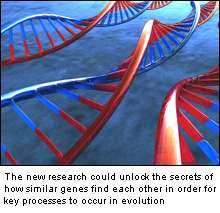
Genes have the ability to recognise similarities in each other from a distance, without any proteins or other biological molecules aiding the process, according to new research published this week in the Journal of Physical Chemistry B. This discovery could explain how similar genes find each other and group together in order to perform key processes involved in the evolution of species.
This new study shows that genes – which are parts of double-stranded DNA with a double-helix structure containing a pattern of chemical bases - can recognise other genes with a similar pattern of chemical bases.
This ability to seek each other out could be the key to how genes identify one another and align with each other in order to begin the process of ‘homologous recombination’ – whereby two double-helix DNA molecules come together, break open, swap a section of genetic information, and then close themselves up again.
Recombination is an important process which plays a key role in evolution and natural selection, and is also central to the body’s ability to repair damaged DNA. Before now, scientists have not known exactly how suitable pairs of genes find each other in order for this process to begin.
The authors of the new study carried out a series of experiments in order to test the theory, first developed in 2001 by two members of this team, that long pieces of identical double-stranded DNA could identify each other merely as a result of complementary patterns of electrical charges which they both carry. They wanted to verify that this could indeed occur without physical contact between the two molecules, or the facilitating presence of proteins.
Previous studies have suggested that proteins are involved in the recognition process when it occurs between short strands of DNA which only have about 10 pairs of chemical bases. This new research shows that much longer strands of DNA with hundreds of pairs of chemical bases seem able to recognise each other as a whole without protein involvement. According to the theory, this recognition mechanism is stronger the longer the genes are.
The researchers observed the behaviour of fluorescently tagged DNA molecules in a pure solution. They found that DNA molecules with identical patterns of chemical bases were approximately twice as likely to gather together than DNA molecules with different sequences.
Professor Alexei Kornyshev from Imperial College London, one of the study’s authors, explains the significance of the team’s results: “Seeing these identical DNA molecules seeking each other out in a crowd, without any external help, is very exciting indeed. This could provide a driving force for similar genes to begin the complex process of recombination without the help of proteins or other biological factors. Our team’s experimental results seem to support these expectations.”
Understanding the precise mechanism of the primary recognition stage of genetic recombination may shed light on how to avoid or minimise recombination errors in evolution, natural selection and DNA repair. This is important because such errors are believed to cause a number of genetically determined diseases including cancers and some forms of Alzheimer’s, as well as contributing to ageing. Understanding this mechanism is also essential for refining precise artificial recombination techniques for biotechnologies and gene therapies of the future.
The team is now working on a set of further experiments to determine exactly how these interactions work, including the predicted length dependence. In addition, further studies are needed to ascertain whether this interaction, discovered in a test tube, occurs in the highly complex environment of a living cell.
Source: Imperial College London


