Protein that controls hair growth also keeps stem cells slumbering
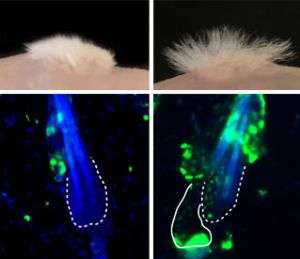
Like fine china and crystal, which tend to be used sparingly, stem cells divide infrequently. It was thought they did so to protect themselves from unnecessary wear and tear. But now new research from Rockefeller University has unveiled the protein that puts the brakes on stem cell division and shows that stem cells may not need such guarded protection to maintain their potency.
This research, to be published in the January 25 issue of Cell, raises questions about what stem cells need in order to maintain their ability to regenerate tissue. It may also be key in developing new treatments for thinning hair.
The impetus for the work began five years ago when Elaine Fuchs, head of the Laboratory of Mammalian Cell Biology and Development, and several researchers in her lab discovered that the protein NFATc1 was one of only a few that are highly expressed within the stem cell compartment of the hair follicle. Clinical research, meanwhile, showed that a particular immunosuppressant that inhibits NFATc1, a drug called cyclosporine A, has a rather unsightly side effect: excessive hair growth.
Fuchs and Valerie Horsley, a postdoc in her lab, realized that there was a connection between the drug's side effect and the abundance of NFATc1 within the hair follicle's stem cell compartment -- the bulge. The mice they treated with the drug grew fur at a much faster rate than mice they did not treat. The researchers then showed that this excessive hair growth was due to increased stem cell activity within the bulge, a process that cranked up the production of hair. Specifically, the hair cycle shifted gears from its resting phase, when stem cells slumber, to its growth phase, when stem cells proliferate.
To maintain their multipotent properties, though, it appears that these stem cells hardly needed much "rest" at all. These findings came as a surprise to the researchers, who, like their colleagues, had believed that stem cells proliferating infrequently protected them from depletion or mutations that would lead to hair loss. "It seems like the resting phase isn't as necessary as was once thought," says Horsley. "Even though these stem cells are highly proliferative, they still maintain their stem cell character."
Using genetically engineered mice bred by colleagues at Harvard Medical School, Horsley and Fuchs then further explored what happens when skin stem cells lack NFATc1. They found that these mice looked exactly like the hairy mice that were treated with cyclosporine A: The loss of NFATc1 didn't stop the hair cycle, but rather shortened the resting phase and prompted precocious entry to the growth state.
In probing the underlying mechanisms mediating this process, Horsley and Fuchs discovered that NFATc1, a transcription factor, blocks the expression of a gene that provides the cell cycle with "go ahead" signals at certain checkpoints. By blocking these signals, NFATc1 prevents the stem cells from dividing, preventing unnecessary wear and tear. These same cells, if treated with cyclosporine A, show a rapid loss of the transcription factor, an effect that turns the light green at these checkpoints.
For those with thinning hair, this research may hold promise. As people age, the resting phase of the hair cycle gets longer and longer such that the stem cells proliferate less frequently and hair does not grow at the rate it once did. "If we could use a local and more specific inhibitor of NFATc1 than cyclosporine A to stimulate these stem cells, which are just sitting there during an extended resting phase, we might be able to promote new hair growth," says Fuchs, who is Rebecca C. Lancefield Professor at Rockefeller and an investigator at the Howard Hughes Medical Institute. "In a sense, by blocking NFATc1 activity in our older mice, their hair follicles were brought back to what appeared to be a more youthful state."
So far, these proliferating stem cells lacking NFATc1 have not led to increased tumor formation, which is often a dangerous byproduct of triggering stem cells into action. "This is the first case where we have been able to activate the hair cycle without accompanying signs of tumorigenesis," says Fuchs. "If we can control the activation process of follicle stem cells without promoting tumorigenesis, then this would be a big move in the right direction."
Source: Rockefeller University


