Airport safety: magnetic fingerprinting in the fog?
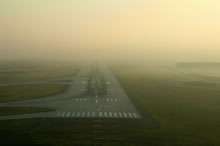
By monitoring tiny fluctuations in the Earth’s magnetic field caused by a passing plane, a team of European researchers has developed an innovative system to increase airport safety even in the worst weather conditions.
Using magnetic field detectors, a team of researchers, led by Uwe Hartmann and Haibin Gao of Saarland University in Germany, has developed a unique system to pinpoint the location of aircraft at airports even in places where other traffic monitoring systems face difficulties.
Their novel approach, tested at airports in Frankfurt and Saarbruecken in Germany and in Thessaloniki in Greece, relies on an array of small, cheap sensors monitoring the “magnetic fingerprint” of planes – the slight influence aircrafts’ metallic bodies have on the Earth’s magnetic field.
“Our tests have shown that the system detects all passing aircraft, 100 percent of them, and in 75 percent of cases can pinpoint their location to within 7.5 metres – a level of accuracy comparable to most existing air traffic management systems,” Gao says.
Seeing around buildings and through fog
Most importantly, the system, developed under the EU-funded Ismael project, has some unique advantages over the most common ground-based monitoring systems in use today.
Because it relies on detecting changes in the Earth’s magnetic field, the Ismael system can see through obstacles, such as buildings and the fingers of airliner parking bays – structures that create potentially dangerous areas of shadow for radar systems, particularly at large, sprawling airports.
And, unlike cameras or human air traffic controllers, it can monitor planes even in the heaviest downpour or the thickest fog.
“Thessaloniki airport has a major problem with fog, so bad in fact that it has to close for part of the year because air traffic controllers can’t see the aircraft at the end of the runway two kilometres away. In the tests, the Ismael system showed it can solve that problem,” Gao explains.
The project manager says that, in all the trials, the system lived up to the researchers’ expectations, and it has continued to prove its worth in Frankfurt where it is still operating on an experimental basis. The system has also elicited interest from other airport authorities around the world, although it is likely to be several years before it is used commercially.
“You have to use the best components, the best materials and get new equipment certified for use in an airport environment. That all makes sense from a safety point of view, but it also means that it takes seven years, on average, for a newly developed system to be installed,” Gao says.
Seeking partners and investors
The project partners – a mixture of academia and technology firms – have, therefore, approached big equipment manufacturers already supplying the airport market for assistance.
“We are looking for a partnership and investment to take this forward and, so far, there has been a fair amount of interest,” the project manager says.
Even though the certification process is likely to push up costs, Gao assures that the Ismael system will remain a cost-effective way to complement and improve existing traffic management systems at big airports, and to install a comprehensive monitoring system at small airports that may otherwise not be able to afford it.
The sensor units, which are currently about the same size as a PC graphics card, but could be as small as a coin in the future, are expected to cost several hundred euros each. Although an airport could monitor the whole length of its runways with them, possibly by installing them conveniently beneath the runway lights, only a few located at the entry and exit gates to the runways, and in other key areas, would be sufficient to boost safety.
From runways to car parks
In fact, the technology need not be confined to runways and docking bays alone.
“During the course of the project, we saw the potential to use this system in crowded airport parking lots to monitor car traffic and let drivers know where unoccupied spaces are available,” Gao says.
And because systems used in parking lots do not have to meet the same high safety and reliability standards demanded of airport systems, the Ismael technology could start being used in that context much sooner.
Source: ICT Results


