Orbiting Camera Details Dramatic Wind Action on Mars
January 24, 2008
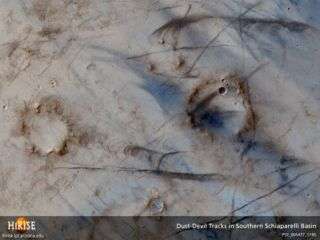
Dust-devils are vortices of wind that form when air rising from a warm surface encounters shear in the above atmosphere. Martian dust devils can attain gargantuan proportions, reaching the size of terrestrial tornadoes with plumes that tower up to 9 kilometers above the surface. Dust-devils play an important role in sustaining the aerosols that make up Mars’ red sky and in cleaning the Martian surface after a dust storm. This observation shows a region near the Martian equator that is a perfect tablet for the scribblings of dust-devils. This region is made up of dark bedrock that is thinly blanketed by bright dust. Dark tracks form when dust-devils scour the surface, exposing the darker substrate. The tracks tend to cluster together, as dust-devils repeatedly form over terrain that has been previously scoured and is consequently darker and warmer than the surrounding surface. Once lofted by a dust-devil, the fine dust can be transported great distances before it settles again onto the surface. Image Credit: NASA/JPL/University of Arizona
Mars has an ethereal, tenuous atmosphere with less than one-percent the surface pressure of Earth, which challenges scientists to explain complex, wind-sculpted landforms seen with unprecedented detail in images from NASA's Mars Reconnaissance Orbiter.
One of the main questions has been if winds on present-day Mars are strong enough to form and change geological features, or if wind-constructed formations were made in the past, perhaps when winds speeds and atmospheric pressures were higher.
The eye-opening new views of wind-driven Mars geology come from the University of Arizona's High Resolution Imaging Science Experiment camera (HiRISE). As the orbiter flies at about 3,400 meters per second (7,500 mph) between 250 and 315 kilometers (155 to 196 miles) above the Martian surface, this camera can see features as small as half a meter (20 inches).
"We're seeing what look like smaller sand bedforms on the tops of larger dunes, and, when we zoom in more, a third set of bedforms topping those," said HiRISE co-investigator Nathan Bridges of NASA's Jet Propulsion Laboratory in Pasadena, Calif. "On Earth, small bedforms can form and change on time scales as short as a day."
There are two kinds of "bedforms," or wind-deposited landforms. They can be sand dunes, which are typically larger and have distinct shapes. Or they can be ripples, in which sand is mixed with coarser particles. Ripples are typically smaller and more linear.
HiRISE also shows detail in sediments deposited by winds on the downwind side of rocks. Such "windtails" show which way the most current winds have blown, Bridges said. They have been seen before, but only by rovers and landers, never by an orbiter. Researchers can now use HiRISE images to infer wind directions over the entire planet.
Scientists discovered miles-long, wind-scoured ridges called "yardangs" with the first Mars orbiter, Mariner 9, in the early 1970s. New HiRISE images reveal surface texture and fine-scale features that are giving scientists insight into how yardangs form.
"HiRISE is showing us just how interesting layers in yardangs are," Bridges said. "For example, we see one layer that appears to have rocks in it. You can actually see rocks in the layer, and if you look downslope, you can see rocks that we think have eroded out from that rocky layer above."
New images show that some layers in the yardangs are made of softer materials that have been modified by wind, he added. The soft material could be volcanic ash deposits, or the dried-up remnants of what once were mixtures of ice and dust, or something else. "The fact that we see layers that appear to be rocky and layers that are obviously soft says that the process that formed yardangs is no simple process but a complicated sequence of processes," Bridges said.
"HiRISE keeps showing interesting things about terrains that I expected to be uninteresting," said Alfred McEwen of the University of Arizona Lunar and Planetary Laboratory, HiRISE principal investigator. "I was surprised by the diversity of morphology of the thick dust mantles. Instead of a uniform blanket of smooth dust, there are often intricate patterns due to the action of the wind and perhaps light cementation from atmospheric volatiles."
Paul Geissler of the U.S. Geological Survey, Flagstaff, Ariz., has discovered from HiRISE images that dark streaks coming from Victoria Crater probably consist of streaks of dark sand blown out from the crater onto the surface. Scientists had wondered if wind might have blown away lighter-colored surface material, exposing a darker underlying surface. Geissler is comparing HiRISE images to images taken by NASA's Mars Exploration Rover Opportunity rover at Victoria Crater.
Bridges is lead author and McEwen is a co-author on the paper titled "Windy Mars: A dynamic planet as seen by the HiRISE camera" in Geophysical Research Letters in December.
Source: NASA
-
New views show old NASA Mars landers
Feb 09, 2012 |
4.4 / 5 (8) |
9
-
Photo from NASA Mars orbiter shows wind's handiwork
Jan 26, 2012 |
5 / 5 (6) |
3
-
Scientists still searching for the Beagle 2 crash site on Mars
Jan 16, 2012 |
5 / 5 (3) |
1
-
Meteorite shockwaves trigger dust avalanches on Mars
Dec 16, 2011 |
5 / 5 (5) |
14
-
With 'Google Earth' for Mars, explore the red planet from home
Dec 08, 2011 |
5 / 5 (5) |
30
-
Engineers build first sub-10-nm carbon nanotube transistor
Feb 01, 2012 |
4.9 / 5 (30) |
30
-
Something old, something new: Evolution and the structural divergence of duplicate genes
Jan 31, 2012 |
4.6 / 5 (7) |
1
-
The hidden nanoworld of ice crystals: Revealing the dynamic behavior of quasi-liquid layers
Jan 30, 2012 |
5 / 5 (3) |
1
-
Stock market network reveals investor clustering
Jan 27, 2012 |
3.9 / 5 (23) |
8
-
Of microchemistry and molecules: Electronic microfluidic device synthesizes biocompatible probes
Jan 26, 2012 |
5 / 5 (1) |
0
-
Titan's lack of impact craters
Feb 09, 2012
-
Real pictures of black hole eating a star?
Feb 08, 2012
-
Hypothetical way to travel faster than light, but not technically exceed lightspeed
Feb 06, 2012
-
How do scientists monitor the Sun's activity?
Feb 05, 2012
-
Search patterns in observational studies
Feb 05, 2012
-
Derivation of Pogson's law
Feb 03, 2012
- More from Physics Forums - General Astronomy
More news stories
Could Venus be shifting gear?
(PhysOrg.com) -- ESAs Venus Express spacecraft has discovered that our cloud-covered neighbour spins a little slower than previously measured. Peering through the dense atmosphere in the infrared, the ...
Space & Earth / Space Exploration
4 hours ago |
5 / 5 (4) |
6
|
Humans may have helped the decline of African rainforests 3000 years ago
(PhysOrg.com) -- Large areas of rainforests in Central Africa mysteriously disappeared over three thousand years ago, to be replaced by savannas. The prevailing theory has been that the cause was a change ...
Mars Science Laboratory computer issue resolved
(PhysOrg.com) -- Engineers have found the root cause of a computer reset that occurred two months ago on NASA's Mars Science Laboratory and have determined how to correct it.
Space & Earth / Space Exploration
5 hours ago |
5 / 5 (5) |
3
|
Clam fields found at deep, low-temperature Mariana vents
(PhysOrg.com) -- Scientists have marveled at the unusual life forms thriving at high temperature hydrothermal vents of the deep ocean.
Space & Earth / Earth Sciences
4 hours ago |
not rated yet |
0
|
Two new moons for Jupiter
Advances in technology have lead to the discovery of new planets outside of our Solar System, and now even new moons in our own backyard.
Space & Earth / Space Exploration
4 hours ago |
not rated yet |
2
Hovering not hard if you're top-heavy, researchers find
Top-heavy structures are more likely to maintain their balance while hovering in the air than are those that bear a lower center of gravity, researchers at New York University's Courant Institute of Mathematical Sciences ...
Grass to gas: Researchers' genome map speeds biofuel development
Researchers at the University of Georgia have taken a major step in the ongoing effort to find sources of cleaner, renewable energy by mapping the genomes of two originator cells of Miscanthus x giganteus, a large perenn ...
Drug halts organ damage in inflammatory genetic disorder
A new study shows that Kineret (anakinra), a medication approved for the treatment of rheumatoid arthritis, is effective in stopping the progression of organ damage in people with neonatal-onset multisystem inflammatory disease ...
Cochlear implants may be safe, effective for organ transplant patients
Cochlear implants may be a safe, effective option for some organ transplant patients who've lost their hearing as an unfortunate consequence of their transplant-related drug regime, researchers report.
Researchers develop new method for creating tissue engineering scaffolds
Researchers at Northwestern University have developed a new method for creating scaffolds for tissue engineering applications, providing an alternative that is more flexible and less time-intensive than current technology.
Molecular profiling reveals differences between primary and recurrent ovarian cancers
There is a need to analyze tumor specimens at the time of ovarian cancer recurrence, according to a new study published in Molecular Cancer Therapeutics. Researchers used a diagnostic technology called molecular profiling to examine ...