Plant fungus indirectly affects parasitoid wasp
January 24, 2008
A story about a wasp, a caterpillar and a fungus ends with more dominating female wasps

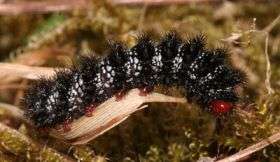
The checkerspot caterpillar is the larva of the Glanville fritillary butterfly, Melitaea cinxia. Credit: Saskya van Nouhuys

Understanding survival of a species can be a lot more complicated than meets the eye because ecosystems are so interrelated.

Take, for example, a parasitic wasp that grows up inside a checkerspot butterfly caterpillar, eventually killing the caterpillar. In a recent study, a Cornell researcher discovered that host caterpillars that eat fungus-infected plants harbor more female than male wasp larvae by 2-to-1.

That's good for the survival of the wasp because only the females are able to colonize more new host caterpillars. This is essential in their fragmented habitat. Indeed, the researcher found that over six years, a butterfly population was more than twice as likely to be colonized by the wasp if the local plants were infected with fungus than if the plants were healthy.

That's bad for the survival of the butterfly, which is already an endangered species, because its populations become more vulnerable to parasites.

"The fungus affects the wasp through two intermediary species, a plant and a caterpillar," said Saskya van Nouhuys, a Cornell visiting assistant professor for the last decade in the Department of Ecology and Evolutionary Biology and a researcher at the University of Helsinki's Department of Biological and Environmental Sciences. "It's exciting because the plant's pathogen affects the population dynamics of the wasps through its effect on the sex ratio of the baby wasps rather than the number of baby wasps."

The study, recently published in the Proceedings of the Royal Society B, focused on the fungus (Podosphaera plantaginis), the plant (Plantago lanceolata), the checkerspot caterpillar (Melitaea cinxia) and the parasitoid wasp (Cotesia melitaearum) that share habitat in Åland, Finland.

The story is complicated partly because the female parasite wasp can determine the sex of the eggs she deposits in the caterpillar. And, in general, said van Nouhuys, the wasp chooses to lay female eggs in the healthiest caterpillars. But in this case, van Nouhuys suspects that the skewed sex ratios of the wasp larvae may not be due to the mother choosing to lay more female eggs, but because males and females compete for food inside the host caterpillar. And then the males lose, perhaps because they are smaller.

The fungus is not lethal to the plant but changes the chemistry of infected leaves. Although caterpillars that eat these leaves end up the same size as their non-fungus-eating counterparts, their development rate is slower.

Source: Cornell University


Rank 4 /5 (5 votes)
Tags

Relevant PhysicsForums posts

More news stories

A mitosis mystery solved: How chromosomes align perfectly in a dividing cell

Although the process of mitotic cell division has been studied intensely for more than 50 years, Whitehead Institute researchers have only now solved the mystery of how cells correctly align their chromosomes during symmetric ...

Biology / Cell & Microbiology

created 2 hours ago | popularity 5 / 5 (3) | comments 0 | with audio podcast

The proteins ensuring genome protection

Researchers from the University of Geneva (UNIGE), Switzerland, have discovered the crucial role of two proteins in developing a cell 'anti-enzyme shield'. This protection system, which operates at the level of molecular ...

Biology / Cell & Microbiology

created 2 hours ago | popularity 5 / 5 (2) | comments 0 | with audio podcast

Researchers find extensive RNA editing in human transcriptome

In a new study published online in Nature Biotechnology, researchers from BGI, the world's largest genomics organization, reported the evidence of extensive RNA editing in a human cell line by analysis of RNA-seq data, demons ...

Biology / Biotechnology

created 2 hours ago | popularity 5 / 5 (3) | comments 0 | with audio podcast

Entire genome of extinct human decoded from fossil

(PhysOrg.com) -- In 2010, Svante Pääbo and his colleagues presented a draft version of the genome from a small fragment of a human finger bone discovered in Denisova Cave in southern Siberia. The ...

Biology / Biotechnology

created Feb 07, 2012 | popularity 4.7 / 5 (58) | comments 48 | with audio podcast

Why are there so few fish in the Earth's oceans?

(PhysOrg.com) -- A Stony Brook University researcher has found that, contrary to popular belief, there are not plenty of fish in the sea.

Biology / Plants & Animals

created Feb 08, 2012 | popularity 4.3 / 5 (17) | comments 27 | with audio podcast


Scientists discover molecular secrets of 2,000-year-old Chinese herbal remedy

For roughly two thousand years, Chinese herbalists have treated Malaria using a root extract, commonly known as Chang Shan, from a type of hydrangea that grows in Tibet and Nepal. More recent studies suggest that halofuginone, ...

New method to examine batteries -- MRI from the inside

There is an ever-increasing need for advanced batteries for portable electronics, such as phones, cameras, and music players, but also to power electric vehicles and to facilitate the distribution and storage of energy derived ...

Google might launch Drive for cloud storage soon

(PhysOrg.com) -- Google's next big move, according to the Wall Street Journal, is a cloud storage service called Drive. Hardly first to the plate, Google is simply catching up to introducing its cloud reposi ...

Lab study raises questions over nano-particle impact

Tests involving chickens have raised questions about the impact on health from engineered nano-particles, the ultra-fine grains commonly used in drugs and processed foods, scientists said on Sunday.

Starve a virus, feed a cure? Findings show how some cells protect themselves against HIV

A protein that protects some of our immune cells from the most common and virulent form of HIV works by starving the virus of the molecular building blocks that it needs to replicate, according to research published online ...

Injured boomers beware: Know when to see doctor

(AP) -- It happened to nurse Jane Byron years after an in-line skating fall, business owner Haralee Weintraub while doing "men's" push-ups, and avid cyclist Gene Wilberg while lifting a heavy box.