Haptics: just reach out and touch, virtually
January 25, 2008
European researchers have pioneered a breakthrough interface that allows people to touch, stretch and pull virtual fabrics that feel like the real thing. The new multi-modal software linked to tactile hardware and haptics devices have enormous potential for shopping, design and human-machine interaction.
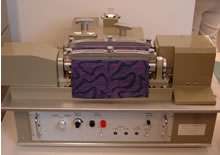
A revolutionary new interface allows users to really feel virtual textiles. The system combines a specially designed glove, a sophisticated computer model and visual representation to reproduce the sensation of cloth with an impressive degree of realism.
“It is a multi-modal approach that has never been tried before,” says Professor Nadia Magnenat-Thalmann, coordinator of the HAPTEX project. HAPTEX stands for Haptic sensing of virtual textiles.
The new system is a major breakthrough achieved through highly focused work of a small consortium of five research institutes. In just three years, they have created a pre-commercialisation prototype of the device and its related multi-modal software.
But it was not easy. Creating the realistic sensation of deformable textiles required a huge amount of modelling. “That was our first big challenge,” says Magnenat-Thalmann, taking precise measurements of the tensile, bending and stretching properties of the material.
“You also need very high resolution; the visual system will give a realistic impression of movement with just 20 frames a second, but touch is much more sensitive. You need a thousand samples a second to recreate touch,” she tells ICT Results.
Major challenges
In the end, the team created two models. One global model tracks the overall properties of the material. A second, fine-resolution model then maps the actual sensation on skin. All this information had to be combined with a detailed visual representation of the textile.
“That was another major problem,” notes Magnenat-Thalmann, “because the two must be in sync or the sensation will not be realistic.” Like a video with the audio out of sync, any latency between the visual and the sensual destroys the effect.
These were three major challenges from the outset, but they were just the beginning. “We had major jobs to do with the hardware, too. Nobody has combined a force-feedback device with a tactile one,” reports Magnenat-Thalmann.
HAPTEX overcame this problem by developing a powered exoskeleton glove with a pair of pin arrays that provide tactile sensation to two fingers. The glove gives the sensation of bending and stretching the fabric, while the pin arrays convey texture. Then this integrated device is combined with the visual and tactile database to give an overall impression.
Feeling is believing
“We have a working prototype device and we have validated it. It gives a reliable and reproducible sensation of real fabrics in a virtual world,” says Magnenat-Thalmann.
Reviewers were very impressed with the project’s results, but Magnenat-Thalmann says the project did not achieve all that they hoped for. “Originally, our vision was to create a system that allowed users to distinguish between, say, cotton, wool and silk in a blind test. The system is not that sensitive yet.”
It is, however, in pre-commercialisation form. The team now hopes to secure funding for a second project that will take the device from prototype stage to full commercialisation. If they succeed, it will be a first of its kind.
It will also mean entirely new markets. The textile industry and online shopping are obvious examples, but Magnenat-Thalmann also sees applications in gaming, where it could be used to make virtual worlds more realistic.
Source: ICT Results
-
Engineers build first sub-10-nm carbon nanotube transistor
Feb 01, 2012 |
4.9 / 5 (33) |
30
-
Something old, something new: Evolution and the structural divergence of duplicate genes
Jan 31, 2012 |
4.6 / 5 (7) |
1
-
The hidden nanoworld of ice crystals: Revealing the dynamic behavior of quasi-liquid layers
Jan 30, 2012 |
5 / 5 (4) |
1
-
Stock market network reveals investor clustering
Jan 27, 2012 |
3.9 / 5 (23) |
8
-
Of microchemistry and molecules: Electronic microfluidic device synthesizes biocompatible probes
Jan 26, 2012 |
5 / 5 (2) |
0
-
How to calculate total compressibility in liquid porous solid system
5 hours ago
-
Need help reading 3-D
Feb 11, 2012
-
A way to send and receive wireless data
Feb 11, 2012
-
Calling function with no input argument
Feb 10, 2012
-
Force free body diagram problem on gym equipment
Feb 10, 2012
-
Empirical data regarding shower heads and water
Feb 10, 2012
- More from Physics Forums - General Engineering
More news stories
Google might launch Drive for cloud storage soon
(PhysOrg.com) -- Google's next big move, according to the Wall Street Journal, is a cloud storage service called Drive. Hardly first to the plate, Google is simply catching up to introducing its cloud reposi ...
Iran blocks email, restricts net access: reports
Iran has further restricted access to the Internet and blocked popular email services for the past few days, in a move a top lawmaker said could "cost the regime dearly," media reports said on Sunday.
7 hours ago |
5 / 5 (2) |
3
Love a click away in Indonesia's Twitter Republic
He was a geeky kid from Yogyakarta, she a glamorous city girl in Jakarta. In a country with one of the world's most vibrant social networking scenes they fell in love on Twitter.
15 hours ago |
4 / 5 (1) |
0
Walney offshore wind farm is world's biggest (for now)
(PhysOrg.com) -- The Walney wind farm on the Irish Sea--characterized by high tides, waves and windy weather--officially opened this week. The farm is treated in the press as a very big deal as the Walney ...
Navy to begin tests on electromagnetic railgun prototype launcher
The Office of Naval Research (ONR)'s Electromagnetic (EM) Railgun program will take an important step forward in the coming weeks when the first industry railgun prototype launcher is tested at a facility ...
Feb 06, 2012 |
4.5 / 5 (19) |
94
|
Scientists discover molecular secrets of 2,000-year-old Chinese herbal remedy
For roughly two thousand years, Chinese herbalists have treated Malaria using a root extract, commonly known as Chang Shan, from a type of hydrangea that grows in Tibet and Nepal. More recent studies suggest that halofuginone, ...
New method to examine batteries -- MRI from the inside
There is an ever-increasing need for advanced batteries for portable electronics, such as phones, cameras, and music players, but also to power electric vehicles and to facilitate the distribution and storage of energy derived ...
A mitosis mystery solved: How chromosomes align perfectly in a dividing cell
Although the process of mitotic cell division has been studied intensely for more than 50 years, Whitehead Institute researchers have only now solved the mystery of how cells correctly align their chromosomes during symmetric ...
Overeating may double risk of memory loss
New research suggests that consuming between 2,100 and 6,000 calories per day may double the risk of memory loss, or mild cognitive impairment (MCI), among people age 70 and older. The study was released today and will be ...
Lab study raises questions over nano-particle impact
Tests involving chickens have raised questions about the impact on health from engineered nano-particles, the ultra-fine grains commonly used in drugs and processed foods, scientists said on Sunday.
Starve a virus, feed a cure? Findings show how some cells protect themselves against HIV
A protein that protects some of our immune cells from the most common and virulent form of HIV works by starving the virus of the molecular building blocks that it needs to replicate, according to research published online ...
Jan 25, 2008
Rank: not rated yet