What happened to the antimatter?
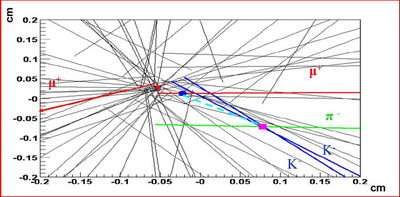
Scientists of the DZero collider detector collaboration at the Department of Energy's Fermi National Accelerator Laboratory have announced that their data on the properties of a subatomic particle, the B_s meson ("B sub s"), suggest that the particle oscillates between matter and antimatter in one of nature's fastest rapid-fire processes-more than 17 trillion times per second. Their findings may affect the current view of matter-antimatter asymmetry, and might also offer a first glimpse of the contributions of new physics, such as supersymmetry, to particle physics.
The DZero result, suggesting a preferred oscillation frequency between 17 and 21 times per picosecond (trillionth of a second), is described in a paper submitted to the journal, Physical Review Letters. The result, a measure of the oscillation or "mixing" frequency of the particle, has a confidence level of 90 percent, and so does not qualify as a discovery. Physicists have agreed that claims of a discovery must have a confidence level of 99.99995 percent, indicating a 99.99995 percent chance that the result can be reproduced. The data for the DZero result were culled from one inverse femtobarn of total collision data, or more than one billion events from Fermilab's Tevatron particle accelerator -- a milestone capitalizing on the significant luminosity improvements in the Tevatron. The DZero result also sets the stage for future results. Within the next month or so, the CDF collider detector collaboration at Fermilab expects to have a result with greater precision than the DZero result.
"Not only is this an exciting result, but the analysis of a one-inverse-femtobarn data set represents a major milestone for DZero." said DZero cospokesperson Jerry Blazey of Northern Illinois University. "Next, the Tevatron experiments can focus on obtaining a precise measurement of B_s mixing, which will tell us even more about the curious subatomic world where particles can spontaneously turn into their own antiparticles and back again."
One of the greatest mysteries of the universe is its apparent composition of only matter, and not antimatter. If matter and antimatter were created equally at the time of the Big Bang, matter and antimatter should have annihilated into pure energy. Clearly, this did not happen. How did our universe of matter survive? Laboratory experiments make it possible to observe some forms of matter oscillating into anti-matter and back. Studying such processes can help solve the mystery of the preponderance of matter in the universe, and DZero has made important progress in this direction.
"We congratulate DZero on this step," said CDF cospokesperson Rob Roser of Fermilab. "We at CDF are looking forward to our result on a similar size data sample where, given our sensitivity, we expect to get even closer to a discovery."
Much can be learned about nature by studying matter-antimatter oscillations. In a landmark experiment in the mid 1980's, a different type of meson (neutral B_d mesons, a b-antiquark and d-quark pair) was observed to oscillate at a much higher rate than theoretical predictions of the day. It was soon realized that this was evidence of the existence of the top quark at a much higher mass than had been expected - as was subsequently confirmed by its discovery at the Tevatron in 1995 by the DZero and CDF collaborations. The DZero limit on B_s oscillation is nearly forty times faster than the oscillation of the B_d meson. Theorists believe the B_s may show sensitivities to massive supersymmetric particles, much as the B_d showed sensitivities to the massive top quark, although this result appears to be inconclusive.
"Many theoretical models of supersymmetry predict a much faster oscillation of B_s mesons than has been reported by DZero, and are therefore disfavored by the new data," said Fermilab theorist Joseph Lykken, who is not a member of the experiment. "Other approaches to supersymmetry suggest smaller effects; these may be observed with more data, combined with improved searches by DZero and CDF for rare decays of B_s mesons."
The probe of B_s mixing is one of many ongoing quests for Fermilab scientists during Collider Run II of the Tevatron. Others include the Higgs boson, postulated as the source of mass in the universe; single top quark production, isolating the most massive of quarks, which so far has only been seen to exist in pairs; and New Phenomena, such as new dimensions or supersymmetry.
A meson, such as the B_s, is an unusual particle made up of both matter and antimatter-one quark and one antiquark. The neutral B_s meson is composed of a bottom (or "B") antiquark and a strange ("s") quark. The annihilation of matter and antimatter is not a universal event; annihilation occurs when a particle meets its corresponding antiparticle, and both disappear.
While it has been known that the neutral B_s meson (b-antiquark and s-quark) oscillates between matter and antimatter, it has proven difficult to pin down the details. The current theory of matter suggests that B_s mesons oscillate much faster than B_d mesons (anti-bottom quark plus a down quark); consequently, their oscillations are very difficult to detect. Almost all B_s mesons turn into anti-mesons in a fraction of a trillionth of a second. Measuring the frequency of oscillation is of utmost importance, since a deviation from predictions could point to some unexpected new force or interaction lurking around the corner. The DZero experiment has now made an important contribution to this quest and to understanding matter oscillation, by setting the first direct confidence interval on the frequency of the B_s meson oscillations to anti-matter.
Source: Fermi National Accelerator Laboratory


