Towards a new test of general relativity?
March 23, 2006
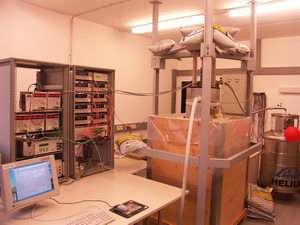
Overall picture of the experimental apparatus where the Gravitomagnetic London Moment in rotating superconductors has been detected. Credits: ESA
Scientists funded by the European Space Agency have measured the gravitational equivalent of a magnetic field for the first time in a laboratory. Under certain special conditions the effect is much larger than expected from general relativity and could help physicists to make a significant step towards the long-sought-after quantum theory of gravity.
Just as a moving electrical charge creates a magnetic field, so a moving mass generates a gravitomagnetic field. According to Einstein's Theory of General Relativity, the effect is virtually negligible. However, Martin Tajmar, ARC Seibersdorf Research GmbH, Austria; Clovis de Matos, ESA-HQ, Paris; and colleagues have measured the effect in a laboratory.
Their experiment involves a ring of superconducting material rotating up to 6 500 times a minute. Superconductors are special materials that lose all electrical resistance at a certain temperature. Spinning superconductors produce a weak magnetic field, the so-called London moment. The new experiment tests a conjecture by Tajmar and de Matos that explains the difference between high-precision mass measurements of Cooper-pairs (the current carriers in superconductors) and their prediction via quantum theory. They have discovered that this anomaly could be explained by the appearance of a gravitomagnetic field in the spinning superconductor (This effect has been named the Gravitomagnetic London Moment by analogy with its magnetic counterpart).
Small acceleration sensors placed at different locations close to the spinning superconductor, which has to be accelerated for the effect to be noticeable, recorded an acceleration field outside the superconductor that appears to be produced by gravitomagnetism. "This experiment is the gravitational analogue of Faraday's electromagnetic induction experiment in 1831.
It demonstrates that a superconductive gyroscope is capable of generating a powerful gravitomagnetic field, and is therefore the gravitational counterpart of the magnetic coil. Depending on further confirmation, this effect could form the basis for a new technological domain, which would have numerous applications in space and other high-tech sectors" says de Matos. Although just 100 millionths of the acceleration due to the Earth's gravitational field, the measured field is a surprising one hundred million trillion times larger than Einstein's General Relativity predicts. Initially, the researchers were reluctant to believe their own results.
"We ran more than 250 experiments, improved the facility over 3 years and discussed the validity of the results for 8 months before making this announcement. Now we are confident about the measurement," says Tajmar, who performed the experiments and hopes that other physicists will conduct their own versions of the experiment in order to verify the findings and rule out a facility induced effect. In parallel to the experimental evaluation of their conjecture, Tajmar and de Matos also looked for a more refined theoretical model of the Gravitomagnetic London Moment. They took their inspiration from superconductivity. The electromagnetic properties of superconductors are explained in quantum theory by assuming that force-carrying particles, known as photons, gain mass. By allowing force-carrying gravitational particles, known as the gravitons, to become heavier, they found that the unexpectedly large gravitomagnetic force could be modelled.
"If confirmed, this would be a major breakthrough," says Tajmar, "it opens up a new means of investigating general relativity and it consequences in the quantum world."
Source: European Space Agency
-
Physicist says testing technique for gravitomagnetic field is ineffective
Jun 01, 2007 |
4.5 / 5 (37) |
0
-
The future of health care
Jan 31, 2012 |
not rated yet |
1
-
Weightlessness weighs heavy on genes -- a fly's perspective
14 hours ago |
3.5 / 5 (2) |
0
-
Many bodies make one coherent burst of light: Researchers see superfluorescence from solid-state material
Jan 30, 2012 |
4.8 / 5 (4) |
5
-
Earth's energy budget remained out of balance despite unusually low solar activity
Jan 30, 2012 |
3.9 / 5 (11) |
27
-
Engineers build first sub-10-nm carbon nanotube transistor
Feb 01, 2012 |
5 / 5 (21) |
19
-
Something old, something new: Evolution and the structural divergence of duplicate genes
Jan 31, 2012 |
4.6 / 5 (7) |
1
-
The hidden nanoworld of ice crystals: Revealing the dynamic behavior of quasi-liquid layers
Jan 30, 2012 |
5 / 5 (2) |
1
-
Stock market network reveals investor clustering
Jan 27, 2012 |
4.1 / 5 (21) |
8
-
Of microchemistry and molecules: Electronic microfluidic device synthesizes biocompatible probes
Jan 26, 2012 |
not rated yet |
0
More news stories
Renowned physicist invents microscope that can peer at living brain cells
(PhysOrg.com) -- Ever since scientists began studying the brain, theyve wanted to get a better look at what was going on. Researchers have poked and prodded and looked at dead cells under electron microscopes, ...
New kind of high-temperature photonic crystal could someday power everything from smartphones to spacecraft
A team of MIT researchers has developed a way of making a high-temperature version of a kind of materials called photonic crystals, using metals such as tungsten or tantalum. The new materials which ...
16 hours ago |
4.9 / 5 (12) |
4
|
Searching for a solid that flows like a liquid
(PhysOrg.com) -- A series of neutron scattering experiments at Oak Ridge National Laboratory and other research centers is exploring the key question about a long-sought quantum state of matter called supersolidity: ...
14 hours ago |
3 / 5 (1) |
7
|
Optics get magnetic powers
For decades, scientists have studied a class of materials called multiferroics in which static electric and magnetic structures are coupled to each other. This allows capabilities such as controlling ...
14 hours ago |
5 / 5 (1) |
0
Manipulating the texture of magnetism
Knowing how to control the combined magnetic properties of interacting electrons will provide the basis to develop an important tool for advancing spintronics: a technology that aims to harness these properties ...
14 hours ago |
5 / 5 (2) |
0
Amazon fungi found that eat polyurethane, even without oxygen
(PhysOrg.com) -- Until now polyurethane has been considered non-biodegradable, but a group of students from Yale University in the US has found fungi that will not only eat and digest it, they will do so even in the absence ...
Scientists chart high-precision map of Milky Way's magnetic fields
(PhysOrg.com) -- Scientists at the Naval Research Laboratory (NRL) are part of an international team that has pooled their radio observations into a database, producing the highest precision map to date of ...
Whole exome sequencing identifies cause of metabolic disease
Sequencing a patient's entire genome to discover the source of his or her disease is not routine yet. But geneticists are getting close.
Hearing metaphors activates brain regions involved in sensory experience
When a friend tells you she had a rough day, do you feel sandpaper under your fingers? The brain may be replaying sensory experiences to help understand common metaphors, new research suggests.
Hackers intercept FBI, Scotland Yard call (Update)
(AP) -- Trading jokes and swapping leads, investigators from the FBI and Scotland Yard spent the conference call strategizing about how to bring down the hacking collective known as Anonymous, responsible ...
Discovery of extremely long-lived proteins may provide insight into cell aging
One of the big mysteries in biology is why cells age. Now scientists at the Salk Institute for Biological Studies report that they have discovered a weakness in a component of brain cells that may explain ...
Jul 07, 2009
Rank: not rated yet