Live webcast from Turkey of Mar. 29 total solar eclipse
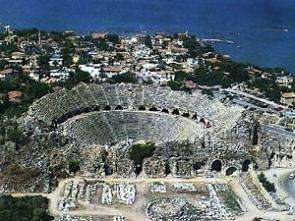
On March 29, just prior to a rare, four-minute total eclipse of the sun, three University of California, Berkeley, astronomers will take the stage in a 1,900-year-old Roman amphitheater in Turkey to introduce local students and the public to the science and lore of solar eclipses.
For the benefit of eclipse watchers elsewhere in the world, the 1:55 p.m. Turkish time eclipse will be Webcast live, thanks to the support of San Francisco's Exploratorium and the National Aeronautics and Space Administration (NASA). This program is part of the yearly "Sun-Earth Day" celebration sponsored by NASA's Sun-Earth Connection Education Forum.
Though the eclipse occurs at 2:55 a.m. Pacific time, avid local eclipse fans and night owls can experience it live at all-night open houses at the Exploratorium and at Oakland's Chabot Space & Science Center. Sound sleepers can catch a delayed celebration with solar viewing at UC Berkeley's Lawrence Hall of Science or view it anytime on the Web at: http://sunearthday.nasa.gov/ or http://www.exploratorium.edu/eclipse/2006/.
UC Berkeley research astronomer Nahide Craig organized the event in Side, Turkey, with the Exploratorium under the auspices of the forum, an educational outreach project co-directed by research astronomer Isabel Hawkins of UC Berkeley's Space Sciences Laboratory (SSL) and James Thieman of the NASA Goddard Space Flight Center. Side (pronounced SEE-deh), located about an hour outside Antalya in southwestern Turkey, sits on a peninsula jutting into the Mediterranean Sea and is notable as the site of a tryst between Marc Antony and Cleopatra.
Hawkins will co-anchor the 75-minute Webcast with Exploratorium physicist Paul Doherty, drawing upon the expertise of UC Berkeley research physicist Janet Luhmann, principal investigator of the IMPACT instrument aboard the soon-to-be-launched STEREO spacecraft, and NASA Goddard educators. Craig, a native of Turkey and education manager of STEREO/IMPACT, will work the crowd. Also on hand to help the local public and schools will be Ruth Paglierani, coordinator of public programs at SSL, and Troy Cline, education technology manager of NASA Goddard.
In Turkey, the team plans activities in the days leading up to the eclipse - some of them will be podcast by NASA Goddard and the Exploratorium - including visits to local schools. The day of the eclipse, they will set up telescopes in the amphitheater and distribute sun-safe eclipse glasses to the 2,500 people expected to crowd into the event.
The moon's shadow will first darken the Earth along the eastern shore of Brazil and then move across the Atlantic Ocean to make landfall in Ghana, Africa. It will continue moving northeast through Togo, Benin, Nigeria, Niger, Chad, Libya, Egypt, across the Mediterranean and into Turkey, ending at sunset in northern Mongolia. A partial eclipse will be seen within the much broader path of the moon's penumbral shadow that includes the northern two thirds of Africa, Europe and central Asia.
The Webcast itself will start at about 1 p.m. Turkish time (2 a.m. PST) on March 29, building to the eclipse, which will reach totality at 1:55 p.m. in Turkey (2:55 a.m. PST). First-to-last contact will be between 1:38 PST and 4:13 a.m. PST.
Hawkins noted that the sun is very quiet now, with no sunspots visible on the surface to intrigue viewers prior to the eclipse. She hopes, however, that as the moon blocks the light of the sun, lots of stunning solar prominences will decorate the edge of the sun.
The lively and informational public program will include:
-- Live views of the eclipse in both white light and as seen through an H-alpha filter, which blocks all but the light emitted by hydrogen in order to reveal more detail on the surface of the sun
-- Introduction to Side, Turkey, and to the 2nd-century A.D. Roman theater where the crew is based
-- Eclipse images from NASA's Solar Heliospheric Observatory (SOHO) satellite, which is stocked with 12 sun-gazing instruments
-- Updates on leading-edge solar research conducted by UC Berkeley and NASA astronomers
-- Live updates from the path of totality provided by NASA Goddard's Fred Espenak, who has been dubbed "Mr. Eclipse" and will be observing in Libya, and from Ghana by Kennedy Reed of Lawrence Livermore National Laboratory.
Source: UC Berkeley , By Robert Sanders


