Making (accurate predictions of) waves
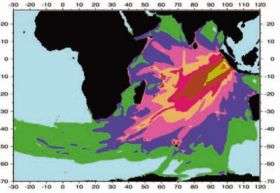
A new review of tsunami hazards concludes that the 2004 catastrophe was far from the worst possible in many Indian Ocean borderlands -- and notes that warning systems to guard at-risk populations are still lagging.
Costas Synolakis, director of the University of Southern California Tsunami Research Center, is co-author of "Far-Field Tsunami Hazard From Mega-Thrust Earthquakes in the Indian Ocean," just published in Geophysical Journal International.
Synolakis and co-author Emile Okal of Northwestern University evaluated all known potential tsunami-generating sources in the vast area between Africa, Asia, Australia and Antarctica, and then calculated the impact of the tsunamis they can generate, should they rupture. Their paper presents the geographical distribution of risk.
"This is really the first time the risk has been examined on a basin wide scale," according to Synolakis.
The pair examined eight scenarios, two along Southern Sumatra (in Indonesia), two in the North Andaman segment of the Sumatra Subduction Zone, two sources along the Makran Subduction Zone (south of western Pakistan) and two sources south of the Indonesian island of Java.
According to Synolakis, a professor in the USC Viterbi School of Engineering's Sonny Astani Department of Civil and Environmental Engineering, "the most important lesson from the scenarios we investigated is that the patterns of far-field maximum amplitudes predicted by our simulations will not be a repeat of those observed in 2004." The differences result from differences in the directions in which the disturbances propagate, "and in many instances the results are counterintuitive."
Synolakis expressed confidence in the reliability of the projections. "Even if the earthquakes, as they materialize in the future, have geometric characteristics that are slightly different from our hypothetical scenarios, the far field impact projections are robust to small initial perturbations arising from uncertainty in the rupture characteristics."
Among the paper's conclusions:
-- The impact in the mid-ocean Maldive Islands from all scenarios appears to be similar or less than what was observed in 2004 - however the low-lying structure of the islands makes them more difficult to evacuate than other risk sites.
-- The impact in Madagascar and the Mascarene Islands (Mauritius, Rodrigues and Reunion) and the Seychelle Islands north of them could be far greater than in 2004, particularly from earthquakes in Southern Sumatra and in South Java. Madagascar is found particularly vulnerable from South Sumatran tsunamis.
-- Africa suffered in excess of 300 deaths in 2004, 300 of them in Somalia. Its east coast is vulnerable from south Sumatran tsunamis and in particular, Somalia remains at high risk due to the focusing effect of the Maldives ridge. The Comoro islands located between Tanzania and Madagascar would probably be affected more severely than in 2004.
-- Large earthquakes in south Java would generate substantial levels of destruction in Northern Australia, despite the sparse level of development there.
-- The Strait of Malacca area appears more vulnerable than in 2004, from earthquakes in the North Andaman. Bali and Lombok could be severely affected by large events in south Java. In fact Bali was affected by the 1994 tsunami, whose trigger was smaller than the ones envisioned here.
Many of these scenarios have never been examined before. Synolakis' USC colleague Jose Borrero and others examined the local impact from south Sumatran scenarios in a 2006 paper in the Proceedings of the National Academy of Sciences. Synolakis and Okal concentrated on basin-wide impacts not studied earlier.
The impact to the eastern coast of India and in Myanmar and Bangladesh from the North Andaman scenarios was examined in a paper recently published in Nature by Phil Cummins (2007) of Geoscience Australia. The impact the new paper predicts is slightly different, Synolakis says, but only in the geographical distribution of the carnage.
According to that paper, the Makran Coast of Baluchistan constitutes a subduction zone along which the Arabian plate sinks under the Eurasian one. This was the site of a major earthquake on 1945 November 27, which was accompanied by a significant regional tsunami, with run-up in the five to ten meter range.
Synolakis and Okal, who is a professor in Northwestern's Department of Earth and Planetary Science, examined different rupture scenarios and their affect on the Makran coast, Oman and the west coast of India. "They are substantial and need more detailed study," Synolakis said, making reference to a documented catastrophe that occurred 24 centuries ago: "While the tsunami impact could be inferred from Pliny's reports of the adventure sof the fleet of Alexander the Great returning from India at the Straits of Hormuz in 434 AD, it has not yet been examined to the extent it deserves given the commercial and military value of the Straits.
Synolakis and Okal agree with Cummins about a critical need for the area: a warning net.
"It is quite clear that a tested and true tsunami early warning system as now works in the Pacific by the Pacific Tsunami Warning Center needs to be urgently implemented in the Indian Ocean," said Synolakis. "This system should include hundreds of pre-computed detailed scenarios of inundation for all Indian Ocean nations to facilitate emergency planning for evacuation should any of these scenarios materialize. Public education is a must and local people and visitors should be made aware of tsunami hazards, no matter how unlikely they may be, just us Hawaii and Oregon are already doing."
Synolakis and Okal began work on the project almost in the immediate aftermath of Sumatra 2004 and was completed last year.
"Our work was triggered from three different two week classes we taught for UNESCO in 2006/2007 on tsunami hazard mitigations in the Indian Ocean," said Synolakis. "More than eighty professionals attended having been nominated by their governments and we tried to show them how to assess with us the local impact from adjacent sources. We tried to guide them towards understanding and evaluating transoceanic impact, but the computational tools they had then were just not optimal.
"The work we present here extends the synthesis of hundreds of inundation projections done by our students in these classes, with varying degrees of success. However, all the specific scenarios we used are the synthesis of extensive literature and archive review, a synthesis of the preliminary material we developed in the UNESCO classes and of course all the computations are new."
Source: University of Southern California


