Secret of the carnivorous pitcher plant's slurp -- solved at last
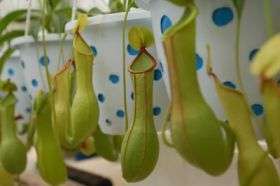
Splash! Ooch! Yum! And so another unsuspecting insect victim of Nepenthes alata (N. alata), commonly known as the carnivorous pitcher plant, falls victim to the digestive fluids at the bottom of the plant's famous cup-shaped leaf. For almost a century, scientists have sought the full chemical recipe for the pitcher plant's fluid.
Japanese scientists now report completely deciphering this complex cocktail of digestive and antibacterial enzymes. Their study is scheduled for the February issue of ACS’ Journal of Proteome Research.
Unlike other plants that absorb nutrients from the soil, carnivorous plants growing in nutrient-poor soils have special organs to capture insects, digest them and absorb the nitrogen and phosphorous their environment sorely lacks. The identity of all the myriad proteins involved in this evolutionary marvel — some of which could have beneficial applications in medicine and agriculture — has been a mystery until now.
Tatsuro Hamada and Naoya Hatano used cutting-edge proteomic analysis to identify all of the components. They isolated and sequenced the proteins, then compared each with existing proteins to find structural matches.
Hamada and Hatano detected seven proteins that exist mainly in the pitcher fluid of N. alata — three of which can only be found in this species — including useful enzymes that may inhibit bacterial growth and rotting as the plant slowly digests its prey.
Source: ACS


