Scientists Explore Factors Contributing to DNA Mutations
A team of Penn State University researchers is the first to conduct a genome-wide study to compare the relative importance of factors that contribute to DNA mutations, which are implicated in cancer and over 40 neurological disorders.
Led by assistant professor of biology Kateryna Makova, the group investigated the simultaneous effects of numerous factors that are thought to increase the susceptibility to mutations of microsatellites -- variable-length sequences of recurring DNA subunits. Microsatellites are common throughout the genomes of plants and animals. The work is described in the January 2008 issue of the journal Genome Research.
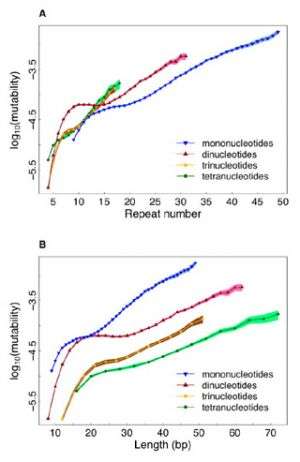
Results of the team's analysis could have several applications. "Our statistical analysis may be useful in predicting which disease-causing microsatellites are likely to have high rates of de novo mutations," said Makova. De novo mutations are those that occur for the first time in a family.
In addition to being of value to medical geneticists, Makova said the results may be useful to forensics experts and conservation geneticists. Because microsatellites are highly variable among individuals in healthy populations, they can be used by forensics experts to identify criminals. Similarly, conservation geneticists can use a lack of microsatellite variability among individuals in a group to distinguish populations that are threatened with low genetic diversity. By identifying the most important factors contributing to microsatellite mutability -- the microsatellite's ability to mutate -- the team's research may help scientists to pinpoint microsatellites that are particularly important for their area of research.
"There have been reports indicating that individual factors might be affecting microsatellite mutability, but nobody has looked at how these factors interact with each other and which factors are more important," said Makova. "This is the first study to bring together multiple factors affecting microsatellite evolution."
In particular, the group, which also included Yogeshwar Kelkar, a graduate student in the Integrative Biosciences Graduate Program, Svitlana Tyekucheva, a graduate student in statistics, and Francesca Chiaromonte, an associate professor of statistics, examined patterns of evolutionary change in repetitive DNA. An example is the microsatellite sequence ACACACACAC. The repeat number of this example sequence is five; in other words, the repeated nucleotides A and C (adenine and cytosine) occur together five times, each repeat length is two, and the length of the full microsatellite is 10. The team found that these three factors -- repeat number, repeat length, and microsatellite length -- were the most significant factors affecting microsatellite mutability.
Makova's research team investigated the rate of evolution of microsatellites by contrasting those in the human genome with comparable microsatellites in the chimpanzee genome. Microsatellites that differed between the two species were considered to have undergone evolutionary changes brought about by mutations. The group, therefore, was able to use the degree of difference between the two species as a proxy for the mutation rate of specific microsatellites.
Once the scientists identified the microsatellites that had high mutation rates, they sought to determine which factors were responsible for the mutations. In addition to finding that microsatellite length, repeat number, and repeat length were important, they also found three more factors that influence mutability: repeat composition, location on sex chromosomes versus chromosomes not involved in sex determination (autosomes), and location inside versus outside mobile DNA sequences (Alu sequences).
"The analysis confirmed what we expected," said Makova. "Mutability increases with repeat number and microsatellite length, likely due to an increased probability of slippage [the process by which two strands of DNA realign incorrectly]. However, we didn't realize just how strong the relationship was. Depending on the number of repeats, the mutability of microsatellites with the same repeat length varied more than 100-fold!"
In addition to these discoveries, the team found that mutability decreases with repeat length, possibly because, for a fixed length, longer repeats indicate a lower repeat number and mutability is lower for microsatellites with lower repeat numbers. At shorter lengths, explained Makova, DNA proofreading and repair mechanisms function more reliably and efficiently.
The team also discovered that repeat composition was a significant predictor of microsatellite mutability. For instance, mutability was higher for sequences with repeated A's than for sequences with repeated C's at low repeat numbers. Among the microsatellites with repeat sizes of two, AT (adenine and thymine) had the highest mutability. AG (adenine and guanine) had higher mutability than AC for repeats greater than 15. The team attributed these differences to the strength of hydrogen bonds between the two nucleotides -- the basic subunit of DNA -- and to the ability of the microsatellites to curl back onto themselves into a "hairpin" shape.
Finally, the researchers examined the effects on mutability of a microsatellite's location inside versus outside Alu sequences. "We were surprised to find that the effect of location in Alu sequences is evident only for mononucleotide microsatellites [microsatellites with only one kind of nucleotide; for example, AAAAAA]," said Makova. "Mutability was higher when mononucleotide sequences with low repeat numbers were inside or overlapped with Alu sequences."
In addition to the work described here, Makova's team's paper includes a number of additional discoveries. "Microsatellite instability is implicated in cancer and numerous neurological diseases," said Makova. "Our findings will be useful to researchers who study these diseases, as well as to forensics experts, conservation geneticists, and other specialists who use microsatellites."
Source: Penn State University


