Linked Hawaiian Telescopes Catch a Nova Surprise
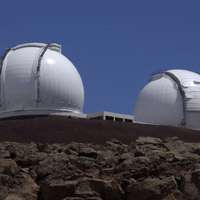
First results from a new NASA-funded scientific instrument at the W. M. Keck Observatory at Mauna Kea, Hawaii, are helping scientists overturn long-standing assumptions about powerful explosions called novae and have produced specific information about one nearby nova.
This sophisticated new system, called the Keck Interferometer, combines the observing power of the two 10-meter (33 feet) Keck telescopes into a single mega-telescope. Using the interferometer's "nulling" mode, data were taken by the Keck Interferometer team on a nearby nova called RS Ophiuchi.
In "nulling" mode, the Keck Interferometer suppresses the blinding light of a star so researchers can study the surrounding environment. The instrument helps them observe very faint objects near bright sources and produces 10 times more resolving power than a single Keck telescope working alone. It is the only instrument of its kind in operation.
The nulling mode was developed to search for dust regions around nearby stars, where planets might be forming, but the bright starlight poses a great challenge. "Because a star is so much brighter than the dust, something has to block the light, which is what the nuller does," said Rachel L. Akeson, Keck Interferometer project scientist at the California Institute of Technology's Michelson Science Center. "This technique turns out to be useful for lots of other kinds of objects, including this one, where dust is near a star that just went nova."
These nova data were taken by a team led by Wes Traub of NASA's Jet Propulsion Laboratory, Pasadena, Calif., and the data analysis and unified model for the nova were produced by a team led by Richard Barry and William Danchi of the Goddard Space Flight Center, Greenbelt, Md.
The star in the constellation Ophiuchus went nova at the perfect time for the team, on Feb. 12, 2006. "We were extremely lucky, because we had astronomers in place at two mountain-top interferometers, Keck in Hawaii and Infrared Optical Telescope Array in Arizona. Within minutes of hearing about the discovery of the nova, we alerted both teams to start observing it that night," said Traub, a senior research scientist at JPL.
The nova system, known as RS Oph consists of a white dwarf and a red giant. The red giant is gradually shedding its massive gaseous outer layers, and the white dwarf is sweeping up much of this wind, growing in mass over time. As the matter builds up on the white dwarf's surface, it eventually reaches a critical temperature that ignites a thermonuclear explosion that causes the system to brighten 600-fold. RS Oph was previously observed blowing its stack in 1898, 1933, 1958, 1967 and 1985, so astronomers were eagerly anticipating the 2006 eruption.
About three-and-a-half days after the nova was detected, the group observed the explosion with the Keck nuller. They set the instrument to cancel the nova's light, allowing them to see the much fainter surrounding material, and then the extremely bright blast zone.
The instrument's versatility was key to a surprising discovery. The nuller saw no dust in the bright zone, presumably because the nova's blast wave vaporized dust particles. But farther from the white dwarf, at distances starting around 20 times the Earth-sun distance, the nuller recorded the spectral chemical signature of silicate dust. The blast wave had not yet reached this zone, so the dust must have pre-dated the explosion.
"This flies in the face of what we expected. Astronomers had previously thought that nova explosions actually create dust," said Richard Barry of Goddard, lead author of the paper on the observations that will appear in the Astrophysical Journal.
The team thinks the dust is created as the white dwarf plows through the red giant's wind, creating a pinwheel pattern of higher-density regions that is reminiscent of galaxy spiral arms. Inside these arms, atoms become cool enough and dense enough to allow atoms to stick together to form dust particles. The nova's blast wave has since destroyed RS Oph's pinwheel pattern, but it should re-form over the next few years, and future observations by NASA's Spitzer Space Telescope could see it. Barry is also coauthor of a paper based on Spitzer observations of RS Oph.
Most studies of RS Oph have relied on spectroscopic models, which have not been able to distinguish various nova components with as much detail as the interferometer. The Keck nuller measured one component of the RS Oph system to an accuracy of just 4 milliarcseconds, or about the size of a basketball seen 7,500 miles away.
The Keck Interferometer is part of NASA's ongoing quest to search for planets orbiting other stars.
Source: NASA


