New polymer could improve semiconductor manufacturing, packaging
January 28, 2008
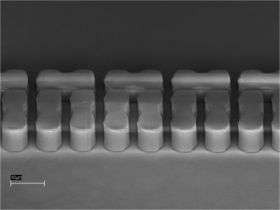
Researchers from Rensselaer Polytechnic Institute's Department of Physics and Center for Integrated Electronics have developed a new inexpensive, quick-drying polymer that could lead to dramatic cost savings and efficiency gains in semiconductor manufacturing and computer chip packaging. In this scanning electron microscope image of the new PES polymer in a photolithography application, the straight side walls indicate the material's good photodefinition characteristics. Credit: Rensselaer Polytechnic Institute
Researchers at Rensselaer Polytechnic Institute and Polyset Company have developed a new inexpensive, quick-drying polymer that could lead to dramatic cost savings and efficiency gains in semiconductor manufacturing and computer chip packaging.
Along with allowing enhanced performance and cost savings for conventional photolithography processes, the new material, called polyset epoxy siloxane (PES), should also enable a new generation of lower-cost, on-chip nanoimprinting lithography technology, according to the researchers.
“With this new material, chip manufacturers will be able to trim several steps from their production and packaging processes, and in turn realize a cost savings,” said Toh-Ming Lu, the R.P. Baker Distinguished Professor of Physics at Rensselaer, who oversaw the study. “PES is cheaper and more reliable.”
Lu’s research was published this week in the Journal of Vacuum Science and Technology B.
The widely adopted technique of photolithography involves using a mix of light and chemicals to generate intricate micro- and nano-scale patterns on tiny areas of silicon. As part of the process, a thin polymer film – called a redistribution layer, and crucial to the effectiveness of device – is deposited onto the silicon wafer, in order to ease the signal propagation delay and to protect the chip from different environmental and mechanical factors.
The new PES material developed by Lu’s group and Polyset Company is one such thin polymer film, and it offers several advantages over the incumbent materials typically used in the semiconductor manufacturing industry. In addition, their new PES material can also be used as a thin polymer film for ultraviolet (UV) on-chip nanoimprinting lithography technology, which is still in the early phases of development. The consistency of using PES in conventional technology, and then continuing to use PES while academia and industry test and gradually migrate to the next generation of devices, should help ease the transition, Lu said.
“Having the ability to use one material – our new PES – for both photolithography and imprint will be very attractive to manufacturers,” Lu said. “At its core, our project is basic research, but it also has important industry implications. It’s very exciting.”
Manufacturers today typically use benzocyclobutene and polyimide as polymers for redistribution layers, because of their low water absorption, thermal stability, low curing temperature, low thermal expansion, low dielectric constant, and low leakage current. Lu said PES offers significant advantages to these materials, particularly in the areas of cure temperature and water uptake.
PES cures, or dries and hardens, at 165 degrees Celsius, about 35 percent cooler than the other two materials. The need for less heat should translate directly into lower overhead costs for manufacturers, Lu said. Another advantage of PES is its low water uptake rate of less than 0.2 percent, less than the other materials. Additionally, PES adheres well to copper and can easily be made less brittle if needed. All of these attributes make PES a promising candidate for redistribution layer application and UV imprint lithography.
“The results demonstrate that PES is feasible to be used as UV-curable resist for both the redistribution application for electronic packaging and micro/nano imprint lithography,” said Rensselaer Research Associate Pei-I Wang, co-author of the paper.
Along with photolithography and on-chip nanoimprinting lithography, PES holds the potential for applications in other optical devices, flat-panel display, biotechnology devices, and microelectromechanical systems, Wang said.
Source: Rensselaer Polytechnic Institute
-
Studies show everolimus-eluting stent implantation reduces restenosis and repeat revasculariztion
Oct 21, 2010 |
not rated yet |
0
-
Outpatient treatment proves safe, effective for low-risk patients with pulmonary embolism
Jun 23, 2011 |
not rated yet |
0
-
Researchers find drug-eluting stents safe, effective for PCI in diabetics
Sep 21, 2009 |
not rated yet |
0
-
Push-ups no match for combat
Dec 01, 2011 |
3.7 / 5 (3) |
1
-
Creating markets to pay for public good offer promise, peril
Nov 03, 2011 |
5 / 5 (1) |
0
-
Engineers build first sub-10-nm carbon nanotube transistor
Feb 01, 2012 |
4.9 / 5 (31) |
30
-
Something old, something new: Evolution and the structural divergence of duplicate genes
Jan 31, 2012 |
4.6 / 5 (7) |
1
-
The hidden nanoworld of ice crystals: Revealing the dynamic behavior of quasi-liquid layers
Jan 30, 2012 |
5 / 5 (3) |
1
-
Stock market network reveals investor clustering
Jan 27, 2012 |
3.9 / 5 (23) |
8
-
Of microchemistry and molecules: Electronic microfluidic device synthesizes biocompatible probes
Jan 26, 2012 |
5 / 5 (1) |
0
-
polymer nanocomposites
Feb 10, 2012
-
Corrosion Tests on Magnesium
Feb 09, 2012
-
polyethylene copper nanocomposite
Feb 09, 2012
-
Output of xrd analysis
Feb 08, 2012
-
Transport phenomena problem based on problems 18.B11 and 19B.6 from Bird, stewart, lw
Feb 06, 2012
-
Help with material selection - Car Piston
Feb 05, 2012
- More from Physics Forums - Materials & Chemical Engineering
More news stories
New kind of solar cell could capture significantly more energy than current cells
New solar cells could increase the maximum efficiency of solar panels by over 25%, according to scientists from the University of Cambridge.
Feb 08, 2012 |
4.5 / 5 (12) |
14
|
Nanoshell whispering galleries improve thin solar panels
Visitors to Statuary Hall in the U.S. Capitol Building may have experienced a curious acoustic feature that allows a person to whisper softly at one side of the cavernous, half-domed room and for another on ...
Nanotechnology / Nanomaterials
Feb 07, 2012 |
4.3 / 5 (6) |
6
|
'Dark plasmons' transmit energy
Microscopic channels of gold nanoparticles have the ability to transmit electromagnetic energy that starts as light and propagates via "dark plasmons," according to researchers at Rice University.
Feb 09, 2012 |
4.8 / 5 (9) |
1
|
Revealing how a battery material works
Since its discovery 15 years ago, lithium iron phosphate (LiFePO4) has become one of the most promising materials for rechargeable batteries because of its stability, durability, safety and ability to deliver ...
Nanotechnology / Nanomaterials
Feb 08, 2012 |
5 / 5 (5) |
0
|
Harnessing plasmonics, engineers weld nanowires with light
At the nano level, researchers at Stanford have discovered a new way to weld together meshes of tiny wires. Their work could lead to exciting new electronics and solar applications. To succeed, they called ...
Feb 06, 2012 |
4.8 / 5 (11) |
1
|
Injured boomers beware: Know when to see doctor
(AP) -- It happened to nurse Jane Byron years after an in-line skating fall, business owner Haralee Weintraub while doing "men's" push-ups, and avid cyclist Gene Wilberg while lifting a heavy box.
Google might launch Drive for cloud storage soon
(PhysOrg.com) -- Google's next big move, according to the Wall Street Journal, is a cloud storage service called Drive. Hardly first to the plate, Google is simply catching up to introducing its cloud reposi ...
Latin America mining boom clashes with conservation
Latin America is experiencing a mining boom as prices rise fuelled by a hike in global demand, but the region is also being hit by a wave of violent protests, strikes and rallies by environmentalists.
Love a click away in Indonesia's Twitter Republic
He was a geeky kid from Yogyakarta, she a glamorous city girl in Jakarta. In a country with one of the world's most vibrant social networking scenes they fell in love on Twitter.
Europeans protest controversial Internet pact
Tens of thousands of people marched in protests in more than a dozen European cities Saturday against a controversial anti-online piracy pact that critics say could curtail Internet freedom.
Walney offshore wind farm is world's biggest (for now)
(PhysOrg.com) -- The Walney wind farm on the Irish Sea--characterized by high tides, waves and windy weather--officially opened this week. The farm is treated in the press as a very big deal as the Walney ...