The Growing-up of a Star
January 29, 2008
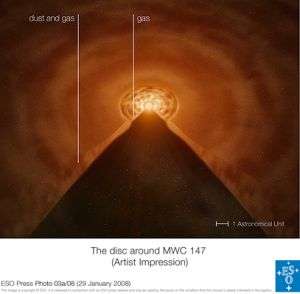
Artist's impression of the disc of matter surrounding MWC 147 as inferred from observations made with ESO's Very Large Telescope Interferometer. A slice has been cut to show the inner structure better. The disc extends out to 100 times the distance between the Earth and the Sun (100 Astronomical Units - 100 AU). It is inclined by about 50 degrees as seen from Earth. The dust in the outer disc emits mainly at mid-infrared wavelengths, while close to the star there is also strong near-infrared emission from very hot gas. This gas is transported towards the forming star, increasing its mass at a rate of 7 millionths of the mass of the Sun - or about 2 times the mass of the Earth - per year. Source: ESO
Using ESO's Very Large Telescope Interferometer, astronomers have probed the inner parts of the disc of material surrounding a young stellar object, witnessing how it gains its mass before becoming an adult.
The astronomers had a close look at the object known as MWC 147, lying about 2,600 light years away towards the constellation of Monoceros ('the Unicorn'). MWC 147 belongs to the family of Herbig Ae/Be objects. These have a few times the mass of our Sun and are still forming, increasing in mass by swallowing material present in a surrounding disc.
MWC 147 is less than half a million years old. If one associated the middle-aged, 4.6 billion year old Sun with a person in his early forties, MWC 147 would be a 1-day-old baby.
The morphology of the inner environment of these young stars is however a matter of debate and knowledge of it is important to better understand how stars and their cortège of planets form.
The astronomers Stefan Kraus, Thomas Preibisch, and Keiichi Ohnaka have used the four 8.2-m Unit Telescopes of ESO's Very Large Telescope to this purpose, combining the light from two or three telescopes with the MIDI and AMBER instruments.
"With our VLTI/MIDI and VLTI/AMBER observations of MWC147, we combine, for the first time, near- and mid-infrared interferometric observations of a Herbig Ae/Be star, providing a measurement of the disc size over a wide wavelength range," said Stefan Kraus, lead-author of the paper reporting the results. "Different wavelength regimes trace different temperatures, allowing us to probe the disc's geometry on the smaller scale, but also to constrain how the temperature changes with the distance from the star."
The near-infrared observations probe hot material with temperatures of up to a few thousand degrees in the innermost disc regions, while the mid-infrared observations trace cooler dust further out in the disc.
The observations show that the temperature changes with radius are much steeper than predicted by the currently favoured models, indicating that most of the near-infrared emission emerges from hot material located very close to the star, that is, within one or two times the Earth-Sun distance (1-2 AU). This also implies that dust cannot exist so close to the star, since the strong energy radiated by the star heats and ultimately destroys the dust grains.
"We have performed detailed numerical simulations to understand these observations and reached the conclusion that we observe not only the outer dust disc, but also measure strong emission from a hot inner gaseous disc. This suggests that the disc is not a passive one, simply reprocessing the light from the star," explained Kraus. "Instead, the disc is active, and we see the material, which is just transported from the outer disc parts towards the forming star."
The best-fit model is that of a disc extending out to 100 AU, with the star increasing in mass at a rate of seven millionths of a solar mass per year.
"Our study demonstrates the power of ESO's VLTI to probe the inner structure of discs around young stars and to reveal how stars reach their final mass," said Stefan Kraus.
The authors report their results in a paper in the Astrophysical Journal ("Detection of an inner gaseous component in a Herbig Be star accretion disk: Near- and mid-infrared spectro-interferometry and radiative transfer modeling of MWC 147", by Stefan Kraus, Thomas Preibisch, Keichii Ohnaka").
Source: ESO
-
Exomoons? Kepler‘s on the hunt
Jan 09, 2012 |
4.7 / 5 (3) |
0
-
Astronomers look to neighboring galaxy for star formation insight
Nov 30, 2011 |
not rated yet |
3
-
Most complex ground-based observatory - ALMA - opens its eyes
Oct 03, 2011 |
4.9 / 5 (7) |
9
-
Netflix says it's sorry, then creates new uproar
Sep 20, 2011 |
3 / 5 (4) |
2
-
Hubble to target 'hot jupiters'
Aug 22, 2011 |
5 / 5 (1) |
2
-
Engineers build first sub-10-nm carbon nanotube transistor
Feb 01, 2012 |
4.9 / 5 (31) |
30
-
Something old, something new: Evolution and the structural divergence of duplicate genes
Jan 31, 2012 |
4.6 / 5 (7) |
1
-
The hidden nanoworld of ice crystals: Revealing the dynamic behavior of quasi-liquid layers
Jan 30, 2012 |
5 / 5 (3) |
1
-
Stock market network reveals investor clustering
Jan 27, 2012 |
3.9 / 5 (23) |
8
-
Of microchemistry and molecules: Electronic microfluidic device synthesizes biocompatible probes
Jan 26, 2012 |
5 / 5 (1) |
0
-
Never ending outer space.....
8 hours ago
-
Neutron Star fragments?
10 hours ago
-
stationary or not?
14 hours ago
-
Scale of the Universe
Feb 10, 2012
-
Titan's lack of impact craters
Feb 09, 2012
-
Real pictures of black hole eating a star?
Feb 08, 2012
- More from Physics Forums - General Astronomy
More news stories
Latin America mining boom clashes with conservation
Latin America is experiencing a mining boom as prices rise fuelled by a hike in global demand, but the region is also being hit by a wave of violent protests, strikes and rallies by environmentalists.
1 hour ago |
not rated yet |
0
Europe stakes billion-dollar bet on new rocket
A pencil-slim rocket is scheduled to lift into space from South America on Monday, carrying a billion-dollar bet that Europe can grab a juicy slice of the market to place satellites in low orbit.
Space & Earth / Space Exploration
20 hours ago |
4 / 5 (3) |
0
Political leaders play key role in how worried Americans are by climate change: study
More than extreme weather events and the work of scientists, it is national political leaders who influence how much Americans worry about the threat of climate change, new research finds.
Feb 06, 2012 |
5 / 5 (6) |
72
NASA budget will axe Mars deal with Europe: scientists
US President Barack Obama's budget proposal to be submitted next week for 2013 will cut NASA's budget by 20 percent and eliminate a major partnership with Europe on Mars exploration, scientists said Thursday.
Space & Earth / Space Exploration
Feb 10, 2012 |
5 / 5 (3) |
54
Humans may have helped the decline of African rainforests 3000 years ago
(PhysOrg.com) -- Large areas of rainforests in Central Africa mysteriously disappeared over three thousand years ago, to be replaced by savannas. The prevailing theory has been that the cause was a change ...
Google might launch Drive for cloud storage soon
(PhysOrg.com) -- Google's next big move, according to the Wall Street Journal, is a cloud storage service called Drive. Hardly first to the plate, Google is simply catching up to introducing its cloud reposi ...
Love a click away in Indonesia's Twitter Republic
He was a geeky kid from Yogyakarta, she a glamorous city girl in Jakarta. In a country with one of the world's most vibrant social networking scenes they fell in love on Twitter.
Walney offshore wind farm is world's biggest (for now)
(PhysOrg.com) -- The Walney wind farm on the Irish Sea--characterized by high tides, waves and windy weather--officially opened this week. The farm is treated in the press as a very big deal as the Walney ...
GPS court ruling leaves US phone tracking unclear
A US Supreme Court decision requiring a warrant to place a GPS device on the car of a criminal suspect leaves unresolved the bigger issue of police tracking using mobile phones, legal experts say.
Europeans protest controversial Internet pact
Tens of thousands of people marched in protests in more than a dozen European cities Saturday against a controversial anti-online piracy pact that critics say could curtail Internet freedom.
Study finds that anti-diabetic medication can prevent the long-term effects of maternal obesity
In a study to be presented today at the Society for Maternal-Fetal Medicine's annual meeting, The Pregnancy Meeting, in Dallas, Texas, researchers will report findings that show that short therapy with the anti-diabetic medication ...