String Theory Gets a Boost

January 29, 2008 feature
String Theory Gets a Boost
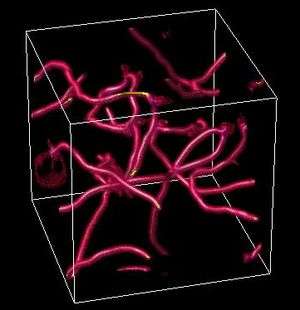
This models a small region of the observable universe right after strings have formed, at around 10^{-36} sec, when the distances between them were still only a few times their thickness. Credit: Mark Hindmarsh

Among the scientific theories that excite a great deal of controversy are those theories that deal with strings. And the idea of cosmic strings gets as much play as any in scientific circles.

Cosmic strings are present in many high-energy physics theories. They are thought to be spaghetti-like structures, each mile weighing perhaps as much as our entire planet. Despite the weight, widths are thought to be significantly smaller than an atom. However, their existence has yet to be detected. Now, though, a team of cosmologists has discovered some hints that cosmic strings exist.

“At the moment,” Martin Kunz, a scientist at the University of Geneva when the paper was written, tells PhysOrg.com, “what we have found slightly prefers, or at least does not disfavor, cosmic strings.” Kunz is part of a team led by Mark Hindmarsh of the University of Sussex in Brighton, U.K., using measurements of the cosmic microwave background radiation to search for evidence of cosmic strings. This team, which includes Neil Bevis at Imperial College in London and Jon Urrestilla at Tufts University in Medford, Massachusetts, USA, have reported their findings in Physical Review Letters: “Fitting Cosmic Microwave Background Data with Cosmic Strings and Inflation.”

“As these strings move around,” Kunz explains, “they will cause perturbations, attracting matter behind them. These perturbations become visible in the comic microwave background radiation. If there are cosmic strings, they induce extra perturbations that could be indirectly detected.”

In order to determine whether cosmic strings might be possible, Kunz and his peers factored a variety of parameters into a supercomputer and created different models. “We made new simulations of traces of cosmic strings,” Kunz says. “We calculated perturbations from standard inflation and calculated them from cosmic strings. We did model comparisons.”

The result was that, after predictions were compared to cosmic microwave data from NASA’s Wilkinson Microwave Anisotropy Probe, it appeared that theories including cosmic strings offer the best explanation for the pattern of microwave radiation present in the universe.

Kunz cautions that cosmic strings are far from an absolute. “We need more data,” he insists. “While this result slightly favors cosmic strings, it isn’t conclusive.” Kunz says that better data may come from the Planck Satellite mission, which is due for launch this year by the European Space Agency.

“If we could detect strings,” Kunz points out, “it would tell us a lot about particle physics, and help us understand more about the fundamental structure of physics at very high energies, much higher than what can be probed in particle accelerators. Finding strings would be very helpful in areas of fundamental theory.”

Until more data is gathered, and more work done in the field, cosmic strings are likely to remain a subject of scientific debate. But this latest work on cosmic strings is encouraging for those who subscribe to string theory – a theory that could possibly tie quantum physics and gravity together, as well as provide a fundamental understanding of high-energy and condensed matter physics.

“What this does is show that cosmic strings could account for what we can detect in the universe,” Kunz says. “It doesn’t prove anything, and we do need more data. But it does show us that cosmic strings are worth looking at again. We haven’t detected them yet, but it’s something to watch for.”

Copyright 2008 PhysOrg.com.
All rights reserved. This material may not be published, broadcast, rewritten or redistributed in whole or part without the express written permission of PhysOrg.com.

4 /5 (110 votes)  

Filter


Move the slider to adjust rank threshold, so that you can hide some of the comments.


Display comments: newest first

Ragtime
Jan 30, 2008

Rank: 1 / 5 (2)
By AWT theory the "strings" are density fluctuations of vacuum and as such they can be observed as a streaks of dark matter (http://www.davidd...tion.jpg ) I.e. the cosmic strings doesn't form swirling things like those predicted in article.
JavaTool
Feb 01, 2008

Rank: not rated yet
cosmic strings are not the strings of string theory
Rank 4 /5 (110 votes)
Tags

Relevant PhysicsForums posts
  • Question about Gravity?
    created1 hour ago
  • Wearing black in a desert
    created2 hours ago
  • Did space exist before mass?
    created2 hours ago
  • How can E&M Waves be polarized?
    created2 hours ago
  • Does light travel for ever?
    created3 hours ago
  • Infinity by Particles
    created4 hours ago
  • More from Physics Forums - General Physics

More news stories

Putting the squeeze on planets outside our solar system

(PhysOrg.com) -- Using high-powered lasers, scientists at Lawrence Livermore National Laboratory and collaborators discovered that molten magnesium silicate undergoes a phase change in the liquid state, abruptly ...

Physics / Condensed Matter

created 9 hours ago | popularity 4.4 / 5 (5) | comments 0 | with audio podcast

Hovering not hard if you're top-heavy, researchers find

Top-heavy structures are more likely to maintain their balance while hovering in the air than are those that bear a lower center of gravity, researchers at New York University's Courant Institute of Mathematical Sciences ...

Physics / General Physics

created 10 hours ago | popularity 5 / 5 (1) | comments 1 | with audio podcast

SLAC, Stanford team focuses on high-energy electrons to treat cancer

Accelerator physicists at SLAC and cancer specialists from Stanford are working on a new technology that could dramatically reduce the time needed for cancer radiation treatments. The team ran an initial experiment ...

Physics / General Physics

created 13 hours ago | popularity 5 / 5 (1) | comments 0

Measurements from high-energy collisions lead to better understanding of why meson particles disappear

For several years, physicists at the Relativistic Heavy Ion Collider (RHIC) at Brookhaven National Laboratory (BNL), USA, have studied an unusual state of matter called the quark–gluon plasma, which they ...

Physics / General Physics

created 13 hours ago | popularity 4.5 / 5 (2) | comments 0

Explained: Sigma

It's a question that arises with virtually every major new finding in science or medicine: What makes a result reliable enough to be taken seriously? The answer has to do with statistical significance -- but ...

Physics / General Physics

created Feb 09, 2012 | popularity 5 / 5 (16) | comments 53


Google users warned of threat to smartphone wallets

Users of Google smartphone wallets were being warned on Friday that there is a way to crack pass codes intended to thwart thieves from going on illicit shopping sprees.

Anonymous knocks CIA website offline (Update)

The website of the Central Intelligence Agency was inaccessible on Friday after the hacker group Anonymous claimed to have knocked it offline.

New error-correcting codes guarantee the fastest possible rate of data transmission

Error-correcting codes are one of the triumphs of the digital age. They’re a way of encoding information so that it can be transmitted across a communication channel — such as an optical fiber o ...

Complex wiring of the nervous system may rely on a just a handful of genes and proteins

Researchers at the Salk Institute have discovered a startling feature of early brain development that helps to explain how complex neuron wiring patterns are programmed using just a handful of critical genes. ...

The power of estrogen -- male snakes attract other males

A new study has shown that boosting the estrogen levels of male garter snakes causes them to secrete the same pheromones that females use to attract suitors, and turned the males into just about the sexiest ...

Humans may have helped the decline of African rainforests 3000 years ago

(PhysOrg.com) -- Large areas of rainforests in Central Africa mysteriously disappeared over three thousand years ago, to be replaced by savannas. The prevailing theory has been that the cause was a change ...