New decontamination system kills anthrax rapidly without lingering effects
In October 2001, letters containing anthrax spores were mailed to several news media offices and two U.S. senators, killing five people and infecting 17 others. Clearing the Senate office building of the spores with chlorine dioxide gas cost $27 million, according to the Government Accountability Office. Cleaning the Brentwood postal facility outside Washington cost $130 million and took 26 months.
Researchers at the Georgia Tech Research Institute (GTRI) in collaboration with Austin-based Stellar Micro Devices, Inc. (SMD) have developed prototypes of a rapid, non-disruptive and less expensive method that could be used to decontaminate bioterrorism hazards in the future.
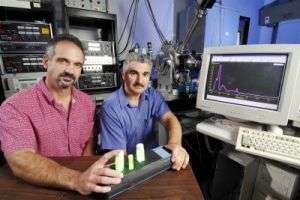
Using flat panel modules that produce X-rays and ultraviolet-C (UV-C) light simultaneously, the researchers can kill anthrax spores in two to three hours without any lingering effects. The system also has the ability to kill anthrax spores hidden in places like computer keyboards without causing damage.
“This is certainly an improvement over previous techniques,” said Brent Wagner, GTRI principal research scientist and director of its Phosphor Technology Center of Excellence (PTCOE). “The UV-C attacks spores on surfaces and the X-rays penetrate through materials and kill spores in cracks and crevices.”
X-ray irradiation is used commercially to sterilize medical products and food by disrupting the ability of a microorganism to reproduce. UV-C also prevents replication, but both types of radiation can penetrate the outer structure of an anthrax spore to destroy the bacteria inside.
The current decontamination standard – chlorine dioxide gas – kills microorganisms by disrupting transport of nutrients across the cell wall, but cannot reach hidden spores. Hard surfaces must be cleaned independently with harsh liquid chlorine dioxide. In addition, people cannot re-enter a room fumigated with chlorine dioxide until the gas is neutralized with sodium bisulfite vapor and vented from the building.
The new decontamination system resembles a coat rack with radiation modules arranged on rings at various heights that face outward to broadcast radiation throughout a room. Since the X-rays and UV-C are lethal at the flux densities used, the system operates unattended and is turned on outside the affected space.
UV-C light in the modules is produced using the optical and electrical phenomenon of cathodoluminescence. Numerous electron beams are generated by arrays of cold cathodes, each acting like the electron gun in a cathode ray tube.
“When an electron beam hits a powder phosphor, it luminesces and emits visible and/or non-visible light,” explained Hisham Menkara, a senior research scientist in GTRI’s Electro-Optical Systems Laboratory.
GTRI became involved in SMD’s project, which was funded by the Air Force Research Laboratory’s Small Business Innovation Research program, because the PTCOE housed UV-C phosphors created and patented by Sarnoff Corporation in the mid-1970s.
“We knew that Georgia Tech had experts in powder phosphors with regard to flat panel displays and we approached them to develop new phosphors for our decontamination purpose,” said Mark Eaton, president and CEO of SMD. “We were fortunate that they had UV-C phosphors available from decades earlier.”
With the Sarnoff phosphors in hand, Wagner and Menkara set off to determine the best UV-C emitting phosphor and optimize its properties for use with X-rays in SMD’s small flat panel display.
To find the best phosphor that emitted light in the UV-C region of the spectrum – wavelengths below 280 nanometers – the emission spectra of each phosphor was measured against the DNA absorption curve. This curve shows the optimal wavelengths to destroy an organism’s DNA.
After investigating many different phosphors, the researchers chose lanthanum phosphate:praseodymium (LaPO4:Pr or LAP:Pr) as the most efficient phosphor, with a power efficiency near 10 percent. Since the UV emission didn’t fall completely under the DNA absorption curve, the relative “killing efficiency” was approximately 50 percent.
In the laboratory, Menkara created the phosphor by mixing precursors lanthanum oxide, hydrogen phosphate and praseodymium fluoride (La2O3, H3PO4 and PrF3, respectively) in a glass beaker with methanol (CH3OH) and ammonium chloride (NH4Cl). Air drying the mixture in a fume hood caused the methanol to completely evaporate.
The resultant cake was crushed into a fine powder, heated in a furnace to a temperature as high as 1250 degrees Celsius for two hours and crushed again.
“To determine the best conditions for producing the highest efficiency phosphor, we tried different precursors and completed the firing under different atmospheric conditions and temperatures,” explained Menkara.
Test results showed that higher temperatures were more efficient and a capped quartz tube was the best container to hold the powder inside the furnace. Wagner and Menkara also found that adding lithium fluoride (LiF) and reducing the praseodymium concentration increased the cathodoluminescent properties of the LAP:Pr phosphor.
With the improved phosphor, laboratory tests conducted by SMD showed that the combined X-ray and UV-C decontamination system could kill anthrax spores.
GTRI researchers hope to develop new UV-C phosphors that can achieve cathodoluminescent efficiency higher than 10 percent with an emission spectrum that provides increased coverage of the DNA absorption curve.
With increased efficiency, UV-C panels could be used for sterilizing medical equipment or purification applications.
“We may be able to use UV-C panels to clean wastewater, which would be better than the lamps currently used. In the environment where the lamps must operate, they are very difficult to clean, whereas flat panels could be cleaned with a squeegee,” noted Eaton.
Another potential application is to kill viruses in buildings used to house chickens. Current methods involve removing the chickens and raising the temperature in the chicken houses for several days to deactivate the virus.
“With the combined UV-C/X-ray system, you could turn the system on for a few hours, kill the viruses and as soon as you turn it off, the chickens could come right back in,” said Wagner.
Source: Georgia Institute of Technology


