New nanotube findings give boost to potential biomedical applications
Carbon nanotubes-cylinders so tiny that it takes 50,000 lying side by side to equal the width of a human hair-are packed with the potential to be highly accurate vehicles for administering medicines and other therapeutic agents to patients. But a dearth of data about what happens to the tubes after they discharge their medical payloads has been a major stumbling block to progress.
Now, Stanford researchers, who spent months tracking the tiny tubes inside mice, have found some answers.
Studies in mice already had shown that most nanomaterials tend to accumulate in organs such as the liver and spleen, which was a concern because no one knew how long they could linger. But fears that the tiny tubes might be piling up in vital organs, like discarded refrigerators at the bottom of a rural ravine, can now be put to rest, said Hongjie Dai, the J. G. Jackson and C. J. Wood Professor of Chemistry at Stanford, whose research team has demonstrated that the nanotubes exit the organs.
Dai and his group found that the carbon nanotubes leave the body primarily through the feces, with some by way of the urine. ''That's nice to know,'' Dai said. ''This now proves that they do get out of the system.''
The full extent of the news, which is scheduled to be published the week of Jan. 28 in Proceedings of the National Academy of Sciences Online Early Edition, is even better than that: The three-month-long study also allays worries that the nanotubes, by simply remaining in the organs for a long time, would prove toxic to the mouse.
''None of the mice died or showed any anomaly in the blood chemistry or in the main organs,'' said Dai, senior author on the PNAS paper. ''They appear very healthy, and they are gaining weight, just like normal mice. There's no obvious toxicity observed.'' The lack of toxicity of nanotubes in mice is consistent with a previous pilot study done by Sanjiv Gambhir, a professor of radiology at Stanford, and his research group in collaboration with Dai's group.
''This is the first time anyone has done a systematic circulation and excretion study like this for nanotubes, and data on other nano particles is also scarce,'' Dai said. ''The excretion pathway may apply to other nano materials and may need to be looked at closely like this also.''
Previous research published by Dai's group has demonstrated the potential for using nanotubes in treating cancerous cells and targeting tumors in mice.
His group used Raman spectroscopy, a method of applying light from a laser beam that effectively ''illuminates'' the presence of the target molecules in the organs of the mice.
Being hit with light from the beam causes a detectable change in the state of a molecule's energy. Carbon nanotubes, composed entirely of carbon atoms that are mostly arranged in linked hexagonal rings, give off a strong signal in response to the beam. This allowed the researchers to pinpoint the position of the chosen molecules, as well as ascertain their abundance in the blood or organs.
Previous detection methods that relied on attaching fluorescent labels or spectroscopic tags to the nanotubes had yielded unreliable results. The attachments tended to either come loose from the tubes or decay over time spans ranging from a few days to only a few hours-far too short to reveal the ultimate fate of the nanotubes.
While knowing the carbon nanotubes will move through the digestive system at a healthy pace is critical to future practical applications, it is also crucial that the nanotubes not enter the digestive system too soon after being injected; they need to spend enough time in the circulatory system to find their way to their target location.
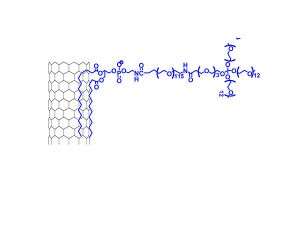
The key to fine-tuning the carbon nanotubes' speed of circulation turns on how the basic, bare-bones floor model is chemically accessorized.
''You can make the nanotubes circulate a very long time in the blood, if the chemistry is done right,'' Dai said. The researchers found that coating their carbon nanotubes with polyethylene glycol (PEG), a common ingredient in cosmetics, worked best.
They used a form of PEG with three little limbs sprouting off a central trunk. ''Those provide better shielding to the nanotube than just a single branch. Therefore, they interact less with the biological molecules around them,'' Dai said.
The team stuffed the PEG liberally into the linked hexagonal rings that compose the nanotubes, prompting Dai to describe the end result as resembling rolled-up chicken wire with feathers sticking out all over.
Though they may sound less than gorgeous visually, the feathery nanotubes turned in a beautiful performance in practical terms, Dai said. The coating of PEG made the nanotubes highly water soluble, which helped them to stay in the blood instead of being absorbed.
''They circulate in the blood for about 10 hours or so in mice, which seems to be a good length of time,'' Dai said.
The right chemical coating on nanotubes also can help ease them out of the mouse in a timely fashion, and the three-branched PEG was effective there, too.
Dai's earlier research demonstrated that nanotubes have promise for treating cancer with two different approaches. Once they have zeroed in on the target cells, shining light on the nanotubes causes them to generate heat, which can kill cancer cells. The other method is to rig the nanotubes to accumulate at targeted sites, where they can deliver medication from within the tubes.
''[Carbon nanotubes] seem to be promising for biomedical applications and for potentially treating cancer, either using drugs or using the physical properties,'' Dai said. ''This is the reason we carried out the study of the fate of nanotubes in mice. I think this is really a very fundamental issue.''
Source: Stanford University


