Archaeologist 'strikes gold' with finds of ancient nasca iron ore mine in Peru
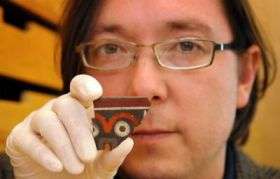
A Purdue University archaeologist discovered an intact ancient iron ore mine in South America that shows how civilizations before the Inca Empire were mining this valuable ore.
"Archaeologists know people in the Old and New worlds have mined minerals for thousands and thousands of years," said Kevin J. Vaughn, an assistant professor of anthropology who studies the Nasca civilization, which existed from A.D. 1 to A.D. 750. "Iron mining in the Old World, specifically in Africa, goes back 40,000 years. And we know the ancient people in Mexico, Central America and North America were mining for various materials. There isn't much evidence for these types of mines.
"What we found is the only hematite mine, a type of iron also known as ochre, recorded in South America prior to the Spanish conquest. This discovery demonstrates that iron ores were important to ancient Andean civilizations."
In 2004 and 2005, Vaughn and his team excavated Mina Primavera, which is located in the Ingenio Valley of the Andes Mountains in southern Peru. The research team performed field checks and collected some samples in 2006 and 2007. The findings of the excavation are published in December's Journal of the Minerals, Metals & Materials Society.
The researchers determined that the mine is a human-made cave that was first created around 2,000 years ago. An estimated 3,710 metric tons was extracted from the mine during more than 1,400 years of use. The mine, which is nearly 700 cubic meters, is in a cliffside facing a modern ochre mine.
Vaughn hypothesizes that the Nasca people used the red-pigmented mineral primarily for ceramic paints, but they also could have used it as body paint, to paint textiles and even to paint adobe walls. The Nasca civilization is known for hundreds of drawings in the Nasca Desert, which are known as the Nasca-Lines and can only be seen from the air, and for an aqueduct system that is still used today.
Vaughn and his team discovered a number of artifacts in the mine, including corncobs, stone tools, and pieces of textiles and pottery. The age of the items was determined by radiocarbon dating, a process that determines age based on the decay of naturally occurring elements.
"Archaeologists have a very good sequence of pottery from this region, so I can look at most pots from this region and determine a date within a century that is based on stylistic changes of the pottery," Vaughn said. "Even before the dating, we knew this was an ancient mine because of the ceramic pieces. These very small fragments, about the size of a penny, had distinct designs on them that are characteristic of the early Nasca civilization."
The artifacts from the excavation are being curated by the Instituto Nacional de Cultura of Peru at its museum in Ica, Peru.
Now that there is archaeological evidence that ancient cultures in the Andes were mining iron ore, it is important to give credit to New World civilizations, Vaughn said.
"Even though ancient Andean people smelted some metals, such as copper, they never smelted iron like they did in the Old World," he said. "Metals were used for a variety of tools in the Old World, such as weapons, while in the Americas, metals were used as prestige goods for the wealthy elite."
This excavation was part of Vaughn's Early Nasca Craft Economy Project, a multiyear National Science Foundation-funded study of Nasca ceramic production and distribution. The project's goal is to better understand the origins of inequality and political economy in this ancient culture.
Vaughn says material scientists and engineers, as well as mineralogists, will be interested in this discovery.
"This study of mining is a great example of how archaeology bridges the social and physical sciences," he said.
The National Science Foundation and the Heinz Foundation funded the Mina Primavera excavation. Next, Vaughn will be excavating a habitation site that has a 4,000-year occupation in hopes of understanding the long-term settlement history of the region.
"I hope to continue surveying for mines and mining-related sites in the region, and hopefully undertake additional excavations at the mine," he said.
Source: Purdue University


