Arctic, Antarctic Melting May Raise Sea Levels Faster than Expected
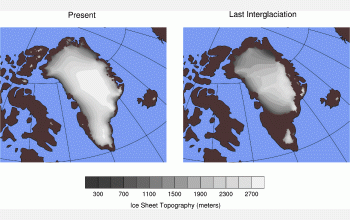
Ice sheets covering both the Arctic and Antarctic could melt more quickly than expected this century, according to two studies that blend computer modeling with paleoclimate records. Led by scientists at the National Center for Atmospheric Research (NCAR) and the University of Arizona, the studies show that by 2100, Arctic summers may be as warm as they were nearly 130,000 years ago when sea levels rose to 20 feet (6 meters) higher than they are today.
Bette Otto-Bliesner (NCAR) and Jonathan Overpeck (University of Arizona) report their new work in two papers appearing in the March 24 issue of Science.
Otto-Bliesner and Overpeck base their findings on data from ancient coral reefs, ice cores, and other natural climate records, as well as output from the NCAR-based Community Climate System Model (CCSM), a powerful tool for simulating past, present, and future climates.
Scientists such as Otto-Bliesner and Overpeck have learned to "read" the Earth's environmental history by sampling sediments and other well-preserved remains deposited over time, said Jay S. Fein, who heads the climate and large scale dynamics program in the National Science Foundation's (NSF) Division of Atmospheric Sciences.
NSF, which provides primary support to NCAR, funded the research . The study also involved researchers from the universities of Calgary and Colorado, the U.S. Geological Survey, and The Pennsylvania State University.
In this case, Fein added, the data describe a period in Earth's history characterized by a high level of Arctic warming. Based on those data, the modeling experiments Otto-Bliesner and Overpeck conducted provide important insights about possible future environmental changes in a warmer world that have the potential to significantly alter our natural and man-made environments.
"Although the focus of our work is polar, the implications are global," says Otto-Bliesner. "These ice sheets have melted before and sea levels rose. The warmth needed isn't that much more than present conditions."
The two studies show greenhouse-gas increases over the next century could warm the Arctic by 5-8 degrees Fahrenheit (3-5 degrees Celsius) in summertime--about as warm as it was 130,000 years ago, between the most recent ice age and the one before it. Changes in Earth's tilt and orbit caused the warm Arctic summers during the last interglacial period. The CCSM accurately captured that warming, which is mirrored in data from paleoclimate records.
Although simulation results depend on the assumptions and conditions of different models, estimates of warming from the CCSM are within the range projected by other climate models, according to the authors.
"Getting the past climate change correct in these models gives us more confidence in their ability to predict future climate change," says Otto-Bliesner.
The CCSM suggests that during the interglacial period, melt water from Greenland and other Arctic sources raised sea level by as much as 11 feet (3.5 meters), says Otto-Bliesner. However, coral records indicate the sea level actually rose 13-20 feet (4-6 meters) or more. Overpeck concludes that Antarctic melting must have produced the remainder of the sea-level rise.
These studies are the first to link Arctic and Antarctic melting in the last interglacial period. Marine diatoms and beryllium isotopes found beneath the West Antarctic Ice Sheet indicate parts of the ice disappeared at some point over the past several hundred thousand years.
Overpeck theorizes that the rise in sea levels produced by Arctic warming and melting could have helped destabilize ice shelves at the edge of the Antarctic ice sheet and led to their collapse. If such a process occurred today, it would be accelerated by global-scale greenhouse-induced warming year round, Overpeck says. In the Arctic, melting would likely be hastened by pollution that darkens snow and enables it to absorb more sunlight.
In the past few years sea level has begun rising more rapidly, now at a rate of about an inch per decade, says Overpeck. Recent studies have also found accelerated rates of glacial retreat along the margins of both the Greenland and West Antarctic ice sheets.
Source: NSF


