Rare parakeets to populate gulf islands
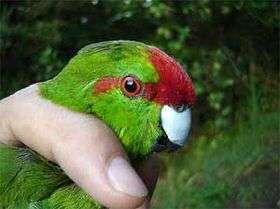
An ambitious plan to translocate 100 kakariki (red-crowned parakeets) from Little Barrier Island to two other Hauraki Gulf islands as well as a mainland site means more people will be able to see the rare birds.
Conservation researcher Luis Ortiz-Catedral, based at Massey University in Auckland, is from Mexico, a land of more raucous, garishly coloured parrots than New Zealand’s subtle-hued species. But it is our small green, long-tailed kakariki that have captured his interest in recent years.
As well as studying a small population of translocated orange-fronted kakariki, which are extremely rare and critically endangered, on remote Maud Island in the Marlborough Sounds, he is planning a large-scale translocation further north of their relative, the red-crowned kakariki. The two-pronged project is part of his doctoral thesis as a researcher at the Institute of Natural Resources, comparing how wild and captive birds cope with translocation.
The red-crowned kakariki thrive in abundance on Little Barrier Island, a protected conservation reserve. Mr Ortiz-Catedral is organising a project to capture then release the 100 birds at Rakino and Motuihe Islands as well as Tawharanui conservation reserve north of Auckland.
This will expand the geographical range of the species and enable scientists and conservationists to better understand how newly located translocated kakariki cope with the change.
A team of volunteers will help him record data of the birds’ health before they are taken by helicopter to neighbouring locations for release. They will then track, observe and record the birds’ feeding, social and breeding behaviour using electronic transmitters once they are in their new habitats.
Since 2004, he has studied the nesting biology and nesting growth of the red-crowned kakariki on Tiritiri Matangi Island, a world famous bird sanctuary also in the Hauraki Gulf.
The outlook for the next series of translocations is promising, he says. The birds, once populous throughout New Zealand but now found only on predator-free offshore islands, are good breeders. A female can produce up to nine chicks in a season. But it was their habit of foraging and nesting on the ground that evolved during New Zealand’s isolated, predator-free epoch that made them fatally vulnerable to predators such as rats, cats and stoats that were later introduced.
The project, he says, is not purely scientific. "There’s also the spiritual appeal that we are returning the parakeets to places they once belonged. It has a powerful symbolic side to it.”
Kakariki may even take flight and do their own relocating once closer to other islands and the mainland, he adds. “Who knows, one day we might see kakariki in Albert Park.”
Source: Massey University


