Scientist discovers six new species of deep sea fish
January 29th, 2008 Scientist discovers six new species of deep sea fish

A sharp eyed marine scientist who spotted six strange fish during a deep sea research expedition has been rewarded for trusting her instincts.

After painstaking work with three taxonomy experts, Dr Nikki King discovered they were – until now – completely unknown to science.

The fish were among marine life landed by the team during a trawl of a stretch of the darkest depths of the Southern Indian Ocean aboard the Royal Research Ship Discovery.

The scientists were carrying out research for the Benthic Crozet project which is a major exploration of the waters and ocean dwellers off the Crozet Islands.

Dr King from the University of Aberdeen's Oceanlab was among those responsible for examining any marine creatures caught.

She said: "I could only identify the six so far – not down to species level. So we packed them into preservative and took them home."

The Research Fellow then worked closely with Dr Peter Møller and Professor Jørgen Nielsen of the Zoological Museum, University of Copenhagen, and Professor Guy Duhamel of the Paris Natural History Museum before the three confirmed the six were indeed new to science.

Dr King said: "Ever since I set my heart on becoming a marine biologist I hoped I would discover one new species, so to have discovered six is tremendously exciting!"

Nikki and her taxonomy collaborators then had the honour of naming the deep sea creatures.

As a result, Professor Monty Priede, Director of Oceanlab, can take great pride in the knowledge that somewhere in the deep lurks a pink eelpout bearing the name Pachycara priedei.

Professor George Wolff from the University of Liverpool – who led the research expedition – was the inspiration for the snailfish now called Paraliparis wolffi.

The research expedition's exploration area and the cruise vessel itself gave rise to Careproctus crozentensis, Apagesoma (new species) and Careproctus discoveryae.

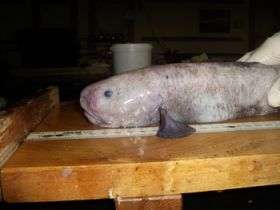
But of the six the closest to Nikki's heart was a large 42cm long brown eelpout now known as Pachycara cousinsi which was named after the 27-year-old's geophysicist fiancé Michael Cousins.

Professor Priede, who also has an eponymous two-headed parasitic worm, is delighted to be immortalised once again. He said: "We are used to discovering new species as we explore the deep sea but usually they are small worms and shrimps.

"Finding six new fishes in one expedition is remarkable.

"The team were fishing in an area that had only been sampled once previously during the voyage of the HMS Challenger 132 years ago.

"Dr King did very well spotting the significance of these fishes among the catches.

"For a zoologist having a species of animal named after one is the ultimate professional accolade, I am, delighted that a little pink fish now carries my name."

Source: University of Aberdeen


print this article email this article download pdf blog this article bookmark this article     Digg this Stumble it share on Facebook share on Reddit add to delicious save to Yahoo! bookmarks
4.2/5 after 16 votes


January 29th, 2008 all stories
Biology /

Comments: 0
Rank: 4.2/5 after 16 votes

  • Stumble this up

  • Digg this

  • Share it:
  • share on Facebook
  • share on MySpace
  • share on Slashdot
  • rss-newsfeed
  • share on Google
  • share on Reddit
  • add to delicious
  • save to Yahoo! bookmarks
  • share on Windows Live
  • Add to Mixx!
Rating: 4.2/5 after 16 votes


Tags


  • Physicists Demonstrate Quantum Memory with Matter Qubits
    Physicists Demonstrate Quantum Memory with Matter Qubits
    Physics / General Physics
    created Jul 03, 2009 | popularity 4.4 / 5 (17) | comments 1
  • 'Holey' Nanosheets for Wastewater Dye Removal
    Nanotechnology / Nanomaterials
    created Jul 01, 2009 | popularity 5 / 5 (5) | comments 1
  • Jellyfish Robot Swims Like its Biological Counterpart
    Jellyfish Robot Swims Like its Biological Counterpart
    Electronics / Robotics
    created Jun 26, 2009 | popularity 4.4 / 5 (8) | comments 1
  • Could Maxwell's Demon Exist in Nanoscale Systems?
    Could Maxwell's Demon Exist in Nanoscale Systems?
    Physics / General Physics
    created Jun 24, 2009 | popularity 4.4 / 5 (18) | comments 29
  • Living Safely with Robots, Beyond Asimov's Laws
    Living Safely with Robots, Beyond Asimov's Laws
    Electronics / Robotics
    created Jun 22, 2009 | popularity 4.6 / 5 (52) | comments 40
  • Other News

    California water plan aims to save Puget Sound orcas

    Biology / Ecology

    created 4 hours ago | popularity not rated yet | comments 0

    A plan to restore salmon runs on California's Sacramento River also could help revive killer whale populations 700 miles to the north in Puget Sound, as federal scientists struggle to protect endangered species in a complex ...


    Scientists 'rebuild' giant moa using ancient DNA

    Biology / Plants & Animals

    created Jul 01, 2009 | popularity 5 / 5 (10) | comments 12

    (PhysOrg.com) -- Scientists have performed the first DNA-based reconstruction of the giant extinct moa bird, using prehistoric feathers recovered from caves and rock shelters in New Zealand.


    Pacific Giant Salamander (Dicamptodon tenebrosus)

    Salamanders, regenerative wonders, heal like mammals, people

    Biology / Microbiology

    created Jul 01, 2009 | popularity 4.9 / 5 (19) | comments 10

    The salamander is a superhero of regeneration, able to replace lost limbs, damaged lungs, sliced spinal cord -- even bits of lopped-off brain. But it turns out that remarkable ability isn't so mysterious after ...


    Genetically modified trees

    Anti-biotech groups obstruct forest biotechnology

    Biology / Biotechnology

    created Jun 30, 2009 | popularity 3.7 / 5 (7) | comments 5

    The potential of forest biotechnology to help address significant social and environmental issues is being "strangled at birth" by the rigid opposition of some groups and regulations that effectively preclude ...


    Super-sleepers could help super-sizers!

    Super-sleepers could help super-sizers!

    Biology / Plants & Animals

    created Jun 29, 2009 | popularity 5 / 5 (2) | comments 4

    Burrowing frogs can survive buried for several years without food or water. Scientists have discovered that the metabolism of their cells changes radically during the dormancy period allowing the frogs to ...