Engineers create new adhesive that mimics gecko toe hairs
January 29th, 2008 The pitter patter of little feet... climbing straight up a wall

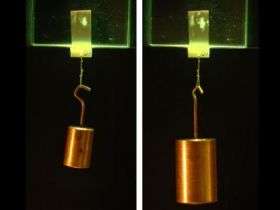
The gecko-inspired adhesive can support significant weight. Increasing weight increases contact area for the adhesive (contact area is the bright area near the top of the patch). As the load increases, more fibers are recruited to make contact, increasing the strength of the adhesion parallel to the surface. When the sliding force is removed, the fibers straighten, and the patch is easily released with negligible pull-off force. The patch has demonstrated better than 1/6 of a real gecko's stress on the same glass surface. Credit: J. Lee and R.S. Fearing, UC Berkeley

A new anti-sliding adhesive developed by engineers at the University of California, Berkeley, may be the closest man-made material yet to mimic the remarkable gecko toe hairs that allow the tiny lizard to scamper along vertical surfaces and ceilings.

The researchers say that such an adhesive could one day be used to outfit a small robot that could climb up walls.

Taking a cue from the millions of hairs covering a gecko's toes, researchers squeezed 42 million hard plastic microfibers onto each square centimeter of material and loaded it with various weights. They found that on a smooth, clean, vertical surface, two square centimeters of the synthetic adhesive could hold 400 grams (0.88 pounds). At the same time, the adhesive easily lifts off with minimal force and no residue.
The pitter patter of little feet... climbing straight up a wall

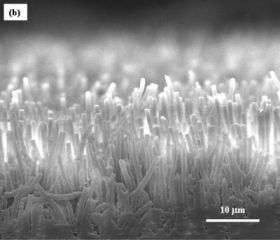
Researchers have developed a directional adhesive, inspired by the gecko, using microfibers made from a hard polymer, polypropylene. The polymer fibers are 600 nanometers in diameter, just 1/100 the diameter of a human hair, and are formed by a casting process. Like the gecko, the synthetic microfiber array is not sticky except when fibers slide a small distance along a surface. While the present microfiber array works on smooth glass, future versions could be useful for medical equipment, sporting goods, or climbing robots where a directional and easy attach-release adhesive is needed. Credit: J. Lee and R.S. Fearing, UC Berkeley

Scientists have long marveled at the gravity-defying feats of the gecko, and a number of research teams across the world are working on duplicating the lizard's adhesive forces. Ron Fearing, UC Berkeley professor of electrical engineering and computer sciences and head of the research team developing the new material, notes that previous research on gecko-like adhesives has focused on the strength of the adhesion. He said that the ease of attachment and detachment are equally important when developing a material that can practically be used for scaling vertical walls and ceilings.

What sets this new gecko-inspired adhesive apart from the others created thus far is that it is directional, only "sticking" when it slides along a smooth surface, not when it is pressed down.

"This difference is critical because if you're climbing up vertical surfaces, you can't afford to use a lot of energy pressing down into the surface to stick," said Fearing. "Using force to attach also requires force to detach. A gecko running uphill may be attaching and detaching its feet 20 times a second, so it'd get very tired if it had to work hard to pull its feet off at every step."

The microfibers, made of polypropylene, are 20 microns long, or one-fifth the thickness of a sheet of paper, with a diameter of 0.6 microns, or one-hundredth the diameter of a human hair.

The structure is similar to a microfiber array developed by the same group in 2006. That material relied upon friction to work, however, requiring the application of force to make it stick. Changes made to the plastic backing enabled the directional adhesion reported in this new material to work on truly vertical surfaces.

"For a gecko, this seemingly subtle change could mean the difference between life or death," said Fearing. "With friction only, a gecko would fall from a wall or ceiling. With directional adhesion, a gecko can stop itself from falling because the mechanism works without the need for force that is perpendicular to the surface."

The new research is described in a pair of papers published online Jan. 23 in the Journal of the Royal Society Interface. Members of Fearing's UC Berkeley research team are Jongho Lee, a graduate student in mechanical engineering, and Bryan Schubert, a graduate student in electrical engineering and computer sciences. Co-author Carmel Majidi, a former UC Berkeley graduate student in electrical engineering and computer sciences, is now a post-doctoral researcher at Princeton University.

"This is a major milestone in the new field of gecko-inspired adhesives," said Kellar Autumn, associate professor of biology at Lewis & Clark College in Portland, Ore., who is considered one of the nation's leading experts on gecko movement and who was not a co-author on this latest research. "Fearing's adhesive is made from a plastic that is very hard -- like real gecko protein -- so it is not 'sticky' to the touch. Also, just like what we found in real gecko foot hairs, Fearing's microfiber arrays are sticky only when they slide across a surface. This could be the first real gecko tape."

Fearing and his colleagues are part of a Nanoscale Interdisciplinary Research Team supported by the National Science Foundation and specifically tasked in 2003 with developing synthetic adhesives that perform like gecko hairs.

In 2000, Fearing teamed up with biologists Robert Full at UC Berkeley and Autumn at Lewis & Clark, and engineer Thomas Kenny from Stanford University, in the first study pointing to the secret of gecko adhesion: intermolecular van der Waals forces that remain weak until surfaces get intimately close. Two years later, members of this same team synthesized gecko hair tips that stick, providing the first direct experimental verification of a van der Waals mechanism for gecko foot-hair adhesion.

Not only is each gecko toe covered by millions of tiny hairs, but those hairs are further split at the end into billions of nanoscale spatulae. The van der Waals forces come into play when these spatulae make contact with the surface.

This new material is also an example of a "smart adhesive," becoming stronger with use, said Fearing, who is also part of UC Berkeley's Center for Information Technology Research in the Interest of Society. "More microfibers bend and engage automatically as the weight increases. When the load is removed, the microfibers disengage. This allows for controlled attachment and detachment and is a critical innovation for clean release and reuse. It's the first time this has been demonstrated with a hard microfiber array."

Another benefit to using hard polymers is that the fibers are less prone than softer plastic to collecting dirt after repeated use.

So far, the new adhesive only works on smooth, clean surfaces. The next step, said Fearing, is to develop a material that can also adhere to rough surfaces and that is self-cleaning.

Source: UC Berkeley


print this article email this article download pdf blog this article bookmark this article     Digg this Stumble it share on Facebook share on Reddit add to delicious save to Yahoo! bookmarks
4.5/5 after 39 votes


January 29th, 2008 all stories
Nanotechnology / Nanophysics

Comments: 0
Rank: 4.5/5 after 39 votes

  • Stumble this up

  • Digg this

  • Share it:
  • share on Facebook
  • share on MySpace
  • share on Slashdot
  • rss-newsfeed
  • share on Google
  • share on Reddit
  • add to delicious
  • save to Yahoo! bookmarks
  • share on Windows Live
  • Add to Mixx!
Rating: 4.5/5 after 39 votes

  • Related Stories

  • Study of gecko feet leads to advances in the science of friction (w/Video)
    created Jun 04, 2009 | popularity not rated yet | comments 0
  • Mimicking gecko feet: Dry adhesive based on carbon nanotubes gets stronger
    created Oct 09, 2008 | popularity not rated yet | comments 0
  • Engineers create new gecko-like adhesive that shakes off dirt
    created Sep 10, 2008 | popularity not rated yet | comments 0
  • Researchers Find Oldest Gecko Fossil Ever Discovered
    created Aug 27, 2008 | popularity not rated yet | comments 0
  • Scientists create gecko-inspired bandage
    created Feb 18, 2008 | popularity not rated yet | comments 0

Tags


  • Physicists Demonstrate Quantum Memory with Matter Qubits
    Physicists Demonstrate Quantum Memory with Matter Qubits
    Physics / General Physics
    created Jul 03, 2009 | popularity 4.4 / 5 (17) | comments 1
  • 'Holey' Nanosheets for Wastewater Dye Removal
    Nanotechnology / Nanomaterials
    created Jul 01, 2009 | popularity 5 / 5 (5) | comments 1
  • Jellyfish Robot Swims Like its Biological Counterpart
    Jellyfish Robot Swims Like its Biological Counterpart
    Electronics / Robotics
    created Jun 26, 2009 | popularity 4.4 / 5 (8) | comments 1
  • Could Maxwell's Demon Exist in Nanoscale Systems?
    Could Maxwell's Demon Exist in Nanoscale Systems?
    Physics / General Physics
    created Jun 24, 2009 | popularity 4.4 / 5 (18) | comments 29
  • Living Safely with Robots, Beyond Asimov's Laws
    Living Safely with Robots, Beyond Asimov's Laws
    Electronics / Robotics
    created Jun 22, 2009 | popularity 4.6 / 5 (52) | comments 40
  • Other News

    A 'quantum of sol' -- how nanotechnology could hold the key to a solar-powered future

    A 'quantum of sol' -- how nanotechnology could hold the key to a solar-powered future

    Nanotechnology / Nanomaterials

    created Jun 30, 2009 | popularity 3.9 / 5 (14) | comments 16

    (PhysOrg.com) -- A new generation of 'nano-structured' millimetre-sized solar cells that could convert the sun's energy to electricity more than twice as efficiently as current technology, is the subject of ...


    Australian researchers are set to begin human trials of a tiny nano-cell that acts as a "Trojan horse" against cancer

    Hi-tech 'Trojan horse' can kill cancer cells: researchers

    Nanotechnology / Bio & Medicine

    created Jun 29, 2009 | popularity 4.6 / 5 (11) | comments 7

    Australian researchers are set to begin human trials of a tiny nano-cell that acts as a "Trojan horse" against cancer cells, a breakthrough they say may curb the need for debilitating chemotherapy.


    Harnessing Nanoparticles To Track Cancer Cell Changes

    Nanotechnology / Bio & Medicine

    created Jul 03, 2009 | popularity not rated yet | comments 1

    The more dots there are, the more accurate a picture you get when you connect them. Cancer researchers adopting that philosophy have developed a new imaging technology that could give scientists the ability to simultaneously ...


    'Holey' Nanosheets for Wastewater Dye Removal

    Nanotechnology / Nanomaterials

    created Jul 01, 2009 | popularity 5 / 5 (5) | comments 1

    (PhysOrg.com) -- Researchers have discovered that extremely thin sheets of nickel oxide with hexagonally shaped holes can absorb hazardous dyes from wastewater nearly as well as the best traditional methods, but are recyclable. ...


    Computer-Guided Nanoparticle Therapy Destroys Tumors

    Nanotechnology / Bio & Medicine

    created Jun 29, 2009 | popularity 5 / 5 (11) | comments 0

    Gold nanoshells are among the most promising new nanoscale therapeutics being developed to kill tumors, acting as antennas that turn light energy into heat that cooks cancer to death. Now, a multi-institutional research team ...