Physicists explain dance marathon of wispy feature in roiling fluids
January 30, 2008
Physicists explain dance marathon of wispy feature in roiling fluids

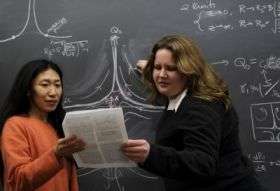
In the Feb. 1 issue of the journal Physical Review Letters, University of Chicago physicists Wendy Zhang (left) and Laura Schmidt, scientifically explain a feature of convecting fluids that colleagues have observed in laboratory experiments. The feature may help explain how hotspot volcanism created the Hawaiian Islands and other such landforms. Credit: Photo by Dan Dry

Theoretical physicists at the University of Chicago are suggesting how thin spouts of magma in the Earth's mantle can persist long enough to form hotspot volcanism of the type that might have created the Hawaiian Islands.

Their calculations also apply to tendrils only a few inches long that form in convecting fluids under laboratory conditions. University of Chicago graduate student Laura Schmidt and Wendy Zhang, an Assistant Professor in Physics, will detail their findings in the Feb. 1 issue of the journal Physical Review Letters.

The work was inspired by laboratory experiments conducted by Anne Davaille in France that mimic, in a simplified way, convecting bubbles of magma as they might look deep beneath the Earth's surface. "This is one robust feature of thermal convection," Zhang said.

"It's a useful thing to know because it's the kind of thing that happens in all sorts of different industries, in all sorts of different contexts." These include oil extraction, the chemical industry and in certain biotechnological applications.

Earth scientists also have theorized that mantle plumes form on a regional scale in the Earth's interior, sometimes breaking the surface to form small landmasses, including Hawaii and Iceland. Nevertheless, debate swirls around how, or even if, mantle plumes can account for such surface features.

Geophysicists often liken a pot of boiling water as a smaller, more rapid version of the convection that takes place in the mantle, the layer of Earth that lies between the surface crust and its core. But unlike a pot of water, the Earth's interior consists of layers with different properties.

In laboratory experiments, Anne Davaille, a geophysicist at the University of Paris 7, studies convection in a small tank by heating two layers of colored liquids of differing densities. She observed the formation and persistence of thin tendrils between the layers, which correspond to subsurface plumes measuring scores of miles across.

"It seems so thin and tenuous, how could it possibly manage to hold itself in place over time as everything else is going on around it?" Zhang asked. "Somehow, they manage to hold themselves together."

The tendrils persist for hours, even as experimental conditions change. "These tendrils have fluid flowing through them, and it starts to mix the two layers," Schmidt said. "When the two layers mix, then the viscosity of the layers changes as well."

Following a series of visits to Davaille's lab, Schmidt and Zhang sought to mathematically explain the phenomenon.

"When you look at the shape of these very thin tendrils, there's something very striking that Anne noticed right away," Zhang said. The tendrils seem to emerge from flow lines that resemble the flared-out end of a trumpet. This trumpet shape marked the location of a stagnation point. Both Davaille's experiments and Schmidt's calculations agree: The thinnest tendrils that persist have a stagnation point.

Schmidt had seen a similar stagnation point in experiments she conducted in the laboratory of Sidney Nagel, the Stein-Freiler Distinguished Service Professor in Physics at the University of Chicago. Those experiments involved unmixable fluids, such as water and oil, instead of the fresh water and salt water mixing in Davaille's laboratory.

Nevertheless, the experimental similarities provided Schmidt and Zhang insights that helped solve the problem. In previous studies, other theoreticians suggested how large flows might rise through the tendrils from the base of the hot spots, Schmidt said. She and Zhang approached the problem differently.

"We include the effect of the stagnation point," Schmidt explained. "Our tendrils are really a thin skin or thin layer of the surface between the fluids that is drawn up. It's not a bulk flow going up through the tendril."

Source: University of Chicago

4.6 /5 (8 votes)  

Rank 4.6 /5 (8 votes)
Tags

Related Stories
Relevant PhysicsForums posts

More news stories

Fast photon control brings quantum photonic technologies closer

(PhysOrg.com) -- Using photons instead of electrons to transmit information could lead to faster and more secure ways to communicate, among other advantages. Now a team of physicists has taken another step toward realizing ...

Physics / Optics & Photonics

created 1 hour ago | popularity 5 / 5 (2) | comments 0 | with audio podcast feature

Rapunzel, Leonardo and the physics of the ponytail

(PhysOrg.com) -- New research provides the first mathematical understanding of the shape of a ponytail and could have implications for the textile industry, computer animation and personal care products.

Physics / General Physics

created 5 hours ago | popularity 4.8 / 5 (4) | comments 0 | with audio podcast

Researchers make better heat sensor based on butterfly wings

(PhysOrg.com) -- Scientists have long known that butterfly wings produce their iridescent colors by bouncing light around and between tiny ridges in structures made of chitin. More recently they’ve discovered ...

Physics / Optics & Photonics

created 2 hours ago | popularity 5 / 5 (2) | comments 0 | with audio podcast report

Explained: Sigma

It's a question that arises with virtually every major new finding in science or medicine: What makes a result reliable enough to be taken seriously? The answer has to do with statistical significance -- but ...

Physics / General Physics

created Feb 09, 2012 | popularity 5 / 5 (21) | comments 87

Quantum physicist explains $100K offer for proof scaled-up quantum computing is impossible

(PhysOrg.com) -- MIT researcher Scott Aaronson has certainly riled the physics community with his offer this past Friday, of $100,000 to anyone who can prove that scaled-up quantum computing is impossible. ...

Physics / Quantum Physics

created Feb 08, 2012 | popularity 4.3 / 5 (15) | comments 38 | with audio podcast weblog


Planck mission steps closer to the cosmic blueprint

(PhysOrg.com) -- ESA's Planck mission has revealed that our Galaxy contains previously undiscovered islands of cold gas and a mysterious haze of microwaves. These results give scientists new treasure to mine ...

Slowing ocean current caused Earth to spin faster

(PhysOrg.com) -- Most people probably didn’t notice it, but back in 2009, the Earth spun around on its axis a tiny bit faster than usual, making for some slightly shorter days. It only happened for a ...

'It's not nutritious until it's eaten'

As part of her "Let's Move! Initiative," First Lady Michelle Obama unveiled a new web resource highlighting new changes in the Chefs Move to Schools, during a CMST gathering in Dallas, TX today. CMTS advocates ...

Independent group inspects Apple supplier

(AP) -- An independent group, the Fair Labor Association, has started auditing Apple Inc.'s Chinese supplier Foxconn after a request by Apple.

New ability to regrow blood vessels holds promise for treatment of heart disease

(Medical Xpress) -- University of Texas at Austin researchers have demonstrated a new and more effective method for regrowing blood vessels in the heart and limbs — a research advancement that could have ...

Motivation to exercise affects behavior

(Medical Xpress) -- For many people, the motivation to exercise fluctuates from week to week, and these fluctuations predict whether they will be physically active, according to researchers at Penn State. In an effort to ...