New Light on Dark Energy
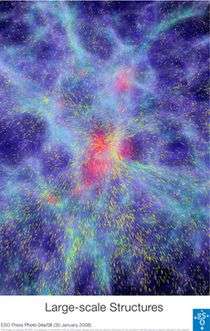
January 30, 2008 Large-scale structures

Snapshot from a computer simulation of the formation of large-scale structures in the Universe, showing a patch of 100 million light-years and the resulting coherent motions of galaxies flowing towards the highest mass concentration in the centre. The snapshot refers to an epoch about 10 billion years back in time. The colour scale represents the mass density, with the highest density regions painted in red and the lowest in black. The tiny yellow lines describe the intensity and direction of the galaxy´s velocities. Like compass needles, they map the infall pattern and measure the rate of growth of the central structure. This depends on the subtle balance between dark matter, dark energy and the expansion of the Universe. Astronomers can measure this effect using large survey of galaxies at different epochs in time, as shown by the new research. Credit: Klaus Dolag and the VVDS team.

Astronomers have used ESO’s Very Large Telescope to measure the distribution and motions of thousands of galaxies in the distant Universe. This opens fascinating perspectives to better understand what drives the acceleration of the cosmic expansion and sheds new light on the mysterious dark energy that is thought to permeate the Universe.

“Explaining why the expansion of the Universe is currently accelerating is certainly the most fascinating question in modern cosmology,” says Luigi Guzzo, lead author of a paper in this week’s issue of Nature, in which the new results are presented. “We have been able to show that large surveys that measure the positions and velocities of distant galaxies provide us with a new powerful way to solve this mystery.”

Ten years ago, astronomers made the stunning discovery that the Universe is expanding at a faster pace today than it did in the past.

“This implies that one of two very different possibilities must hold true,” explains Enzo Branchini, member of the team. “Either the Universe is filled with a mysterious dark energy which produces a repulsive force that fights the gravitational brake from all the matter present in the Universe, or, our current theory of gravitation is not correct and needs to be modified, for example by adding extra dimensions to space.”

Current observations of the expansion rate of the Universe cannot distinguish between these two options, but the international team of 51 scientists from 24 institutions found a way that could help in tackling this problem. The technique is based on a well-known phenomenon, namely the fact that the apparent motion of distant galaxies results from two effects: the global expansion of the Universe that pushes the galaxies away from each other and the gravitational attraction of matter present in the galaxies’ neighbourhood that pulls them together, creating the cosmic web of large-scale structures.

“By measuring the apparent velocities of large samples of galaxies over the last thirty years, astronomers have been able to reconstruct a three-dimensional map of the distribution of galaxies over large volumes of the Universe. This map revealed large-scale structures such as clusters of galaxies and filamentary superclusters ”, says Olivier Le Fèvre, member of the team. “But the measured velocities also contain information about the local motions of galaxies; these introduce small but significant distortions in the reconstructed maps of the Universe. We have shown that measuring this distortion at different epochs of the Universe’s history is a way to test the nature of dark energy.”

Guzzo and his collaborators have been able to measure this effect by using the VIMOS spectrograph on Melipal, one of the four 8.2-m telescopes that is part of ESO’s VLT. As part of the VIMOS-VLT Deep Survey (VVDS), of which Le Fèvre is the Principal Investigator, spectra of several thousands of galaxies in a 4-square-degree field (or 20 times the size of the full Moon) at epochs corresponding to about half the current age of the Universe (about 7 billion years ago) were obtained and analysed.

“This is the largest field ever covered homogeneously by means of spectroscopy to this depth,” says Le Fèvre. “We have now collected more than 13,000 spectra in this field and the total volume sampled by the survey is more than 25 million cubic light-years.”

The astronomers compared their result with that of the 2dFGRS survey that probed the local Universe, i.e. measures the distortion at the present time.

Within current uncertainties, the measurement of this effect provides an independent indication of the need for an unknown extra energy ingredient in the ‘cosmic soup’, supporting the simplest form of dark energy, the so-called cosmological constant, introduced originally by Albert Einstein. The large uncertainties do not yet exclude the other scenarios, though.

“We have also shown that by extending our measurements over volumes about ten times larger than the VVDS, this technique should be able to tell us whether cosmic acceleration originates from a dark energy component of exotic origin or requires a modification of the laws of gravity,” said Guzzo.

“VIMOS on the VLT would certainly be a wonderful tool to perform this future survey and help us answer this fundamental question. This strongly encourages our team to proceed with even more ambitious surveys of the distant Universe,” says Le Fèvre.

Source: ESO


print this article email this article download pdf blog this article bookmark this article     Stumble it Digg this share on Facebook retweet share on Reddit add to delicious
Rate this story - 4.5 /5 (58 votes)

Rank Filter

Move the slider to adjust rank threshold, so that you can hide some of the comments.


Display comments: newest first

  • earls - Jan 30, 2008
    • Rank: 1 / 5 (2)
    "Either the Universe is filled with a mysterious dark energy which produces a repulsive force that fights the gravitational brake from all the matter present in the Universe, or, our current theory of gravitation is not correct and needs to be modified"

    Hmmmmm... Hmm.... Coin toss?
  • Noumenon - Jan 30, 2008
    • Rank: 3 / 5 (2)
    So, locally, galaxies spin and behave as if there is more gravitational force than what is accounted for visually,... and yet considered in relation to other galaxies and clusters on a larger scale, they accelerate as if there is less gravitational force with time than what is accounted for? Poor cosmologist. :)
  • out7x - Jan 31, 2008
    • Rank: 1 / 5 (1)
    This is very important work. Turning 2D into a 3D universe. Onward!! I have little faith in dark energy. Go 10D superstrings!
  • LearmSceince - Feb 11, 2008
    • Rank: not rated yet
    Hmmmmm... Hmm.... Coin toss?


    No. Design experiments that would distinguish between the candidates.
  • marlowg - Mar 01, 2008
    • Rank: not rated yet
    If matter contains an energy component with a wavelength equal to the size of the universe, it would explain why gravity started out stronger in the beginning and got weaker with time. If you do the math for 14 BLY, you will also see that this wavelength's relative energy compared to the rest energy of an electron is on the order of gravity's relative strength compared to the strength of the electric force.

January 30, 2008 all stories

Comments: 5

4.5 /5 (58 votes)
  • Stumble this up

  • Digg this

  • share this

  • hide
  • Related Stories

  • Rapid supernova could be new class of exploding star
    created Nov 05, 2009 | popularity not rated yet | comments 0
  • Stars Fueled by Dark Matter Could Hold Secrets to the Universe
    created Nov 03, 2009 | popularity not rated yet | comments 0
  • Dark Matter in a Galaxy
    created Oct 30, 2009 | popularity not rated yet | comments 0
  • Dark matter sleuths to design world's largest WIMP catcher
    created Oct 29, 2009 | popularity not rated yet | comments 0
  • Astronomers explore 'last blank space' on map of the Universe
    created Oct 28, 2009 | popularity not rated yet | comments 0


  • hide
  • Relevant PhysicsForums posts

  • Electromagnet design
    created 1hour ago
  • Physics practice, please help me!
    created 2 hours ago
  • Work done on femur
    created 4 hours ago
  • Magnet and Motors?
    created 5 hours ago
  • Effect of Volume on Revolution
    created 5 hours ago
  • Hydrostatic pressure
    created 7 hours ago
  • More from Physics Forums - General Physics

Other News

Stars Fueled by Dark Matter Could Hold Secrets to the Universe

Stars Fueled by Dark Matter Could Hold Secrets to the Universe

Physics / General Physics

created Nov 03, 2009 | popularity 4.5 / 5 (51) | comments 41

(PhysOrg.com) -- The first stars in the universe may have been very different from the stars we see today, yet they may hold clues to understanding some of the mysterious features of the universe. These "dark ...


Second Law of Thermodynamics May Explain Economic Evolution

Second Law of Thermodynamics May Explain Economic Evolution

Physics / General Physics

created Nov 02, 2009 | popularity 4.3 / 5 (30) | comments 28

(PhysOrg.com) -- Terms such as the "invisible hand," laissez-faire policy, and free-market principles suggest that economic growth and decline in capitalist societies seem to be somehow self-regulated. Now, ...


High-performance plasmas may make reliable, efficient fusion power a reality

High-performance plasmas may make reliable, efficient fusion power a reality

Physics / Plasma Physics

created Nov 02, 2009 | popularity 4.7 / 5 (39) | comments 33

In the quest to produce nuclear fusion energy, researchers from the DIII-D National Fusion Facility have recently confirmed long-standing theoretical predictions that performance, efficiency and reliability ...


'Teapot effect' solved

Solving Teapot Effect

Physics / General Physics

created Nov 02, 2009 | popularity 4.9 / 5 (11) | comments 10

(PhysOrg.com) -- A team of scientists from France have worked out why teapots dribble at low flow rates, and how to stop them. The effect is called the "teapot effect", and solving it could finally put an ...


Laser accelerated protons to the highest energies so far

Researchers use trident laser to accelerate protons to record energies

Physics / General Physics

created Nov 02, 2009 | popularity 4.7 / 5 (6) | comments 10

An international team of physicists at Los Alamos National Laboratory has succeeded in using intense laser light to accelerate protons to energies never before achieved. Using this technique, scientists can ...