Mercury's magnetosphere fends off the solar wind
January 30, 2008 MESSENGER at Mercury

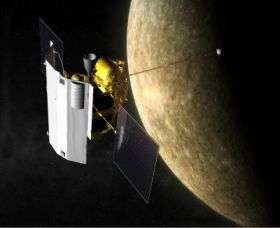
Artist's concept of the NASA's MESSENGER spaceraft at Mercury. Credit: NASA

The planet Mercury's magnetic field appears to be strong enough to fend off the harsh solar wind from most of its surface, according to data gathered in part by a University of Michigan instrument onboard NASA's MESSENGER spacecraft.

U-M's Fast Imaging Plasma Spectrometer (FIPS) on Jan. 14 took the first direct measurements of Mercury's magnetosphere to determine how the planet interacts with the space environment and the Sun.

The solar wind, a stream of charged particles, fills the entire solar system. It interacts with all planets, but bears down on Mercury, 2/3 closer than the Earth to the Sun.

Earth's magnetosphere is strong enough to protect us from the solar wind's radiation, but Mercury's magnetic field is comparatively weaker.

"From our magnetic measurements, we can tell that Mercury is managing to stand up to a lot of the solar wind and protect the surface of the planet, at least in some spots. Even though the magnetic field was weak, it was enough," said Thomas Zurbuchen, FIPS instrument project leader and a professor in the U-M Department of Atmospheric, Oceanic and Space Science.

Zurbuchen said scientists can tell Mercury is putting up a good fight because instruments detected a layer of much slower-moving magentospheric plasma around the planet.

It's possible that the magnetosphere shield has holes. Scientists found ions in the magnetosphere that may have been knocked off the surface by the solar wind at the poles, for example. The source and chemical composition of the ions is still unclear, Zurbuchen said. The particles could also be from the planet's thin atmosphere.

"Mercury's magnetosphere is more similar to Earth's than we might have thought," Zurbuchen said.

The spacecraft did find one major difference. Mercury has no Van Allen Belts, wing-shaped regions of energetic particles trapped by Earth's magnetic field.

"We flew through the region they would be in and they just weren't there," Zurbuchen said. "It could be that they're intermittent, but when we were there, they weren't."

Mercury and Earth are the only two terrestrial planets in the solar system with magnetospheres produced by an intrinsic magnetic field

This was the first of three planned flybys of Mercury. MESSENGER is scheduled to enter orbit in 2011.

View Movie: http://www.nasa.gov/mov/209705main_Prockter08Departure.mov

Source: University of Michigan


print this article email this article download pdf blog this article bookmark this article     Stumble it Digg this share on Facebook retweet share on Reddit add to delicious
Rate this story - 4.1 /5 (15 votes)


January 30, 2008 all stories

Comments: 0

4.1 /5 (15 votes)
  • Stumble this up

  • Digg this

  • share this

  • hide
  • Related Stories

  • Cassini Captures Ghostly Dance of Saturn's Northern Lights (w/ Video)
    created Nov 24, 2009 | popularity not rated yet | comments 0
  • Cassini's Big Sky: The View from the Center of Our Solar System
    created Nov 20, 2009 | popularity not rated yet | comments 0
  • Science at the petascale: Roadrunner supercomputer results unveiled
    created Oct 26, 2009 | popularity not rated yet | comments 0
  • Galileo's Jupiter Journey Began Two Decades Ago
    created Oct 19, 2009 | popularity not rated yet | comments 0
  • Cassini Data Help Redraw Shape of Solar System (w/ Video)
    created Oct 16, 2009 | popularity not rated yet | comments 0


  • hide
  • Relevant PhysicsForums posts

  • Question about 2-body gravity
    created Nov 24, 2009
  • life on Mars
    created Nov 24, 2009
  • Semi-major axis from cartesian co-ordinates
    created Nov 23, 2009
  • Primary Mirror grinding
    created Nov 23, 2009
  • More from Physics Forums - General Astronomy

Other News

Monster Waves on the Sun are Real

Monster Waves on the Sun are Real (w/ Video)

Space & Earth / Astronomy

created 6 hours ago | popularity 5 / 5 (8) | comments 1

Sometimes you really can believe your eyes. That's what NASA's STEREO (Solar Terrestrial Relations Observatory) spacecraft are telling researchers about a controversial phenomenon on the sun known as the "solar ...


Cosmic 'dig' reveals vestiges of the Milky Way's building blocks

Cosmic 'Dig' Reveals Vestiges of the Milky Way's Building Blocks

Space & Earth / Astronomy

created 11 hours ago | popularity 4.9 / 5 (13) | comments 1

(PhysOrg.com) -- Peering through the thick dust clouds of our galaxy's "bulge" (the myriads of stars surrounding its center), a team of astronomers has unveiled an unusual mix of stars in the stellar grouping ...


No Wheel Stall in Diagnostic Drive

Spirit Mars Rover: No Wheel Stall in Diagnostic Drive

Space & Earth / Space Exploration

created 7 hours ago | popularity 4.5 / 5 (2) | comments 0

(PhysOrg.com) -- On Sol 2095 (Tuesday, Nov. 24), Spirit performed a set of diagnostic actions related to a stall of the right-rear wheel on the previous drive, three days earlier.


Climate experts debate strategies for reducing atmospheric carbon and future warming

Climate experts debate strategies for reducing atmospheric carbon and future warming

Space & Earth / Environment

created 7 hours ago | popularity 2.8 / 5 (6) | comments 6

(PhysOrg.com) -- Reducing carbon dioxide to safe levels may require extracting carbon from the air, says Cornell climate researcher.


Oceanic crust formation is dynamic after all

Oceanic crust formation is dynamic after all

Space & Earth / Earth Sciences

created 10 hours ago | popularity 4.6 / 5 (5) | comments 0

Imagine the Earth's crust as the planet's skin: Some areas are old and wrinkled while others have a fresher, more youthful sheen, as if they had been regularly lathered with lotion.