New solar twin could shed light on another Earth
March 24th, 2006 New solar twin could shed light on another Earth

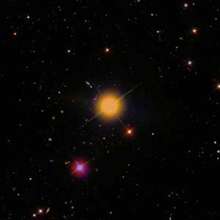
Colour enhanced zoom around HD98618, created using information from the Sloan Digital Sky Survey.

ANU (Australian National University) astronomers have discovered a nearby solar twin which may shed light on the search for planets that are similar to Earth and that may even support life. HD98618 is only the second star found so far that is almost identical to the Sun in age, size, temperature and chemistry, according to the researchers Dr Jorge Meléndez, Ms Katie Dodds-Eden and Mr José Robles, from the Research School of Astronomy and Astrophysics.

“This solar twin doesn’t only have the same mass as the Sun, it was also formed with the same ‘chemical recipe’. So this star was equipped in the same way as the Sun to form Earth-like planets,” Mr Robles said.

“Hopefully, as new planet finding techniques are developed and refined, astronomers will find whether HD98618 hosts terrestrial planets, which may even contain life.”

HD98618 lies a mere 126 light-years away in the northern constellation of Ursa Major (the ‘Big Dipper’). It is bright enough to see in binoculars, but only in the Northern Hemisphere.

The researchers believe that HD98618 is about four billion years-old, about 10 per cent younger than our own Sun. Its chemical properties are almost identical to the Sun and to the other closest Sun twin, a star known as 18 Scorpii, which was discovered a decade ago.

“It means that hypothetical terrestrial planets around this solar twin may have had enough time to develop some kind of complex life, assuming the time-scale for complex life formation is similar to Earth’s,” Dr Meléndez said.

The team says that focused observations of the two stars by planet-hunter teams could reveal or rule out within a few years giant planets, such as our own Jupiter, around HD98618. “18 Scorpii and HD98618 offer hope to find solar systems similar to our own in the Universe,” Dr Meléndez said.

The discovery also has implications for research in other areas. Solar twins are ideal for the absolute calibration of astronomical measuring instruments. They can provide data useful in modelling the solar phenomena that may affect climate change, and will help settle the argument about the uniqueness or otherwise of our Sun and Solar System.

“We had a number of candidates with similar properties to the Sun, but while we held out hope for each star that it would turn out to be really special, it was not at all certain to happen. HD 98618 was one of the last of our candidates to be analysed, so it was quite a surprise when we discovered how it stood out from the other candidates, together with 18 Scorpii. It was very exciting - I had to blink twice to be sure I wasn’t imagining it,” Ms Dodds-Eden said.

The researchers made the discovery using the largest telescope in the world, the 10m Keck I telescope on the summit of Hawaii’s dormant Mauna Kea volcano.

Their paper detailing the discovery will be published in Astrophysical Journal Letters.

Source: Australian National University


print this article email this article download pdf blog this article bookmark this article     Digg this Stumble it share on Facebook share on Reddit add to delicious save to Yahoo! bookmarks
4.7/5 after 33 votes


March 24th, 2006 all stories
Space & Earth /

Comments: 0
Rank: 4.7/5 after 33 votes

  • Stumble this up

  • Digg this

  • Share it:
  • share on Facebook
  • share on MySpace
  • share on Slashdot
  • rss-newsfeed
  • share on Google
  • share on Reddit
  • add to delicious
  • save to Yahoo! bookmarks
  • share on Windows Live
  • Add to Mixx!
Rating: 4.7/5 after 33 votes

  • Related Stories

  • VLBA locates superenergetic bursts near giant black hole
    created Jul 02, 2009 | popularity not rated yet | comments 0
  • Earth's most prominent rainfall feature creeping northward
    created Jul 01, 2009 | popularity not rated yet | comments 0
  • New class of black holes discovered
    created Jul 01, 2009 | popularity not rated yet | comments 0
  • Astronomers discover pair of solar systems in the making
    created Jul 01, 2009 | popularity not rated yet | comments 0
  • Scientists bid adieu to plucky solar probe
    created Jun 30, 2009 | popularity not rated yet | comments 0

Tags


  • Physicists Demonstrate Quantum Memory with Matter Qubits
    Physicists Demonstrate Quantum Memory with Matter Qubits
    Physics / General Physics
    created Jul 03, 2009 | popularity 4.4 / 5 (17) | comments 1
  • 'Holey' Nanosheets for Wastewater Dye Removal
    Nanotechnology / Nanomaterials
    created Jul 01, 2009 | popularity 5 / 5 (5) | comments 1
  • Jellyfish Robot Swims Like its Biological Counterpart
    Jellyfish Robot Swims Like its Biological Counterpart
    Electronics / Robotics
    created Jun 26, 2009 | popularity 4.4 / 5 (8) | comments 1
  • Could Maxwell's Demon Exist in Nanoscale Systems?
    Could Maxwell's Demon Exist in Nanoscale Systems?
    Physics / General Physics
    created Jun 24, 2009 | popularity 4.4 / 5 (18) | comments 29
  • Living Safely with Robots, Beyond Asimov's Laws
    Living Safely with Robots, Beyond Asimov's Laws
    Electronics / Robotics
    created Jun 22, 2009 | popularity 4.6 / 5 (52) | comments 40
  • Other News

    Forty years ago man first walked on the moon

    Space & Earth / Space Exploration

    created 20 hours ago | popularity 4.3 / 5 (4) | comments 2

    Forty years ago on July 20, 1969, American astronaut Neil Armstrong realized the oldest dream of human civilizations when he became the first man to walk on the moon.


    The least sea ice in 800 years

    The least sea ice in 800 years

    Space & Earth / Earth Sciences

    created Jul 01, 2009 | popularity 4.1 / 5 (63) | comments 59

    New research, which reconstructs the extent of ice in the sea between Greenland and Svalbard from the 13th century to the present indicates that there has never been so little sea ice as there is now. The ...


    Gas around young galaxy

    Intense heat killed the Universe's would-be galaxies, researchers say

    Space & Earth / Astronomy

    created Jul 01, 2009 | popularity 3.4 / 5 (21) | comments 27

    (PhysOrg.com) -- Our Milky Way galaxy only survived because it was already immersed in a large clump of dark matter which trapped gases inside it, scientists led by Durham University's Institute for Computational ...


    Scientists' Drill Hits Magma: Only Third Time on Record

    Scientists' Drill Hits Magma: Only Third Time on Record

    Space & Earth / Earth Sciences

    created Jun 29, 2009 | popularity 4.7 / 5 (22) | comments 19

    (PhysOrg.com) -- Scientists drilling a borehole deep into Iceland’s rocky crust to explore new methods of using geothermal energy hit a major roadblock on Thursday: Their drill ran into molten rock at a depth ...


    NASA manager pitches a cheaper return-to-moon plan

    Space & Earth / Space Exploration

    created Jun 30, 2009 | popularity 4.1 / 5 (8) | comments 18

    (AP) -- Like a car salesman pushing a luxury vehicle that the customer no longer can afford, NASA has pulled out of its back pocket a deal for a cheaper ride to the moon.