Researchers create gold aluminum, black platinum, blue silver
February 1, 2008 Researchers create gold aluminum, black platinum, blue silver

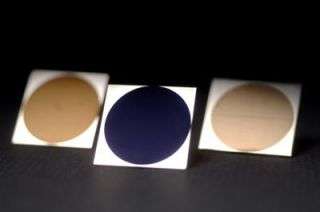
Gold platinum, blue titanium, and gold aluminum. Credit: Richard Baker, University of Rochester

Using a tabletop laser, a University of Rochester optical scientist has turned pure aluminum, gold. And blue. And gray. And many other colors. And it works for every metal tested, including platinum, titanium, tungsten, silver, and gold.

Chunlei Guo, the researcher who a year ago used intense laser light to alter the properties of a variety of metals to render them pitch black, has pushed the same process further in a paper in today’s Applied Physics Letters. He now believes it’s possible to alter the properties of any metal to turn it any color—even multi-colored iridescence like a butterfly’s wings.

Since the process changes the intrinsic surface properties of the metal itself and is not just a coating, the color won’t fade or peel, says Guo, associate professor of optics at the Institute of Optics at the University of Rochester. He suggests the possibilities are endless—a cycle factory using a single laser to produce bicycles of different colors; etching a full-color photograph of a family into the refrigerator door; or proposing with a gold engagement ring that matches your fiancée’s blue eyes.

“Since the discovery of the black metal we’ve been determined to get full control on getting metals to reflect only a certain color and absorb the rest, and now we finally can make a metal reflect almost any color we wish,” says Guo. “When we first found the process that produced a gold color, we couldn’t believe it. We worked in the lab until midnight trying to figure out what other colors we could make.”

Guo and his assistant, Anatoliy Vorobeyv, use an incredibly brief but incredibly intense laser burst that changes the surface of a metal, forming nanoscale and microscale structures that selectively reflect a certain color to give the appearance of a specific color or combinations of colors.

The metal-coloring research follows up on Guo’s breakthrough “black metal” discovery in late 2006, when his research team was able to create nanostructures on metal surfaces that absorbed virtually all light, making something as simple as regular aluminum into one of the darkest materials ever created.

Guo’s black metal, with its very high absorption properties, is ideal for any application where capturing light is desirable. The potential applications range from making better solar energy collectors, to more advanced stealth technology, he says.

The ultra-brief/ultra-intense light Guo uses is produced by a femtosecond laser, which produces pulses lasting only a few quadrillionths of a second. A femtosecond is to a second what a second is to about 32 million years. During its brief burst, Guo’s laser unleashes as much power as the entire electric grid of North America does, all focused onto a spot the size of a needlepoint.

The intense blast forces the surface of the metal to form nanostructures—pits, globules, and strands that response incoming light in different ways depending on the way the laser pulse sculpted the structures. Since the structures are smaller than the wavelength of light, the way they reflect light is highly dependent upon their specific size and shape, says Guo. Varying the laser intensity, pulse length, and number of pulses, allows Guo to control the configuration of the nanostructures, and hence control what color the metal reflects.

Guo and Vorobyev also achieve the iridescent coloring by creating microscale lines covered with nanostructures. The lines, arranged in regular rows, cause reflected light of different wavelengths to interfere differently in different directions. The result is a piece of metal that can appear solid purple from one direction, and gray from another, or multiple colors all at once.

To alter an area of metal the size of a dime currently takes 30 minutes or more, but the researchers are working on refining the technique. Fortunately, despite the incredible intensity involved, the femtosecond laser can be powered by a simple wall outlet, meaning that when the process is refined, implementing it should be relatively simple.

The new process has worked on every metal Guo has tried, and the results are so consistent that he believes it will work for every metal known. His team is currently working to find the right tuning to create the rest of the rainbow for the solid-colored metal, including red and green.

Source: University of Rochester


print this article email this article download pdf blog this article bookmark this article     Stumble it Digg this share on Facebook retweet share on Reddit add to delicious
Rate this story - 4.7 /5 (111 votes)

Rank Filter

Move the slider to adjust rank threshold, so that you can hide some of the comments.


Display comments: newest first

  • zevkirsh - Feb 01, 2008
    • Rank: not rated yet
    can we do this with infra-red and other frequencies to make theese materials totally invisible in other spectra? Could this basically eliminate the signature of aircraft, cars, and other objects...to electromagnetic beams, if that were possible.
    z
  • mrlewish - Feb 01, 2008
    • Rank: not rated yet
    How about I bring out my DeLorean and have it colored?
  • earls - Feb 01, 2008
    • Rank: not rated yet
    Interesting question zevkirsh. I think it would just appear "black" however. See the article about the blackest material made to date.
  • Ashibayai - Feb 01, 2008
    • Rank: not rated yet
    Yeah, I'd be interested in hearing if this can be expanded to other wavelengths. I doubt it would work in a wide range of wavelengths simultaneously though.
  • CWFlink - Feb 01, 2008
    • Rank: not rated yet
    Possible applications: 1) solar heating panels need to absorb light... surfaces often painted black, but would probably work better if etched this way instead of painted; 2) also, radiative cooling surfaces should work best if blacken this way; 3) similarly, if can make "white", surfaces should be cooler... i.e. cool roofing material, etc.
  • deatopmg - Feb 03, 2008
    • Rank: not rated yet
    what is the durability of these surfaces? Could they be used to any advantage to replace ruled gratings? It seems that touching them would destroy the effect...but it's great work nevertheless
  • Gregori - Feb 03, 2008
    • Rank: 5 / 5 (1)
    its proabably just cosmetic and aesthetic aplications, which is also cool. I've been wating for them to do something like this for a long time.

    I was wondering where the wierd rainbow pattern come from when you weld to pieces of metal and can this be controlled too, it looks really cool.
  • billyswong - Feb 03, 2008
    • Rank: not rated yet
    deatopmg, I guess most of them won't be so easily destroyed by touching, since they are of metal. One need to at least scratch it. Maybe gold would be too soft but aluminum should be able to withstand touching.
  • Lokigrins - Feb 03, 2008
    • Rank: not rated yet
    I can't wait to see a pink jon boat...
  • Graeme - Apr 21, 2008
    • Rank: not rated yet
    Once all the colours are available it should be possible to burn a photographic image into the metal surface. Those rainbow colours after welding will be due to varying thickness of oxide layers. already with oxides it is possible to get some nice colour effects.
  • NovaElite - Dec 22, 2008
    • Rank: not rated yet
    i was wondering if this technology can be applied to wedding rings to make a platinum band look like the blue metal in this link; http://img.photob...617.jpg.
  • NovaElite - Dec 22, 2008
    • Rank: not rated yet
    http://img.photobucket.com /albums /v349 /Baranor /Guildwars /gw617.jpg
  • hfilipenk - Jun 13, 2009
    • Rank: not rated yet

February 1, 2008 all stories

Comments: 13

4.7 /5 (111 votes)
  • Stumble this up

  • Digg this

  • share this

  • hide
  • Related Stories

  • Laser technology creates new forms of metal and enhances aircraft performance
    created Jul 15, 2009 | popularity not rated yet | comments 0
  • Scientists create metal that pumps liquid uphill
    created Jun 02, 2009 | popularity not rated yet | comments 0
  • Regular Light Bulbs Made Super-Efficient with Ultra-Fast Laser
    created May 29, 2009 | popularity not rated yet | comments 0
  • Ultra-intense laser blast creates true 'black metal'
    created Nov 21, 2006 | popularity not rated yet | comments 0
  • Highlight: Damping of acoustic vibrations in gold nanoparticles
    created Nov 19, 2009 | popularity not rated yet | comments 0


  • hide
  • Relevant PhysicsForums posts

Other News

In the Brain, Seven Is A Magic Number

In the Brain, Seven Is A Magic Number

Physics / General Physics

created 8 hours ago | popularity 4.3 / 5 (15) | comments 5

Having a tough time recalling a phone number someone spoke a few minutes ago or forgetting items from a mental grocery list is not a sign of mental decline; in fact, it's natural.


Scientists react as they stand in front of a screen at CERN

First atoms reported smashed in Large Hadron Collider (Update)

Physics / General Physics

created 10 hours ago | popularity 4.8 / 5 (17) | comments 7

Two circulating beams on Monday produced the first particle collisions in the world's biggest atom smasher, the Large Hadron Collider (LHC), three days after its restart, scientists announced.


Visual assistance for cosmic blind spots

Visual assistance for cosmic blind spots

Physics / General Physics

created 11 hours ago | popularity 4.3 / 5 (3) | comments 0

A bit of imagination on the part of a measuring instrument wouldn't be a bad thing. It could help to add data from areas where the instrument is unable to measure. However, it must do so constructively. In ...


A mechanical model of vocalization

Physics / General Physics

created 7 hours ago | popularity not rated yet | comments 0

When people speak, sing, or shout, they produce sound by pushing air over their vocal folds -- bits of muscle and tissue that manipulate the air flow and vibrate within it. When someone has polyps or some other problem with ...


Big Bang atom smasher sends beams in 2 directions (AP)

Large Hadron Collider sends beams in 2 directions

Physics / General Physics

created 14 hours ago | popularity 4.9 / 5 (10) | comments 0

(AP) -- The world's largest atom smasher made another leap forward Monday by circulating beams of protons in opposite directions at the same time in the $10 billion machine after more than a year of repairs, ...