NASA to Beam Beatles' 'Across the Universe' Into Space
February 1st, 2008 NASA to Beam Beatles' 'Across the Universe' Into Space

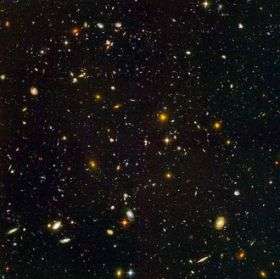
An estimated 10,000 galaxies are revealed in humankind's deepest portrait of the visible universe ever from the Hubble Space Telescope Credit: NASA

For the first time ever, NASA will beam a song -- The Beatles' "Across the Universe" -- directly into deep space at 7 p.m. EST on Feb. 4.

The transmission over NASA's Deep Space Network will commemorate the 40th anniversary of the day The Beatles recorded the song, as well as the 50th anniversary of NASA's founding and the group's beginnings. Two other anniversaries also are being honored: The launch 50 years ago this week of Explorer 1, the first U.S. satellite, and the founding 45 years ago of the Deep Space Network, an international network of antennas that supports missions to explore the universe.

The transmission is being aimed at the North Star, Polaris, which is located 431 light years away from Earth. The song will travel across the universe at a speed of 186,000 miles per second. Former Beatle Sir Paul McCartney expressed excitement that the tune, which was principally written by fellow Beatle John Lennon, was being beamed into the cosmos.

"Amazing! Well done, NASA!" McCartney said in a message to the space agency. "Send my love to the aliens. All the best, Paul."

Lennon's widow, Yoko Ono, characterized the song's transmission as a significant event.

"I see that this is the beginning of the new age in which we will communicate with billions of planets across the universe," she said.

It is not the first time Beatles music has been used by NASA; in November 2005, McCartney performed the song "Good Day Sunshine" during a concert that was transmitted to the International Space Station. "Here Comes the Sun," "Ticket to Ride" and "A Hard Day's Night" are among other Beatles' songs that have been played to wake astronaut crews in orbit.

Feb. 4 has been declared "Across The Universe Day" by Beatles fans to commemorate the anniversaries. As part of the celebration, the public around the world has been invited to participate in the event by simultaneously playing the song at the same time it is transmitted by NASA. Many of the senior NASA scientists and engineers involved in the effort are among the group's biggest fans.

"I've been a Beatles fan for 45 years – as long as the Deep Space Network has been around," said Dr. Barry Geldzahler, the network's program executive at NASA Headquarters, Washington. "What a joy, especially considering that 'Across the Universe' is my personal favorite Beatles song."

Source: NASA


print this article email this article download pdf blog this article bookmark this article     Digg this Stumble it share on Facebook share on Reddit add to delicious save to Yahoo! bookmarks
4.2/5 after 25 votes

Rank Filter

Move the slider to adjust rank threshold, so that you can hide some of the comments.


Display comments: newest first

  • Sean_W - Feb 01, 2008
    • Rank: 3 / 5 (2)
    I would have sent something by Metallica but to each their own.
  • quantum_flux - Feb 01, 2008
    • Rank: not rated yet
    The Call of Ktulu! Or maybe Wipeout by....who was that by again!?

    At any rate, it's good that we are broadcasting our presence to the rest of the universe. Now if we only had some form of defense for protecting ourselves when they find out that Earth is such a welcoming planet to live on.
  • vlam67 - Feb 02, 2008
    • Rank: 3 / 5 (2)
    Just pray that any aliens out there is not genetically allergic to music, and decide to wipe out the source of allergen.
  • Doug_Huffman - Feb 02, 2008
    • Rank: 1.7 / 5 (3)
    Surfaris and Beach Boys (Boyz?).

    Goodie, ETIs will learn of The Beatles sixty-ish years after Adolph Schicklgruber and his band, NAZIs and the Thousand Year Reich.
    D'ya imagine ETI is waiting out the thousand years after they recieve the signal - not yet?

February 1st, 2008 all stories
Space & Earth / Space Exploration

Comments: 4
Rank: 4.2/5 after 25 votes

  • Stumble this up

  • Digg this

  • Share it:
  • share on Facebook
  • share on MySpace
  • share on Slashdot
  • rss-newsfeed
  • share on Google
  • share on Reddit
  • add to delicious
  • save to Yahoo! bookmarks
  • share on Windows Live
  • Add to Mixx!
Rating: 4.2/5 after 25 votes

  • Related Stories

  • Scientists bid adieu to plucky solar probe
    created Jun 30, 2009 | popularity not rated yet | comments 0
  • Odd discovery may help refine theories about how planets form
    created Jun 17, 2009 | popularity not rated yet | comments 0
  • Giant eruption reveals 'dead' star
    created Jun 16, 2009 | popularity not rated yet | comments 0
  • Baby Stars Finally Found in Jumbled Galactic Center
    created Jun 10, 2009 | popularity not rated yet | comments 0
  • Keck Study Sheds New Light on "Dark" Gamma-ray Bursts
    created Jun 08, 2009 | popularity not rated yet | comments 0

Tags


  • Physicists Demonstrate Quantum Memory with Matter Qubits
    Physicists Demonstrate Quantum Memory with Matter Qubits
    Physics / General Physics
    created Jul 03, 2009 | popularity 4.4 / 5 (13) | comments 1
  • 'Holey' Nanosheets for Wastewater Dye Removal
    Nanotechnology / Nanomaterials
    created Jul 01, 2009 | popularity 5 / 5 (5) | comments 1
  • Jellyfish Robot Swims Like its Biological Counterpart
    Jellyfish Robot Swims Like its Biological Counterpart
    Electronics / Robotics
    created Jun 26, 2009 | popularity 4.4 / 5 (7) | comments 1
  • Could Maxwell's Demon Exist in Nanoscale Systems?
    Could Maxwell's Demon Exist in Nanoscale Systems?
    Physics / General Physics
    created Jun 24, 2009 | popularity 4.4 / 5 (18) | comments 29
  • Living Safely with Robots, Beyond Asimov's Laws
    Living Safely with Robots, Beyond Asimov's Laws
    Electronics / Robotics
    created Jun 22, 2009 | popularity 4.6 / 5 (51) | comments 39
  • Other News

    Global warming tactic cools climate but won’t help corals, say researchers

    Space & Earth / Earth Sciences

    created 23 hours ago | popularity 2.3 / 5 (3) | comments 6

    (PhysOrg.com) -- “Geoengineering” experiments proposed to reduce global warming by blocking sunlight with atmosphere-injected particles may cool the world but still leave carbon dioxide levels dangerously high, Stanford scientists ...


    The least sea ice in 800 years

    The least sea ice in 800 years

    Space & Earth / Earth Sciences

    created Jul 01, 2009 | popularity 4.3 / 5 (57) | comments 44

    New research, which reconstructs the extent of ice in the sea between Greenland and Svalbard from the 13th century to the present indicates that there has never been so little sea ice as there is now. The ...


    Gas around young galaxy

    Intense heat killed the Universe's would-be galaxies, researchers say

    Space & Earth / Astronomy

    created Jul 01, 2009 | popularity 3.1 / 5 (18) | comments 23

    (PhysOrg.com) -- Our Milky Way galaxy only survived because it was already immersed in a large clump of dark matter which trapped gases inside it, scientists led by Durham University's Institute for Computational ...


    New class of black holes discovered

    New class of black holes discovered

    Space & Earth / Astronomy

    created Jul 01, 2009 | popularity 4.9 / 5 (18) | comments 15

    A new class of black hole, more than 500 times the mass of the Sun, has been discovered by an international team of astronomers.


    NASA manager pitches a cheaper return-to-moon plan

    Space & Earth / Space Exploration

    created Jun 30, 2009 | popularity 4 / 5 (7) | comments 17

    (AP) -- Like a car salesman pushing a luxury vehicle that the customer no longer can afford, NASA has pulled out of its back pocket a deal for a cheaper ride to the moon.